
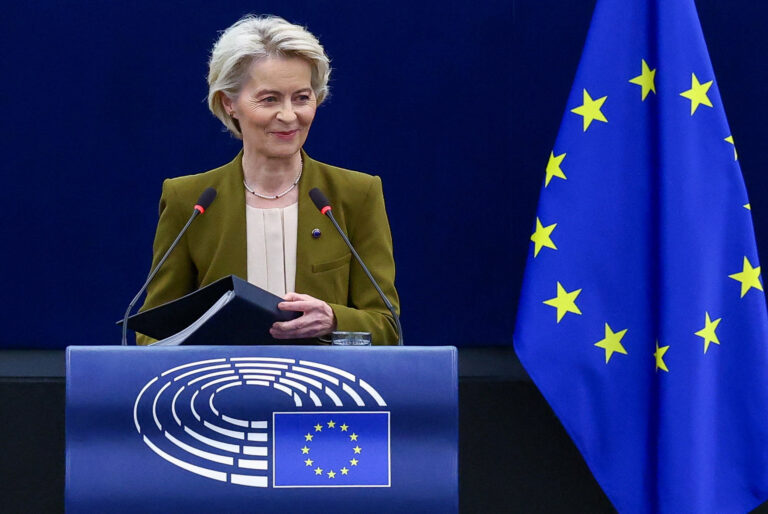
The European Union will grant Ukraine a loan for its reconstruction from the interest on frozen Russian assets, European Commission President Ursula von der Leyen announced in her State of the Union address on Wednesday. Ukraine will only repay this loan once Russia has paid reparations, but the Russian assets themselves will not be affected.
Belgian Foreign Minister Maxime Prévot spoke out against the seizure of the assets themselves, recently warning of a “systemic shock” and a subsequent weakening of the euro in an interview with the AFP news agency.
Belgium, in particular, manages the Euroclear securities depository, where most of the 200 billion in Russian assets in Europe are held.
On the issue of the war in the Gaza Strip, von der Leyen reaffirmed her “long-standing” sympathy for Israel, which has “a right to self-defense.” However, the extent of the suffering of the civilian population in the Palestinian territory prompted her to propose sanctions against “extremist” ministers and violent Jewish settlers to the EU Council. “The second proposal will be a partial suspension of the association agreement with Israel on free trade,” she added.
In her speech in Strasbourg, she acknowledged that it would be difficult to find consensus in support of this move. Criticism of Israel's radical response to the Hamas attack on October 7, 2023, drew the most applause, but for most of the time, several MEPs looked at their cell phones.
“Next month, we will set up a donor group for Palestine, including a special instrument for the reconstruction of the Gaza Strip,” she added.
Von der Leyen wants to promote demand for “clean” technologies and announced incentives for “climate-neutral” products from the EU, in addition to investments in the construction of data centers. She acknowledged that investors who want to finance “clean” projects need to know whether there is demand.
Climate and environmental goals are “very important,” she said. “We know what ends crises. It is clean, domestically produced energy,” she added, explaining that the Commission would propose tightening decarbonization targets. In her opinion, only “solutions” in the form of climate-neutral technologies would promote competitiveness and support European exports to the Global South.
“I am convinced that the future of clean technologies will continue to lie in Europe. To achieve this, however, we must ensure that our industry has the necessary materials. The only solution is to create a truly circular economy,” she continued.
“We are well on track to achieve our 2030 targets, which call for a reduction in emissions of at least 55 percent. That is the strength of the European Green Deal, and we must continue to pursue our climate and environmental goals,” she said, adding that “science speaks clearly in this regard.”
According to von der Leyen, the Commission plans to invest heavily in domestic industry, particularly in the field of defense technologies. The agenda also includes reducing bureaucracy to simplify entrepreneurship, particularly in the areas of “military mobility” and digital technologies.
(reuters, sab)