
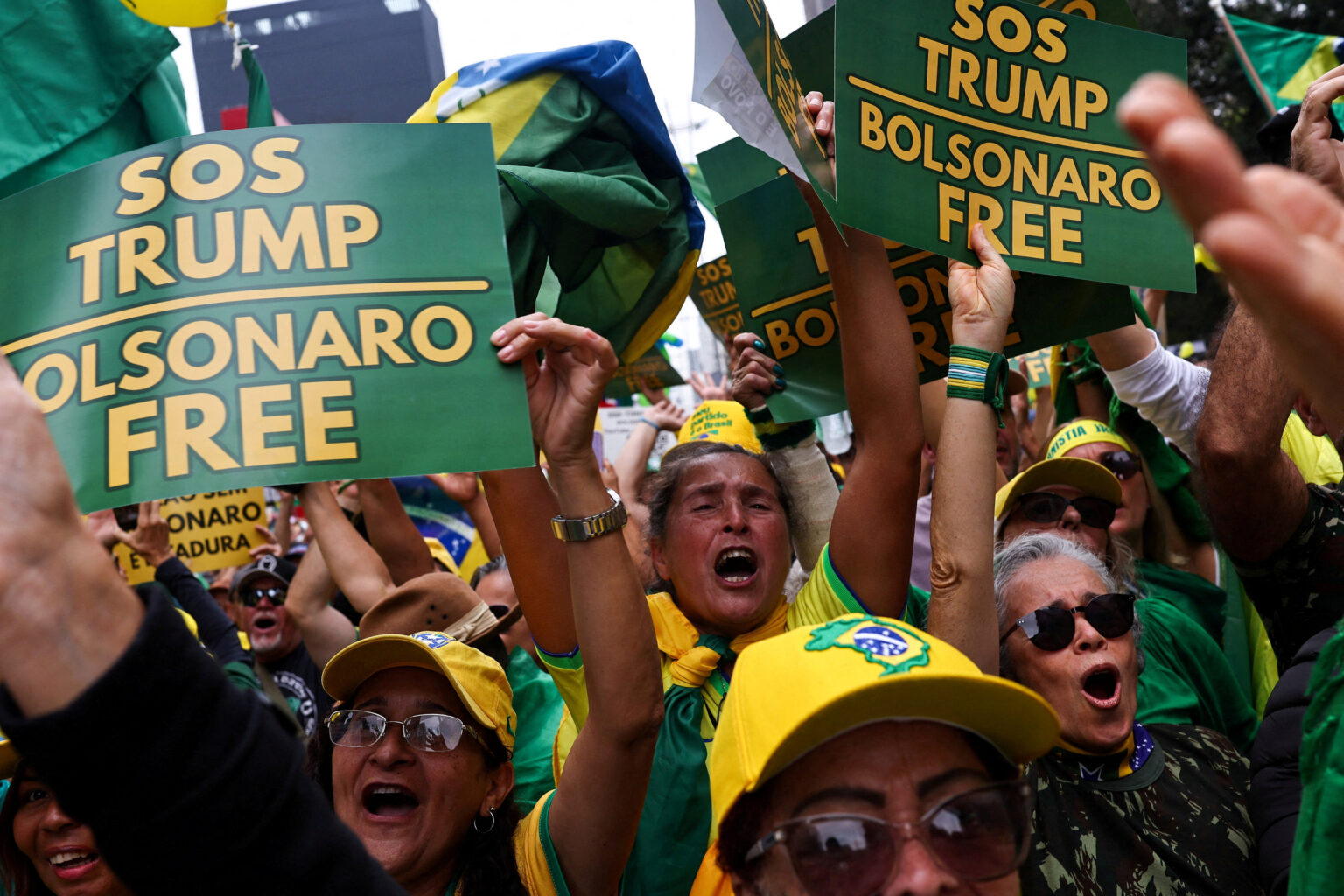
On Thursday, the Supreme Federal Court ruled on one of the most high-profile cases in Brazil today. Former President Jair Bolsonaro and seven of his associates from the ranks of ministers and the military were found guilty of organizing a conspiracy to overthrow the legally elected government and President Luiz Inácio Lula da Silva.
The right-wing ex-president and his supporters demanded a review of the electronic election results and expressed concern about possible electoral fraud. However, the lawsuit before the Supreme Federal Court (STF) was dismissed in early 2023 by its president, Alexandre de Moraes, who also convicted Bolsonaro.
In addition to him, three other judges of the five-member senate voted in favor of the conviction.
Politicized trial against politicians
De Moraes, in particular, is associated with controversies related to violations of the principle of impartiality and alleged political persecution. He had at least one American journalist remanded in custody for a whole year without setting a date for the actual trial. In other cases, too, he ordered “excessively” long prison sentences.
The judges of the STF hold the title of “minister” and number eleven. Five of them were selected by lot to sit on the tribunal that ruled on Bolsonaro, but their names immediately raised concerns about impartiality.
Flávio Dino was Minister of Justice during President Lula's previous term in office. Cristiano Zanin has long been Lula's personal lawyer and is also chairman of the five-member Senate. The majority is currently formed by Moraes.
Bolsonaro's opponents warned that the former army captain, together with the commanders of the navy, the army, and several other ministers, had allegedly planned to control Brazilian institutions and “restore the junta government.” The junta held power in South America's largest country from 1964 to 1985.
According to Lula's supporters, Judge De Moraes has “taken the lead” in “punishing crimes against democracy,” as left-wing Senator Eliziane Gama explained.
De Moraes proposed a 43-year prison sentence for Bolsonaro at Tuesday's hearing, and Judge Dino agreed. The proceedings were then interrupted and adjourned until Wednesday, but two of the five votes for a conviction had already been cast.
When the trial resumed, Judge Luiz Fux declared that the court “did not have sufficient jurisdiction” and proposed acquitting the former president of all charges. One day later, on Thursday, Judge Carmen Luciová completed the three-quarters majority.
“This criminal trial is almost like Brazil's encounter with its past, present, and future,” she said before voting for conviction.
This makes Bolsonaro the first former president of Brazil to be convicted of “attacking democracy.”
Bolsonaro's support grows
Independence Day celebrations took place in Brazil over the weekend. At the same time, massive protests in support of the former president took place in the states of Rio de Janeiro, São Paulo, and Minas Gerais, with the number of participants exceeding that of the official celebrations.
Lula attended the official celebrations on September 7, whose theme was “Sovereign Brazil against the traitors of the nation,” which observers interpreted as an indirect reference to Bolsonaro's trial.
Attendance at the official celebrations was also lower than in previous years, with only about 500 civilians coming to the capital, Brasília. In addition, there were at least two incidents in which combat vehicles ran over people. The first involved a Navy photographer, while the second vehicle ran over several non-soldiers.
Against the backdrop of the trial, the center and right-wing parties in the federal parliament are preparing an amnesty request for the defendants, including the former president. “History has shown us that amnesty and forgiveness are the best means of calming the country,” said the governor of the state of São Paulo, Tarcisio de Freitas.
Will the US Army also come to Brazil?
The United States is not afraid to use economic and military power against the Lula administration and the Supreme Federal Court, the White House said Tuesday in response to the “persecution of former President Jair Bolsonaro” through the “instrumentalization” of the judiciary.
“Freedom of expression is absolute, and we will defend it in our own way,” said government spokeswoman Karoline Leavitt.
As a reminder, in early September, the Pentagon, under its new name “United States Department of War,” dispatched a fleet of combat ships and 4,500 soldiers, including 2,000 marines. Their goal is to fight “narco-terrorist” organizations with support from Caracas. According to the White House, they have already stopped a smuggler boat and killed 11 crew members.
According to the US government, Venezuelan leader Nicolás Maduro supports organizations such as the “El Sol” and “Tren de Aragua” cartels, which smuggle drugs into the US on a large scale. After classifying them as “drug terrorists” following his inauguration, Trump enabled the military to take action against them.
At the same time, however, Secretary Pete Hegseth has approved the deployment of the Navy to the Caribbean, which surrounds the coasts of several countries—but not Brazil. In the event of an order from Trump (as commander-in-chief), however, they could theoretically advance further south.