
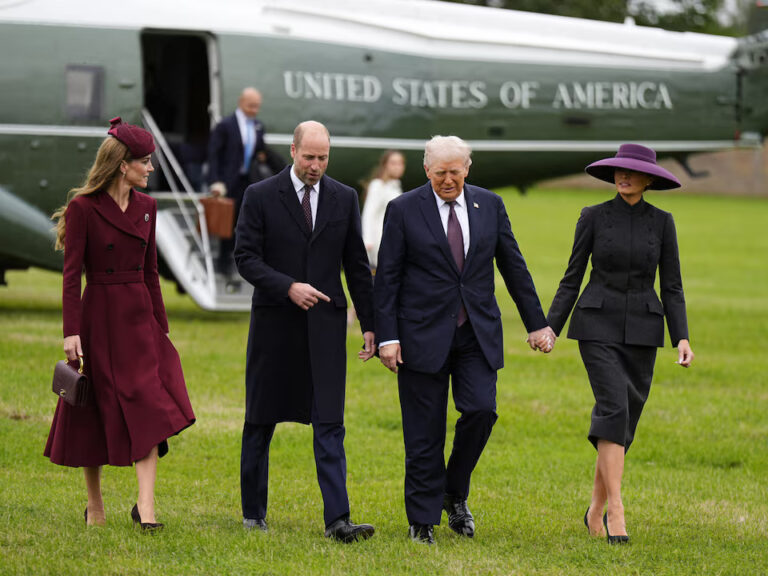
US President Donald Trump has accepted an invitation from Britain's King Charles III and arrived in the United Kingdom for an official state visit.
Upon his arrival, he told reporters that he loves Britain. “It's a very special place,” Trump said.
The invitation was extended to him by Labour Prime Minister Keir Starmer during his visit to the White House in February. Later today, Trump will meet with Starmer at his country estate, Chequers.
Starmer's government is seeking to cement the “special relationship” between the two countries, deepen economic ties, secure billions in investment, negotiate tariffs, and pressure the US president on issues related to Ukraine and Israel.
The visit has already led to a new technology agreement between the two countries. Companies such as Microsoft, Nvidia, Google, and OpenAI have pledged £31 billion ($42 billion) in investments over the coming years in the areas of artificial intelligence, quantum technologies, and civil nuclear energy.
Starmer also wants to make further progress on tariffs. “Basically, I'm here because of trade. They want us to see if the trade agreement can be adjusted a little bit,” Trump said before leaving the White House.
“They would like to see if they can get a slightly better deal, so we'll talk about that.”
But Starmer is taking a risk. Trump is very unpopular in the UK, and the prime minister, whose own approval ratings are falling sharply and who is facing economic problems, must prove that playing the “royal card” will also bring tangible results.
Another visit
For King Charles, this is only the sixth state visit he has received in his home country. He last welcomed French President Emmanuel Macron in July. Trump, on the other hand, already made a state visit to the UK in 2019, when he was received by Queen Elizabeth II.
Trump, an avowed admirer of the monarchy, has never hidden his delight at being not only the first US president, but also the first elected politician ever to be invited by a British monarch for two visits.
As the New York Times recalled, Queen Elizabeth has hosted a total of 112 state visits during her 70-year reign.
However, not a single one of these visits came from Canada or Australia – the reason is simple: these countries and twelve others from the Commonwealth recognize the British monarch as their head of state.
Trump and his wife were welcomed by Prince William, whom the president described as “very nice,” and his wife Kate.
King Charles and Queen Camilla, who has recovered from a sinus infection, joined them on a carriage ride through the castle grounds.
The program also included a procession of horse-drawn carriages through the Windsor estate, a ceremonial horse guard, and the marching of the honor guard, known as the Beating Retreat.
The 17th-century ceremony originally served to withdraw troops to the royal palace, but today it is a solemn tradition. The UK said it was the largest military ceremony during a state visit in a long time.
The royal family presented the presidential couple with historical objects from the Royal Collection relating to the US. The Trumps then visited St. George's Chapel, the final resting place of Queen Elizabeth II. Trump laid a wreath at her grave.
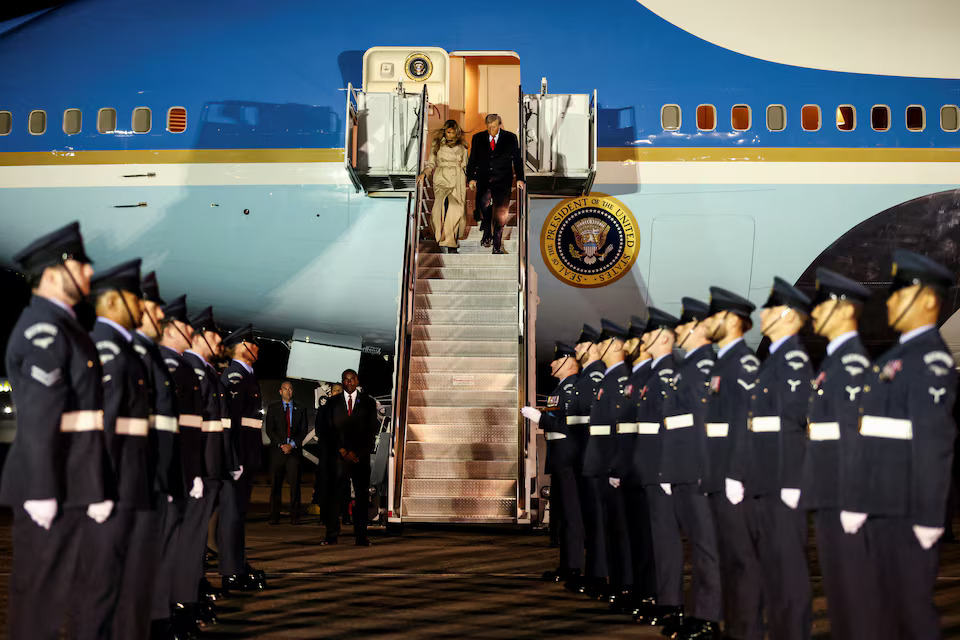
Trump arrived on the night of September 16 with his wife Melania, and the visit officially ends on September 18. Part of the program will be conducted separately: the president will meet with the king and prime minister, while First Lady Melania will be received by Queen Camilla.
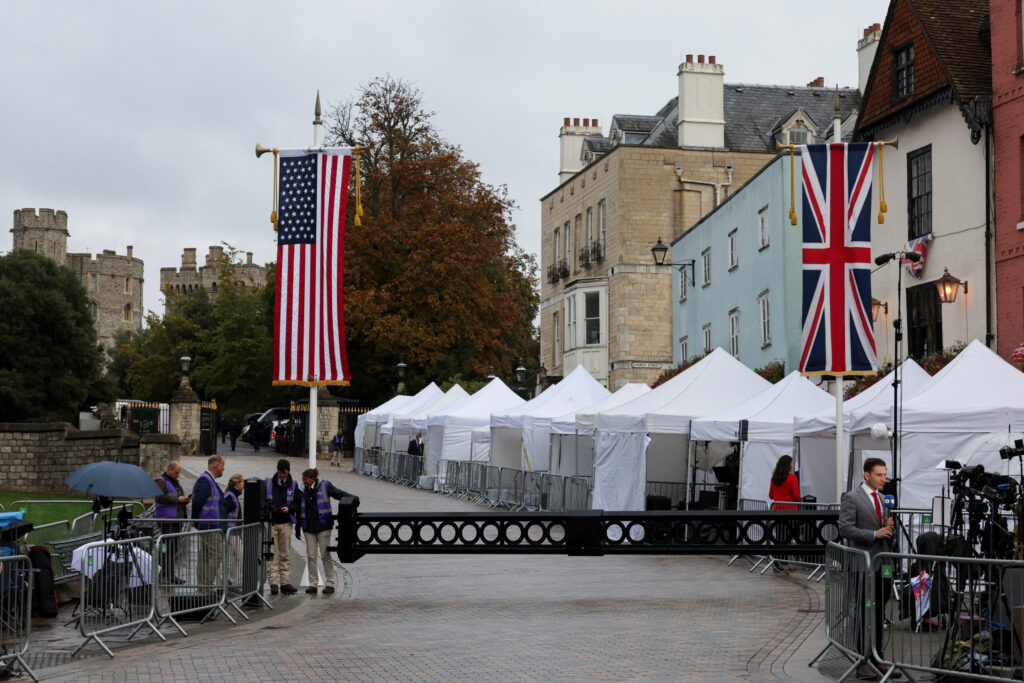
During the visit, the American guests will be staying at Windsor Castle—the oldest and largest inhabited castle in the world, which has served as the family seat of British monarchs for almost a thousand years.
Only President Macron and his wife have been received in this manner; until last year, all state visits took place at Buckingham Palace, where the state banquet was also held.
The president was greeted with protests in the kingdom
The visit's itinerary deliberately avoids London, where protests against Trump have been taking place since Tuesday evening. In recent days, however, Britain has been rocked primarily by demonstrations under the slogan “Unite the Kingdom,” which broke out after the attack on conservative activist Charlie Kirk.
Both the protests and the pun [United Kingdom means United Kingdom, editor's note] can be traced back to the well-known nationalist activist Stephen Yaxley-Lennon, better known under the pseudonym Tommy Robinson. At a rally over the weekend, he was able to mobilize around 150,000 people.
Nevertheless, some anti-Trump demonstrators managed to get close to Windsor. They projected historical images of Trump and controversial financier and sex offender Jeffrey Epstein onto the castle walls. Four people were arrested for this.
As a reminder, one of the notorious “clients” of the US financier and alleged Israeli agent was Prince Andrew, the king's younger brother. The key witness, Virginia Giuffre, made allegations against him, which Andrew denies.
Prime Minister Starmer dismissed Peter Mandelson as British ambassador to Washington last week because of his ties to Epstein—a move that could raise sensitive questions for both Starmer and Trump.
Large protests were expected in London on Wednesday. 1,600 police officers were deployed to deal with the demonstration by the Stop the Trump Coalition movement.
Residents of the capital had mixed reactions to the visit – some were outraged by the invitation, while others considered it a smart political move and an effective example of British “soft power.”
The king's opportunity
For King Charles himself, the visit has mixed significance. He has little in common with Trump – from his environmental issues since the 1950s to his efforts toward interfaith harmony to his recent clear support for Canada, where he is head of state.
At the same time, however, the event is giving him the most global attention since his coronation. “If all goes well ... I think it will be remembered as the most significant event of his reign,” said historian Anthony Seldon.
(reuters)