
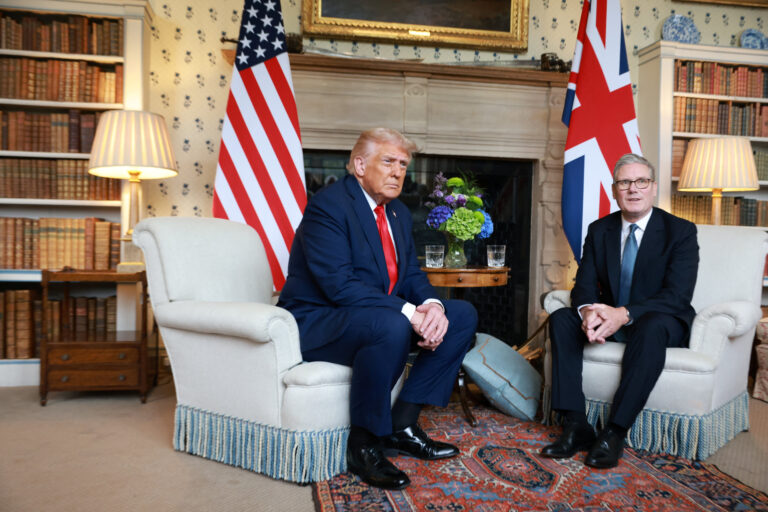
After a day of pompous celebrations, carriage rides, and a state banquet, the heads of state turned their attention to discussions on investment and a joint approach to the wars in Ukraine and the Gaza Strip.
At noon, the US delegation arrived at the Prime Minister's rural residence, Chequers, in Buckingham County. This is the historic seat of the Royal Exchequer, which currently serves as the Prime Minister's country office.
On Wednesday, the conclusion of a technology agreement was announced, under which companies such as Nvidia, Microsoft, Google, and OpenAI have pledged £31 billion (approximately €35.7 billion) in investments in London over the next few years. The aim is to promote artificial intelligence and civil nuclear energy, with the total value of American investments amounting to £150 billion (approximately €172.8 billion).
The official name of the agreement is “Atlantic Partnership for Advanced Nuclear Energy” and also includes joint financing for the construction of small modular reactors led by the British company Rolls Royce.
British Prime Minister Keir Starmer said that both countries are building a “golden age of nuclear energy” that will put the UK and the US at the forefront of global innovation. The government in London said that generating more nuclear energy could lower household electricity bills while also combating climate change.
Trump's specter reaches London
According to Reuters, which described Trump's visit as “unprecedented,” the talks between the Anglo-Saxon leaders focused on global issues and were intended to distract the White House chief's attention from the United Kingdom's domestic problems. In both cases, however, the ghost of American pedophile Jeffrey Epstein looms large.
On September 11, Starmer accepted the resignation of British Ambassador to Washington Peter Mandelson on behalf of the king. Mandelson had repeatedly criticized Trump before taking office, but later described his criticism as “inappropriate and wrong.”
In a letter on his 50th birthday, however, Mandelson described the late “financier” as “my best friend,” which led to his de facto dismissal. The British Embassy is temporarily headed by Chargé d'Affaires James Roscoe.
The Epstein case also links the name of the king's brother, Andrew, Duke of York, and more recently Trump himself—who allegedly also congratulated him on his 50th birthday with a suggestive picture of a naked woman.
Starmer wants to divert attention from spying
The British prime minister tried to divert Trump's attention from the “Internet Security” law, which allows security agencies to monitor citizens, as well as from issues related to freedom of expression.
The White House chief and his State Department repeatedly criticized the British government for restricting freedom of expression, especially after the conviction of veteran Adam Smith-Connor for silently praying outside an abortion clinic.
One of the baits Starmer threw at Trump is the issue of the war in Ukraine. The Labour leader based his argument on a recent statement by the Republican, who last weekend described Russia as an “aggressor.” However, he called on European representatives to stop buying Russian oil, which has not yet happened.
A similar bait could also be the war in Gaza, although Washington and London have different approaches to this issue. Starmer is under pressure from his own MPs to join France, Australia, and Canada in recognizing Palestine's existence.
Trump described the recognition of Palestinian statehood as a “reward for Hamas,” although he specifically told Starmer that he was not particularly interested in the prime minister's “stance.”
(reuters, sab)