
However, to prevent another spark from igniting it soon, it must be clarified what actually happened. Because Zelensky may be a greater threat to Europe than Putin.
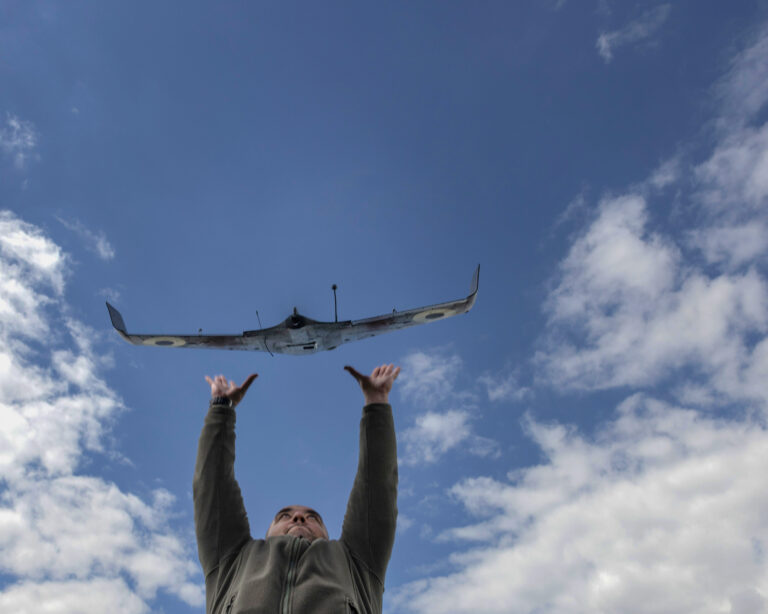
Last week, a serious incident occurred that brought with it the danger of the Ukrainian theater of war spreading to Central Europe. Russian drones entered Poland, and thus NATO airspace, from Belarus and Ukraine.
Three alternative versions
The air defense system worked to a certain extent. However, as is usual with such attacks, defending against them with fighter jets and missiles cost a hundred times the price of the drones themselves, which in the case of drones without explosives is not only expensive but also causes collateral damage. The destroyed roof in the widely published photo was caused by an air defense missile.
However, this does not change the gravity of the situation. Drones can kill and destroy, Ukraine is the scene of Russian military operations, and European politicians are preparing us for war with Russia. The incident also occurred in the days when the exercise involving tens of thousands of NATO soldiers in Poland and the Baltic states was coming to an end and the similarly large-scale Russian-Belarusian exercise “West 2025” was beginning in Belarus.
Fortunately, the incident was not the proverbial spark that ignites a fire. However, to prevent another spark from igniting it soon, it must be clarified what actually happened. In a serious debate, three possibilities emerge: the European one about Russian tests, the American one about an accident, and the Russian one about a Ukrainian false flag operation. An uninvolved observer cannot completely rule out any of them, but can assign different probabilities to them.
A Russian attack is very unlikely
In contrast, the Ukrainian version that it was a Russian attack can be ruled out. NATO probably quickly concluded that this would have looked different. The Poles themselves responded by invoking Article 4 of the NATO treaty, which provides for consultation in the event of a threat to a member state, rather than Article 5, which provides for military action in the event of an attack on a member state.
Warsaw stated that Russia had tested NATO's response with its drones, which, while not an attack, was nevertheless a hostile move. This is also confirmed by most European supporters of the war in Ukraine. Although rivals often test each other in this way, this version is not very likely.
Putin apparently agreed with Trump in Alaska on a number of points aimed at ending the conflict and therefore has no interest in provoking the European hawks and playing into the hands of his opponents in Trump's circle. The quality of mutual relations is evidenced by the presence of American military observers at the aforementioned “West 2025” exercise a few days after the incident.
If Moscow really wanted to test NATO, it would coordinate with its Belarusian protégé. But the Belarusians warned the otherwise hostile Poles about the drones and even shot down five of them themselves!
Furthermore, Moscow's reaction showed that it was itself surprised by the incident and even offered Poland assistance with the investigation. Of course, it cannot be ruled out that Putin and Lukashenko deviated from their usual rationality, but this is unlikely.
The American version is also unlikely
So was it not an accident in which uncontrolled drones simply strayed into Poland? That is what President Trump claims. He was even criticized for this by Polish Foreign Minister Sikorski, who insists on a Russian provocation.
Given the number of drones that Russia regularly uses for attacks on Ukraine—in the last major attack, there were suddenly 400—it is to be expected that the operators will lose control of some of them from time to time. The probability is all the greater as Ukraine has electronic warfare capabilities that can interfere with navigation.
Two facts speak against this: the number of drones and their range. A total of nineteen drones flew towards Poland, which is a little too many for the stray drone version. Above all, however, their technical parameters – a range of 700 kilometers – do not allow them to fly as far as Poland.
Here, too, technical innovations or the interaction of special atmospheric and other conditions that could lead to such an accident cannot be ruled out. If there were no other interpretation, it might make sense to stick with this possibility, as sometimes unlikely events do occur.
But what if the drones were sent under false colors by Ukraine to escalate the conflict in which it is constantly losing?
The Ukrainian operation is most likely
This is what Moscow suggests. Security analyst Jaroslav Štefec summarizes the main arguments. The information about the attack comes from Ukrainian sources, not Polish ones. From the outset, President Zelensky spoke of 19 drones, which corresponds to the number of drones used. How did he know this when only 14 drones landed in Poland after the Belarusian intervention?
In addition, Ukraine urged Poland to refrain from analyzing the control systems of the drones that were found. This would have revealed where they took off from and where they were flying to. Scott Ritter suspects that the Ukrainians used the Pokrova radio-electronic system to take control of the Russian drones and divert them to Poland.
Given the limited range, it would be more likely that the Ukrainians collected a number of Russian drones on their territory and then shot them down themselves.
The version of a Ukrainian false flag operation is also not certain, but only more likely than others, even though it originates from Moscow. It is not based on an unlikely chain of events, and Ukraine has both the capabilities and the motivation for such an operation. Three years ago, it sent a missile to Poland and tried to convince the world that it was a Russian attack.
If this were true, it would mean that a friend poses a greater threat to Europe than an enemy.