
If you dig deep enough in the dark-humoured corners of Instagram, you might find a page named ‘Aldomoromylove’. Sitting on an edge between simplified political content and poor taste, the page is but one example of how social media encourages both the trivialising and the popularising of political facts that have sedimented (and, therefore, faded) in general culture. What lies underneath it, though?
Aldo Moro’s tragic tale is well-known. On 16th March 1978, the architect of the so-called ‘historic compromise’ between Italian ruling party Christian Democracy and the Communist Party was kidnapped in Rome by a radical-left terrorist group called Brigate Rosse (‘Red Brigades’). The ambush killed Moro’s five bodyguards and triggered a national trauma that would unfold over fifty-five days. For almost two months, Moro was kept in a ‘people’s prison’, the exact location of which is an object of controversy to this day.
From there, Moro wrote dozens of letters to his family, fellow leading members of Christian Democracy, and even the Pope. Underneath the complexity of his subtle political reasoning lay simple, recurring appeals for negotiations, prisoner exchanges, and even a legitimisation of the Red Brigades as a political interlocutor.
Despite his vibrant attempts at having his life spared, the Italian state maintained an intransigent line. Official policy, confirmed by Prime Minister Giulio Andreotti and Interior Minister Francesco Cossiga, fellow Christian Democrats and ‘political children’ of Moro’s, was that the state cannot negotiate with terrorists, and its integrity was to be preserved at all costs.
This uncompromising stance was also shared by the Communist Party, whose leader Enrico Berlinguer, despite being personally close to Moro, would not give up on his firm plan to dissociate his party from the several forms of extremism that plagued Italy in the 1970s. The Vatican was among the few actors at play that intervened, offering ‘humanitarian mediation’ and even mobilising the mediatic visibility of Pope Paul VI (another longstanding friend of Moro’s) to appeal to the kidnappers. All the while, Italian intelligence services failed to locate Moro’s hideout, even though later evidence suggested they came very close.
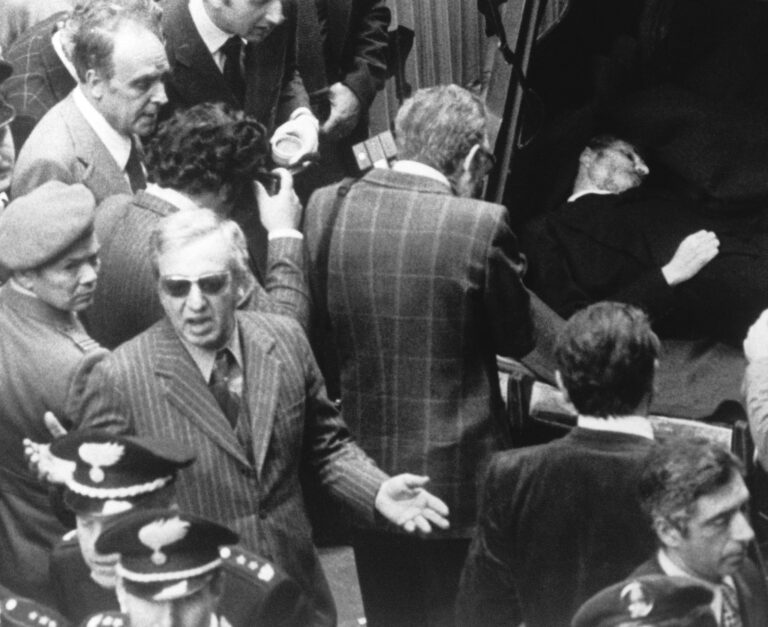
Despite these efforts, and after investigative turnarounds that verged on the unbelievable, Moro was found dead in a red Renault 4 on 9 May 1978. In turn, what had represented the Red Brigades’ most advanced political ‘accomplishment’ turned into their definitive mark of infamy, which would have led to their complete disbandment a few years later.
Told this way, the story might seem straightforward. Yet, unsolved questions remain central to Moro’s case: why were credible negotiation channels systematically closed? Why did the police dismiss promising leads? Why were Moro’s own letters, while desperate still lucid, discredited as forgeries or the product of a troubled mind? These elements cast a sinister shadow onto the events, suggesting that his fate might have been more than operational failure—a deliberate, if well disguised, choice not to have him found and liberated.
Enacting a Crypto Coup
The Red Brigades pulled the trigger that killed Moro, but the trajectory of his captivity was shaped by forces far larger than that clandestine group. Testimonies from repentant terrorists and fragments of intelligence reports suggest that foreign intelligence services, elements of the Italian secret apparatus, and even mafia intermediaries meddled with the affair.
Later parliamentary commissions have emphasised how Moro’s imprisonment became a theatre for Cold War rivalries. US and NATO circles, fearing an unprecedented Communist presence in the Italian government, signalled their opposition to any solution that could legitimise the Red Brigades. The presence of American negotiator Steve Pieczenik as a consultant to the Italian Ministry of Interior hints at more than diplomatic caveats.
This direct involvement was matched by that of domestic movements. Segments of the Gladio network and masonic elements such as Licio Gelli’s Propaganda Due appeared to have their men present at crucial turning points, from the ambush of 16 March onwards, and to have influenced decision-making from behind the scenes. On the other side of the spectrum, Eastern bloc agencies were suspected of exploiting the crisis to destabilise Western Europe through Italy.
On the ground, the most immediate effect of this convergence of forces, where nobody would claim responsibility, was a generalised, subtly staged stalemate. Frameworks for negotiation were systematically neutralised, and even humanitarian attempts to trace Moro were sabotaged. Mafia boss Tommaso Buscetta later testified that Cosa Nostra received signals (from its political connections, presumably) to stay away from the whole quest.
This leaves one with the impression that what had started as a terroristic act, aimed at increasing a group’s political capital, was quickly picked up as an opportunity to prevent an integration of Communists into the democratic spectrum, with the implications that might have had for Italy’s still recent constitutional asset. The Moro affair, in other words, would have functioned as the unintended catalyst for a slow-motion coup, rallying a strange coalition of reluctant participants in Moro’s visionary experiment and outright enemies of democracy. The price for this chaotic yet aptly timed operation was brutally simple: Moro’s life.
The Ultimate Scapegoat
Moro’s prison letters remain possibly the most haunting and moving aspect of his tragedy. Far from being broken, the sixty-two-year-old statesman displayed clarity, political foresight, and abrasive sarcasm. Perceiving the reluctance of Christian Democrats to forcefully pursue his liberation, he accused his colleagues of Machiavellian cynicism, of allowing him to turn into a ‘symbolic victim’ to preserve a precarious but comfortable balance of power. He reminded them that the state had negotiated before, citing prisoner exchanges in other European countries, and denounced the hypocrisy of denying it. Moro’s voice of lamentation, interpreted recently by Italian film director Marco Bellocchio as asking ‘Is there folly in not wanting to die?’, was met with a silence just as violent as the bullets that would end his life.
Having been a fine jurist and an accomplished statesman for years, Moro knew full well what was happening. In what has been called the ‘Moro Memorial’—a transcript of depositions and unpublished letters gathered by his kidnappers, and only recovered in full in 1990, Moro’s writing exposes the lethal logic sustaining his predicament. By refusing compromise, the Italian ruling class elevated the abstraction of political stability over human life and dignity.
Thus, Christian Democracy’s President had to face being indirectly immolated by his party, the institutions he’d served, and his enemies, so they could in turn maintain their alliance with Washington and NATO, and the Communist Party’s first-ever experience of entering government (which would have never been repeated) could be forever crippled. In truth, he was sacrificed on the altar of raison d’état. Who’s the real terrorist?
Statement
The kidnapping and murder of Italian statesman Aldo Moro wasn’t merely an episode of terrorist violence, but a crucible in which the young Italian Republic revealed the limits of its democratic resilience. By refusing negotiation and tolerating or even enabling the intervention of shadowy external forces, state actors chose Moro’s death over compromise and potential realignment. Here was a man condemned by his own peers to become a scapegoat for the preservation of the status quo. His tale reminds us that procedural negotiations tend to be a mere proxy for the brutal force which inevitably underpins politics and, especially, the state.