
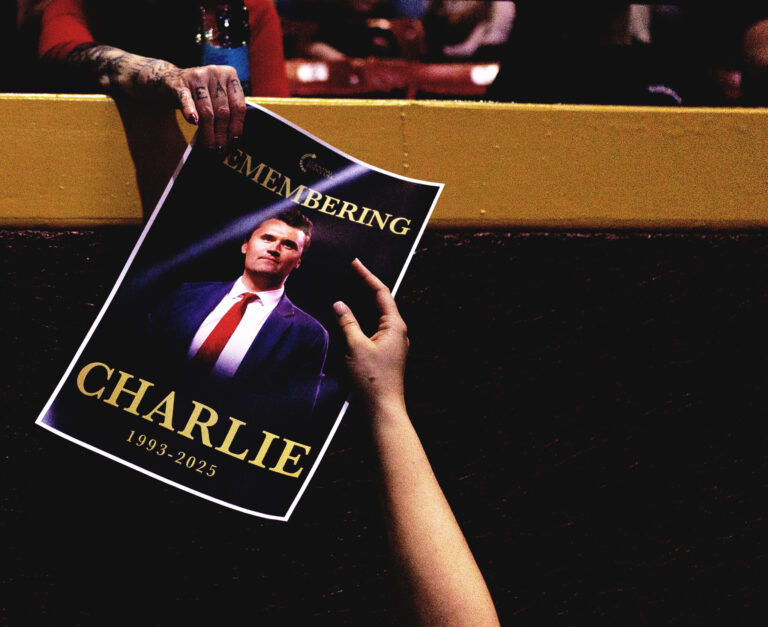
A violent death broadcast live came out of the blue. In an era where every smartphone can capture high-quality footage, everything is documented. When it involves a public appearance by a conservative movement leader at the University of Utah, an assassin can be certain that dozens, perhaps hundreds, of recordings exist. The murder of Charlie Kirk was, from the outset, destined for media exposure. Its impact on society can be likened to the detonation of a nuclear bomb. Media and social networks either amplified or muted this impact, depending on the interests of their readers or followers.
Two Different Worlds
The most striking differences were in the reactions to Charlie Kirk’s murder in Europe and America. Even in a globalised world, a chasm remains between these continents. This divide is embodied not only by American President Donald Trump but also by Charlie Kirk himself. Kirk was among the Republican evangelicals whose worldview Europeans struggle to comprehend. The mental worlds of these groups barely intersect. An example is the anecdote from January 2003, when President George W. Bush told Jacques Chirac that the invasion of Iraq was divinely ordained because ‘Gog and Magog are on the move’ and biblical prophecies were being fulfilled. Chirac, baffled by the apocalyptic references, consulted theologian Thomas Römer, who identified it as evangelical rhetoric, and refused to support the invasion. This difference in worldview is crucial for a broader interpretive framework.
Charlie Kirk was not a household name across America. He was popular among evangelicals and Trump supporters, but beyond these groups, his fame was limited. Interest in him was relatively low but steady, as confirmed by search engine data. His podcast, The Charlie Kirk Show, consistently drew a million listeners. After his murder, interest in him skyrocketed—his Instagram account gained over 3.5 million new followers in a single day. Kirk became a figure known to all. For most Americans, evangelicals are seen as moral, albeit eccentric, people who frequently quote the Bible and attend worship services. The murder of an evangelical is thus perceived as a clear injustice.
An Unknown Figure
In Europe, Kirk was virtually unknown before his death. His name did not appear in search trends before 10 September 2025. Interest was evident only in conservative circles, such as in Hungary, where his organisation, Turning Point USA, served as an inspiration. Even after his death, interest remained modest—his name entered search trends but was not among the most searched terms. Kirk’s ideas remained unfamiliar in Europe, and his image was shaped by stereotypes of evangelicals, often associated with a fanatical stance against abortion and labelled as religious fanatics. This negative image was reflected in European media. For instance, Czech Radio, a public broadcaster funded by Czech taxpayers, described Turning Point USA as an ‘ultraconservative movement of the slain far-right activist.’ In the US, however, Kirk was not considered ‘ultra’—there are more radical voices among conservatives. Such labels have a clear aim: to tarnish Kirk’s image. The term ‘ultra’ evokes aggressive fans, like football ultras, who incite violence rather than support their cause. This transforms a passionate debater into a violent figure who perhaps ‘deserved’ him being assassinated.
An Image Stronger Than Words
Reactions to Kirk’s death can be divided into two camps: some see him as a martyr, while others contextualise his death within his alleged hateful rhetoric. The American right clearly adopts the former view, while the left feels compelled to relativise the murder. In Europe, defending Kirk’s martyrdom was riskier than in the US, where it was the norm. Several individuals who openly celebrated his death in the US lost their jobs. This difference stems not only from varying perceptions of evangelicals but also from the way content spreads. In the US, the video of the assassination, filmed in front of Kirk’s family—his wife, Erika Frantzve, and their two young children, including a daughter born in 2022—dominated. This horrific image of a loved one’s murder before his family was enough for most Americans to view Kirk as a victim. In Europe, words prevailed over images. Kirk was largely an anonymous figure, and the video’s impact was less pronounced. Media emphasised the context of his rhetoric, shaping a negative image.
A notable example of European bias is the Czech context. As evidence of Kirk’s alleged ‘ideological delusion,’ a screenshot surfaced attributing a comment to him in response to a tweet by Volodymyr Zelenskyy: ‘We don’t support you. Show some respect next time. You are an ungrateful petulant child who is responsible for 1 million dead.’ This statement is likely false, as it cannot be officially verified. However, Kirk did refer to Zelenskyy as a ‘CIA puppet’ or ‘gangster’ sending innocent people to their deaths, reflecting the view of some American conservatives that the Ukraine war is a power play by the establishment. This stance is not unique to Kirk. It highlights that some Americans see the Ukraine conflict as another pointless war which the US has nothing to gain by.
In Europe, however, the war is framed as a battle of good against evil, and criticism of Ukraine is often branded as Russian propaganda. Kirk’s death and the reactions to it revealed that cultural wars in the US and Europe differ. Responses in Europe exposed the fact that Europe’s much-touted diversity does not extend to conservative evangelical influencers.
Statement
The assassination of Charlie Kirk, a prominent US evangelical and conservative leader, has laid bare a stark transatlantic divide. In America, his death is mourned as that of a martyr, amplified by a viral video capturing the tragedy before his family, cementing his image as a victim. In Europe, where Kirk was largely unknown, the media focused on his controversial rhetoric, painting him as a radical. This contrast reveals deep cultural rifts, with US conservatives rallying around Kirk’s legacy while European narratives question his influence. The murder underscores how the media shape perceptions, exposing the limits of globalised understanding in a polarised world.