
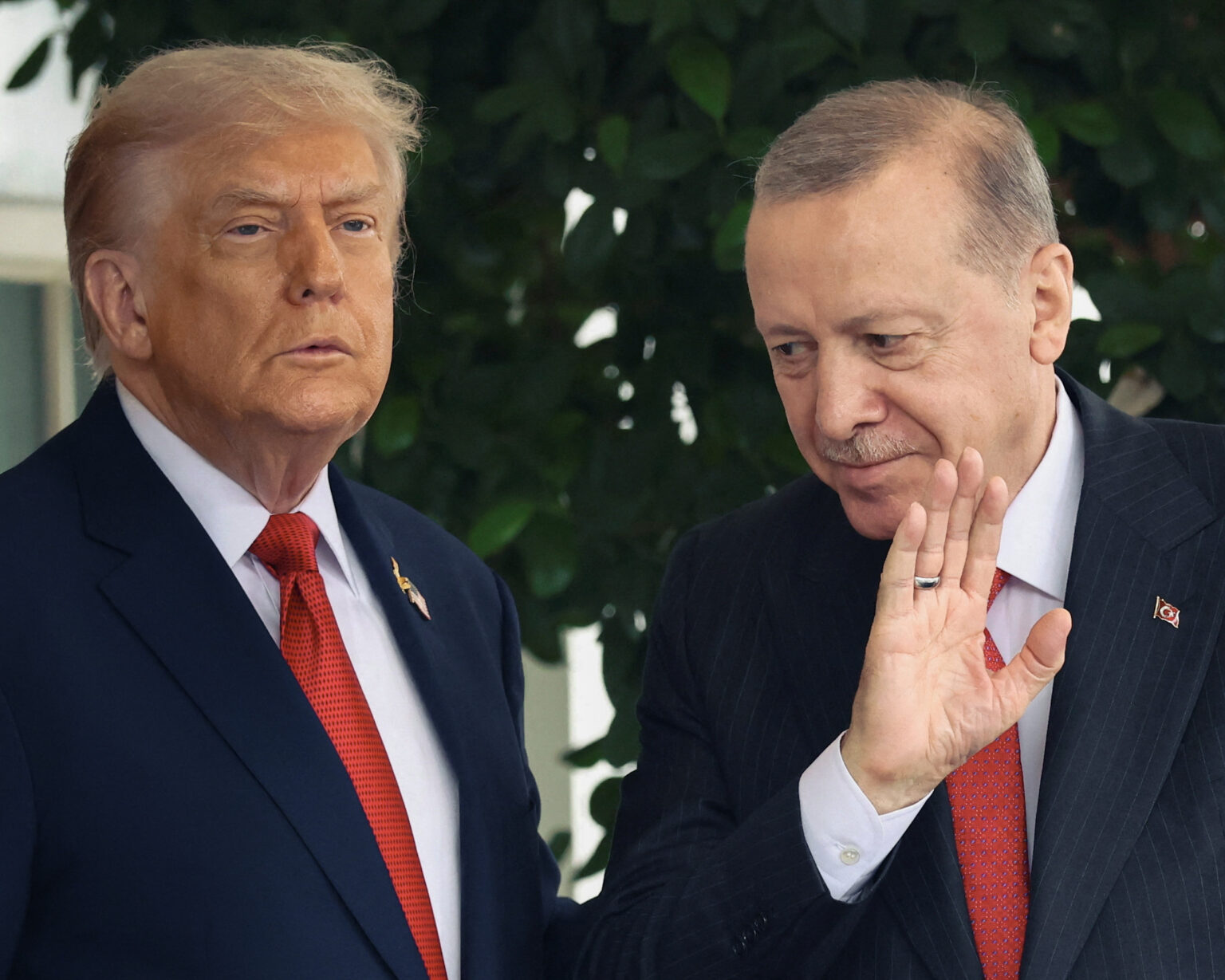
On Thursday, an important meeting took place at the White House between US President Donald Trump and Turkish President Recep Tayyip Erdogan.
After six years of suspended diplomatic relations at the highest level, both heads of state attempted to resolve complex disputes relating to military technology worth billions of dollars, energy security, and ending conflicts in the Middle East.
Six-year dispute over the world's most advanced fighter jets
Erdogan traveled to Washington with a clear goal: to regain access to the F-35 Lightning II program. Turkey was excluded from this prestigious program in July 2019 after purchasing the Russian S-400 Triumf air defense system for $2.5 billion—a decision that Washington viewed as a security risk to NATO technology.
Turkey had invested around $1.6 billion in the F-35 program and was supposed to receive 100 aircraft. In addition, Turkish companies manufactured key components for the entire program, including central parts of the fuselage. Their exclusion required a costly restructuring of the entire supply chain.
“We will talk about the F-35, Halkbank, and a whole range of issues,” Erdogan said before entering the White House, alluding to the Turkish state bank that has been charged by the US with violating sanctions against Iran.
Trump was optimistic ahead of the negotiations. “I expect that I could lift the sanctions on Turkey almost immediately if we have a good meeting,” he said.
The energy chessboard and Russian oil
In one of the most exciting moments of the meeting, the US president directly called on his counterpart to stop buying Russian oil. “I want him to stop buying Russian oil,” Trump said.
For Turkey, however, this poses a complex challenge. The country imports about 25 million tons of Russian oil and 15 to 20 billion cubic meters of natural gas annually, which covers a significant percentage of its energy needs. At the same time, however, Ankara maintains its strategic independence by also supporting Ukraine with supplies of Bayraktar TB2 combat drones.
Erdogan has not yet responded directly to this challenge, but his stance on energy policy will be crucial for future US-Turkish relations.
Breakthrough in Gaza
The most dramatic statement concerned the conflict in Gaza. Trump said with undisguised optimism, “I believe we are close to an agreement. Many people are dying, but we want to bring back the hostages.”
On Tuesday, Trump also presented Arab and Muslim leaders with an ambitious 21-point peace plan that calls for an immediate ceasefire, the release of all hostages, the gradual withdrawal of Israeli forces, and the formation of an international Arab military force to control the Gaza Strip for three years. The plan also calls for the complete exclusion of Hamas from the administration of the area and a massive reconstruction effort worth tens of billions of dollars.
Erdogan, who has repeatedly described Israel's actions in Gaza as genocide, is expected to be an important partner in implementing a peace agreement. In addition, Turkey suspended trade with Israel in May, and its president is calling for an international investigation into war crimes.
Erdogan's unexpected diplomatic gesture
In a surprising moment, Erdogan declared his willingness to “do whatever is necessary” regarding the Greek Orthodox seminary on the island of Heybeliada — an issue that has been a source of tension between Ankara and the Greek Orthodox world for many years.
The leaders also discussed potential trade deals worth tens of billions of dollars, including large purchases of Boeing aircraft. Trump also announced a plan to redistribute tariff revenues to support American farmers.
They also discussed the Patriot system as an alternative to Russian defense systems and the continuation of $23 billion worth of F-16 Viper deliveries.
Trump mysteriously hinted at the possibility of a “significant announcement” regarding Syria during the meeting, with both leaders currently united in their support for the Syrian central government. This also represents a dramatic change from the time when Syria was the main cause of American-Turkish disputes.
(reuters, sie)