
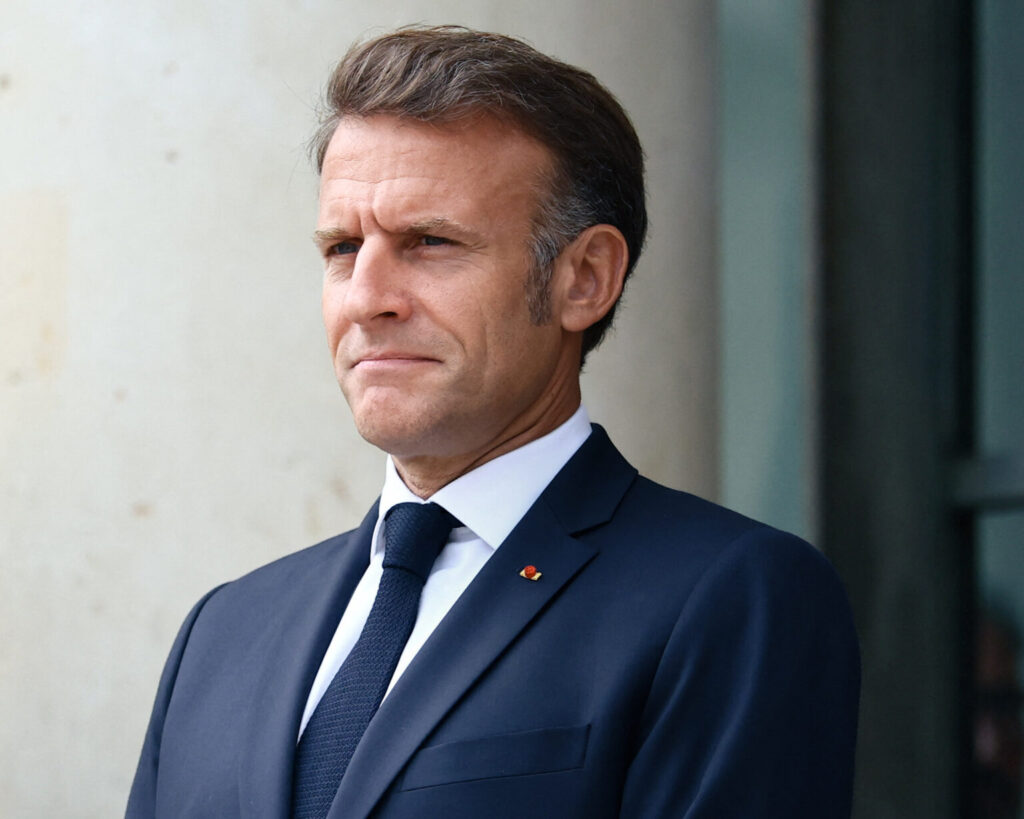
When the French president manages to demonstrate on the international stage that France still matters, the French are often willing to forgive him much on the domestic front. The last to succeed in doing so was Jacques Chirac. By rejecting the U.S.-led invasion of Iraq, he earned the wrath of American neoconservatives but gained popularity at home — and, in the end, history proved him right.
His successors were less fortunate. Both were initially praised for their foreign interventions, yet neither managed to secure reelection. Sarkozy left behind a disaster in Libya, while Hollande’s “rescue” of Mali ultimately led to the expulsion of French forces from the Sahel.
Emmanuel Macron, too, has taken refuge in foreign policy — but not in the way Chirac once did. Rather, he resembles Sarkozy and Hollande, only with far more dangerous consequences.
“Achievements” and failures
Above all, Macron is fleeing from something. What he considers the successes of his liberal policy — reforming the state railways, tax breaks for the wealthy, Green Deal measures, pension reform, the suppression of protests by unions, farmers, and the Yellow Vests — inspire hatred or contempt among large parts of the French public.
His second presidential term was made possible only through the support of oligarchs controlling the country’s major media and by rallying voters against the so-called “fascist threat” represented by Marine Le Pen.
Then there are his outright failures: ballooning public deficits, massive non-EU migration, the failed integration of new migrant generations, and the early elections last year that left France without a governing majority.
It’s little wonder that his approval rating has plunged to 17 percent, with 54 percent of French citizens saying they are “very dissatisfied” with him — putting him in competition with Czech Prime Minister Petr Fiala for the title of the world’s most unpopular leader.
In all four directions
Every French president seeks favorable winds from all four directions to steer him out of domestic trouble. To the north lie Brussels and Berlin — the European Union, in which France plays a key role, and its indispensable partner nation, with which it shares a special bond.
To the south lies Africa — largely francophone in its northern, western, and central regions, where leaders traditionally look to Paris as their natural center.
To the east lies the Orient. In the Middle East, France maintains relations with Arab states, sees itself as the protector of Lebanon and of Christians in the region, and keeps an eye on Syria and Israel. In the Caucasus, it has special ties with Armenia, home to a large diaspora in France. During and after the Cold War, Paris cultivated its own relationships with Iran, China, and Russia — relationships these countries valued.
To the west lie Washington and New York. Franco-American relations are defined by France’s perennial, often frustrating pursuit of equality — mixed with American fascination for French culture. France’s permanent seat on the UN Security Council gives it an influence in world affairs that far exceeds its actual geopolitical weight.
Chirac’s popularity during the Iraq crisis was sustained by both East and West. With his deep understanding of the Middle East, he foresaw the risks of invading Iraq and rightly warned against a similar adventure in Iran. In New York, he used France’s position in the UN Security Council to deny the U.S. intervention legitimacy — and the wave of American media hostility that followed became a badge of honor.
A relatively successful first term
It must be said that Macron performed fairly well on the international stage during his first term — particularly in dealing with the West, the East, and the South. He built a working relationship with Donald Trump, who, while giving him no real influence, allowed him better access than most European leaders enjoyed.
He also met repeatedly with Vladimir Putin, even launching talks in 2019 on a potential strategic partnership with Russia — a move that alarmed the continent’s Russophobes.
In Africa’s Sahel region, Macron spearheaded the anti-terror coalition known as G5 Sahel (Mauritania, Burkina Faso, Mali, Niger, Chad) and succeeded in rallying European allies to the effort. The EU-led Takuba task force, under French command, included fifteen European countries from Portugal to Estonia. The Czech Republic even opened an embassy in Bamako for this purpose.
His performance toward the north was weaker. He gave visionary speeches about Europe’s strategic autonomy from the United States, but Chancellor Angela Merkel — cautious and pragmatic — was not enthused. German conservatives, meanwhile, never supported European independence from Washington. Nor did Macron deliver the structural reforms needed to fix France’s chronic economic issues, which burdened both bilateral relations and the Eurozone.
Still, he did not retreat into foreign affairs as an escape. Domestically, he managed — despite protests — to maintain political stability. During his five-year first term, he governed with only two prime ministers, and cabinet changes remained within the Fifth Republic’s norm — a stark contrast to his chaotic second term.
Now, barely three and a half years into it, his fifth prime minister has taken office — and there is little reason to believe he will be more successful than the previous three, who have all failed to form a stable government since last year’s elections.
Since late summer, trade unions and Jean-Luc Mélenchon’s radical left have been competing to see who can paralyze the country more effectively. The opposition is calling for snap elections, and demands for Macron’s resignation are growing louder.
Before the second round of the presidential election, editors at the French weekly Marianne wanted to publish both candidates’ photos on the cover — Macron with the caption “Rage” and Le Pen with “Chaos.” The magazine’s owner, Czech oligarch Daniel Křetínský, intervened, forcing them to change it to the more favorable “Despite rage… avoid chaos.” Reality, however, has exceeded even that censored warning. The French are furious with Macron — and the country is in chaos.
In his second term, everything is falling apart
Foreign policy offers no counterbalance to this collapse; it mirrors it. Since his reelection in spring 2022, almost nothing has gone right for Macron internationally — and what once seemed to work has now fallen apart.
The most dramatic setback is France’s loss of influence in Africa. The Sahel nations have run out of patience. Military coups in Mali, Burkina Faso, and Niger have brought anti-French governments to power that have expelled not only French but also other European forces. The same has since happened in Chad and Senegal.
These moves enjoy strong public support across the region. The Takuba and G5 Sahel missions have evaporated like steam from a boiling pot. The Czechs have closed their embassy in Bamako — and so has France.
Things are not going better in the West. The arrival of the Biden administration proved disastrous. Though ideologically aligned, Macron never built the personal rapport with Biden that he had with Trump and met instead the familiar American indifference to French ambitions.
As Paris lost one African foothold after another, Washington told African leaders they would do better to deal with the Americans than with the “impossible” French — but the U.S. fared no better, eventually forced to abandon its own bases in Niger.
The biggest problem, however, came with the war in Ukraine. Unlike the U.S. and the U.K., France had no desire to provoke war. Macron tried to use his relationship with Putin to dissuade him from invading — but he had nothing to offer, and Putin made that clear at their now-famous meeting across an absurdly long table.
Once war broke out, Macron’s diplomacy collapsed. He used the conflict in his campaign to smear the opposition as Russian sympathizers — and that was the extent of it. French diplomacy has since been swept into the Anglo-American current, with Macron limping behind Biden and Johnson.
France’s weakened position has also undermined its eastern policy. For Russia, Paris is no longer a partner. In Syria, jihadists backed by Turkey and the U.S. have overrun Christian communities France once claimed to protect.
In Armenia — where France has invested more than any other European country — Macron has been sidelined as Yerevan reorients from Russia toward the West, striking deals with Turkey and the U.S. over the so-called “Trump Corridor” linking Turkey and Azerbaijan.
When France now recognizes Palestinian statehood, it is an attempt to reconnect with its past Middle Eastern policy and distance itself from Trump. Yet this feeble step, even if symbolically right, will not restore France’s lost reputation in the region.
The greatest disaster
The greatest disaster of all has been Macron’s last three years in Europe. Realizing that France’s economic weakness made equal partnership with Germany impossible — and that it could not act as a mediator with Russia — he decided to reinvent himself as Europe’s chief champion of the war in Ukraine.
Since January of this year, he has distanced himself from Donald Trump’s more conciliatory stance and convened a Paris summit of European prime ministers whose agenda, according to Slovak Prime Minister Robert Fico, “sends chills down the spine,” as it points toward open war with Russia.
A war for which Europe is neither militarily, financially, nor morally prepared. A war the French and British would watch from their planes and ships while Germans and Eastern Europeans waded through Ukrainian mud. A war that could well provoke Russian nuclear strikes on Europe.
Yet in Macron’s mind, this dark scenario makes a kind of sense. On a smaller scale, he tried something similar two years ago in Africa. When Niger’s coup toppled its pro-French government in summer 2023, Macron pressed ECOWAS to launch a military intervention. The West African states debated for weeks before concluding that France’s goals were not worth African lives.
In a bizarre yet revealing episode, Macron then refused for weeks to recall his ambassador from Niger after the new government demanded his departure — an unprecedented diplomatic standoff. Today, France has no embassy, no troops, and ECOWAS never intervened. Yet Macron still praises his “foresight” in handling the crisis.
Europe can draw two lessons from this. First, Macron’s desperate hunger for success — after losing everything domestically and failing abroad — makes him willing to risk a war with Russia that others would fight and die in while he observes from a safe distance in a splendid, perhaps even martial, uniform.
Above all, Poland should beware any entanglement with France. The recent comments of President Nawrocki, who spoke of French nuclear weapons being stationed on Polish soil after meeting Macron, are deeply alarming.
Second, Macron can, under pressure, accept a new reality and declare almost anything a victory. If Europeans show half as much common sense as the Africans did, the worst might yet be avoided. In a year and a half, Macron will either fade into oblivion — or preside over the European Council, which is practically the same thing. But one must ask: who in Europe still has even a shred of common sense left?
Author: Petr Drulák