
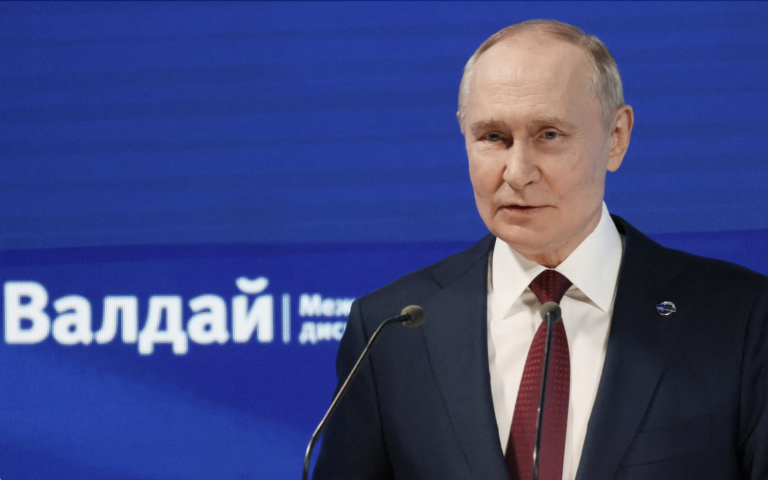
The Valdai Discussion Club event is taking place in Sochi under the motto “A Polycentric World: Instructions for Use.” Kremlin spokesman Dmitry Peskov announced in advance that Putin's speech would be devoted to this main topic.
“The organizers assume that a polycentric—or multipolar—world does not require fixed principles and rules of conduct. In such a world, there are significantly more actors and determining factors at play than in the systems of world order to which we have become accustomed since the mid-20th century,” according to the forum's website.
The Valdai Club was founded in 2004. This year, its main conference brings together 140 participants from 42 countries in Asia, Africa, Europe, Latin America, and the Middle East to discuss issues related to the new world order.
Russia will not attack NATO, but will respond to provocations
On Thursday, October 2, the third and final day of the forum, President Putin also spoke—his speech was broadcast live.
He said Moscow was closely monitoring statements about strengthening the German armed forces and the increasing militarization of Europe. Russia has shown over the centuries that it reacts quickly in the event of provocation.
Putin emphasized that Moscow was not planning any moves against NATO, but would respond in the event of European provocations. “All threats of an aggressive Russia are pure fantasy. It is impossible to believe that Russia would attack NATO,” Russian media quoted him as saying.
In his opinion, European political elites were fueling hysteria by claiming that a war with Russia was imminent. “I want to say honestly—calm down, sleep peacefully, and take care of your own problems. Just look at what is happening on the streets of European cities,” Putin said.
Fight against the entire NATO
Putin accused Europe of being responsible for the continuation of the war in Ukraine. Russia faces a serious challenge, he said, as NATO countries are supporting Kiev with intelligence, weapons, and training for soldiers. “All NATO countries are fighting against Russia in Ukraine,” he emphasized.
If the US supplies Ukraine with long-range Tomahawk missiles, this will trigger a new level of escalation, but will not change the situation on the battlefield. “It is impossible to use Tomahawks without the direct involvement of US military personnel. That would mean a qualitatively new phase of escalation, including in relations between Russia and the United States,” Putin said.
He also thanked the BRICS countries and Arab countries for their peace initiatives and praised the support provided by North Korea and Belarus.
Situation on the front
According to Putin, Ukraine controls only 0.13 percent of the Luhansk region and 19 percent of the Donetsk region. Russian troops control almost the entire Luhansk region, have moved into the cities of Pokrovsk and Kostyantynivka, and have occupied two-thirds of Kupiansk.
Russian forces advanced along the entire front line and established a “security zone” there. Western efforts to strategically defeat Russia would ultimately fail.
In this context, Putin also responded to comments made by Donald Trump, who had described Russia as a “paper tiger”: "I don't know if he meant that ironically. If Russia is a paper tiger, then what is NATO?“
Unlike Kyiv, Moscow is not conducting compulsory mobilization because it has enough soldiers. ”The Ukrainians should leave their army and instead think about how to reach an agreement," Putin said. He countered Ukraine's lack of soldiers with the recommendation to sit down at the negotiating table.
Attacks on nuclear power plants are a dangerous game
Putin accused Kiev of attempting to attack the area around the Zaporizhzhya nuclear power plant. “This is a dangerous game. They should stop,” he emphasized.
Similar actions had already taken place last year, when sabotage groups allegedly also targeted Russian nuclear power plants in Kursk and Smolensk. “We can respond; they have their own facilities,” Putin warned.
Despite the accusations, he assured that the situation at the Zaporizhzhya nuclear power plant was “under control overall.” Russia does not underestimate the threats to its own energy infrastructure and will respond decisively.
Restoring relations with the US
Putin explained that differences between Russia and the US are normal given the size of both countries. The current US administration is primarily pursuing its own interests and is making this clear.
Russia also reserves the right to focus on its national interests. Putin cited the complete restoration of relations with Washington as one of these interests. He described Trump as someone who knows how to listen.
Regarding US President Trump's latest initiative to end the war in Gaza, Putin said there was reason for optimism: “I think there could be light at the end of the tunnel.”
Moscow is “fully prepared” to support Trump's peace plan, provided it includes the two-state solution. This is the basis for a final resolution of the Israeli-Palestinian conflict.
Putin also responded to the idea of a so-called “peace council” led by Trump, which could also include former British Prime Minister Tony Blair. Blair is an experienced politician who could play a positive role.
However, Putin said that a better option would be for the Gaza Strip to be governed by the current administration of President Mahmoud Abbas. “The decisive factor, however, is what the Palestinians themselves, including Hamas, think about it,” he added.
He also criticized US efforts to force India and China to limit their energy ties with Moscow. According to Putin, the introduction of secondary tariffs against Russian trading partners would increase global prices and force the US Federal Reserve to maintain high interest rates. “That, in turn, would slow down the US economy,” he explained.
(reuters, est)