
US President Donald Trump gave a speech on Sunday aboard the aircraft carrier USS Harry S. Truman. This ship, along with the USS George H. W. Bush in the port of Norfolk (Virginia), was the venue for the celebrations marking the 250th anniversary of the founding of the US Navy.
Among other things, he promised that despite the “government shutdown caused by the Democrats,” soldiers would not receive reduced salaries. However, this is not within the authority of the president and commander-in-chief, as the military budget is officially classified as “essential services.”
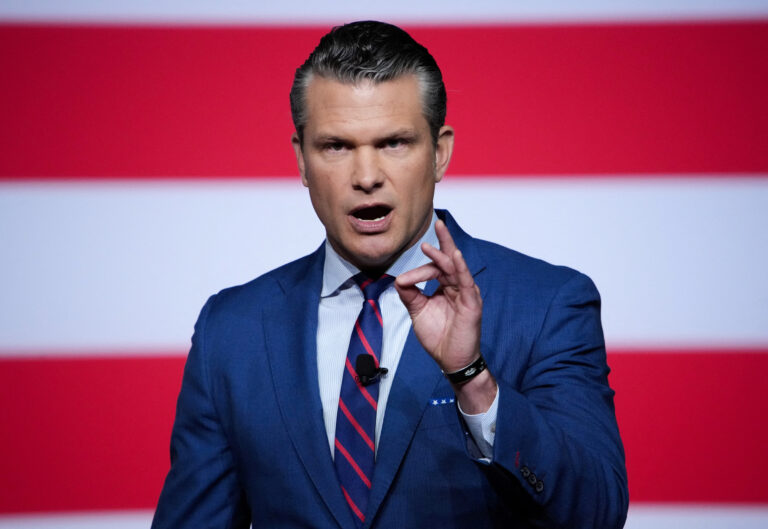
Secretary of War Pete Hegseth told Fox News during the celebrations that “the era of reckless adventurism around the world is coming to an end.” “We have no interest in endless, unclear missions,” he added, indirectly criticizing his neoconservative predecessors.
When asked by his former media colleague Billy Bush whether the operations against cartel ships in the Caribbean were “legal,” he replied that the military had “all the necessary authorizations.”
“These organizations are classified as foreign terrorist organizations. They pose a threat to the homeland and to the American people. They have been poisoning our people for far too long, and President Trump has said: never again,” Hegseth recalled.
War against everything
Even during the Cold War, the US was officially at war with communism. However, after the collapse of the Soviet Union in 1991, this justification disappeared, and the Pentagon needed a new argument to legitimize the military's decades-long foreign deployment.
This argument was provided by former President Richard Nixon, who as early as 1971 had described psychoactive drugs and their abuse as “public enemy number one.” After the end of the Eastern Bloc, US propaganda attempted to construct a new enemy in the Panamanian dictator Manuel Noriega, who was arrested in December 1989.
The “war on drugs” proved to be a viable justification for US soldiers to start fighting drug cartels. The first target was the Medellín cartel, led by the now world-famous Pablo Escobar.
Other opponents of the US who mainly smuggle drugs – but also weapons and people – from Latin America to the north include cartels such as Mexico's Sinaloa, the Gulf Cartel (Cartel del Golfo), Jalisco Nueva Generación, the Venezuelan Tren de Aragua, or the Cartel de los Soles, as well as the Salvadoran MS13.
Trump had already declared them “narco-terrorists” at his inauguration in January, which allowed him to deploy the armed forces against drug smugglers.
Although President George W. Bush had declared the start of the “war on terror” after the attacks on the World Trade Center on September 11, 2001, these two “quasi-wars” are beginning to merge under Trump. The war on terror targeted countries that the US considered “sponsors” – primarily Afghanistan, Pakistan, Iraq, and Syria.
Fighting in the Caribbean
Venezuela is likely to become the target of the expanded war against the cartels. As the US Treasury Department argued in its latest sanctions announcement, the Cartel de los Soles uses symbolism that is “directly” derived from the insignia of the Venezuelan army.
The White House therefore considers Venezuela's dictator Nicolás Maduro to be a “sponsor of narco-terrorism.” Maduro has long rejected these accusations and has responded to the growing US military presence by establishing civilian militias.
At the end of August, Trump declared war on the cartels and announced the deployment of extensive naval units to the Caribbean. On September 2, US soldiers sank a speedboat allegedly smuggling drugs, killing at least 11 people—members of the Tren de Aragua, according to the president.
On September 15, the White House reported another “successful” attack on an alleged smuggling vessel from Venezuela, killing three people. Five days later, another attack followed, with three “male narco-terrorists” as victims.
The latest attack took place on October 3 on Hegseth's orders, killing four people. At the end of September, the Dominican Republic also joined the crackdown on smugglers when it seized a ship carrying 377 packages of cocaine on September 22. According to US intelligence information, the Caribbean state's territory is considered a transshipment point for drugs on their way to the US.
Unconfirmed claims are circulating, particularly on Network X, that the ships actually belonged to fishermen who panicked and fled when they saw military drones. There is no evidence for these claims as yet.
However, it should be noted that the authorization of attacks on small boats within the jurisdiction of the Southern Command (USSOUTHCOM) is questionable under international law. Similar doubts would also arise in the event of a possible ground operation, for which Caracas is preparing.
Maduro said he was “ready” to declare a state of emergency if US troops entered Venezuelan territory. Trump had already toyed with the idea of conducting ground operations and military attacks on places where drugs are produced.
Western Hemisphere as the US's backyard
The operations in the Caribbean—involving at least eight warships and 4,000 Marines and Navy personnel—demonstrate the imperialist approach of the US toward the countries of South America. This approach, which is regularly criticized not only by the left-wing governments there, but also by Russia and China, stems from the official position of the US government.
The Monroe Doctrine of 1823 defines the Western Hemisphere as an area into which European powers are not allowed to expand. Due to historical developments and, in particular, China's rise to superpower status, it now also applies to Asian powers.
Although Trump has rejected claims of a planned regime change, he could change his stance as soon as Beijing intervenes in the conflict. As the analysis portal Geopolitics pointed out, China is Venezuela's most important trading partner, which undermines the Monroe Doctrine.
The communist government is considered by US foreign policy hawks to be a long-standing supporter of the “Chavist” dictator. While Russia, Iran, and other OPEC countries provide economic support to the Maduro regime, “none has been as crucial as China in ensuring the continuity of Hugo Chávez and Nicolás Maduro's power.”
The Pentagon is therefore continuously increasing its military presence in the Caribbean and, according to some analysts, expects Maduro to respond to these indirect provocations in order to provide a pretext for open military operations. At the same time, this conflict can be seen as the beginning of a proxy war between the US and China in the arena of a new Cold War.