
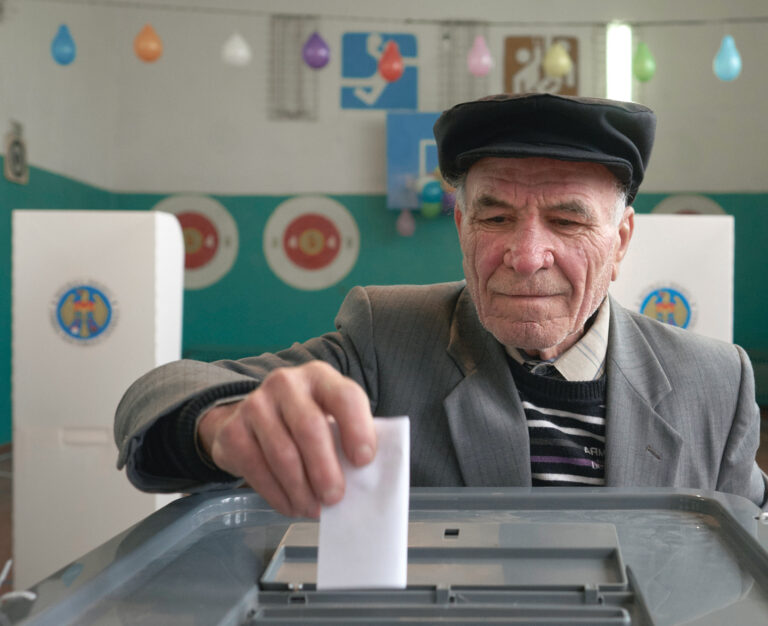
On the last weekend of September, Moldovans went to the polls once again. Following last year's presidential elections and referendum on the EU, this time parliamentary elections were held. The result was as usual: the pro-Brussels forces won. But the battle for Moldovan “democracy” was somewhat more expensive than before: through influence on the judiciary, manipulation in the media, harassment of opposition voters, and subsidies from Brussels. But the European elite has turned Moldova into a battleground in the power struggle with Russia, and in such a case, concerns about democracy or a few euros must take a back seat.
Demonization of the opposition, vague paragraphs, and election obstructions
Brussels' latest triumph in Moldova—half for the largest ruling party, a quarter for the opposition—is the result of a well-coordinated scenario with some innovations. Moldovan democracy today is dominated by the fight against corruption and Russian influence. With these two major goals, the pro-Brussels forces justify the closure of television stations and internet media, as well as court proceedings against opposition politicians.
The Moldovan authorities were not content with the usual media demonization of the opposition. A few days before the elections, President Sandu warned that everything was really at stake for the country. On the same day, hundreds of raids were carried out against suspected Kremlin networks, resulting in the arrest of more than seventy people. This capped off an election campaign during which more than two thousand house searches and raids had been carried out. This is made possible by vague wording in the criminal code, which criminalizes both high treason and “disinformation campaigns.”
Exclusion from the elections and manipulation of the number of polling stations abroad
A few days before the elections, the electoral authority also excluded two parties that advocated stronger relations with Russia because they were alleged to have bought votes and benefited from opaque foreign funding. The Moldovan intelligence service plays a key role in this struggle. Before taking office, its head, Alexandru Musteata, worked for Soros' non-governmental organization in Chișinău for ten years.
The authorities also resorted to their favorite tactic of making it difficult for those who vote for the opposition to cast their ballots. In breakaway Transnistria, where more than a tenth of the population lives, there were to be only 12 polling stations, compared to 40 four years ago.
In the end, there were none at all; the inhabitants of the breakaway republic were supposed to vote outside Transnistria for “security reasons,” but they could not reach the polling stations because the authorities had closed the bridges over the Dniester for “technical reasons.”
And as before, the 300,000 Moldovans living in Russia had only two polling stations at their disposal, while in Italy alone there were over seventy polling stations for the less numerous but pro-European diaspora.
The corruption of the pro-European elite is not being investigated
The allegations of corruption may well be justified, after all, this is a country where the general level of corruption is almost on a par with that of Ukraine. Strangely enough, however, they are only directed against pro-Russian politicians; the oligarch Ilan Shor has been living in exile in Russia for several years. The governor of the autonomous region of Gagauzia, where the government in Chișinău is as unpopular as it is in Transnistria, Yevgenia Gutul, was sentenced to seven years in prison in August for her support of Shor.
However, there is no mention of scandals involving the president's supporters or European funds, even though more than enough of them are flowing into the country. Over the past four years, more than €1 billion has come from Brussels, and €2 billion is expected for the period 2025-2027. That is a lot of money, even by Brussels standards.
The average annual subsidy for Moldova for this year and the next two years amounts to 4 percent of GDP; by comparison, the net inflow of European funds to Slovenia is around 2 percent and to Czechia just under 1 percent. When the Moldovan authorities accuse Russia of interfering in Moldovan politics via social networks and the training of activists, the amount that Russia spends on Moldovan operations, in their opinion, does not even exceed one percent of Moldovan GDP.
Whether Russia actually invests so much in Moldova cannot be confirmed or refuted by independent sources. What is certain, however, is that Russian influence is as real as corruption. This is due to the fact that a significant part of Moldovan society sees the future in strong relations with Russia, while another part is oriented towards Europe.
Without neutrality, the country faces a Ukrainian scenario
The election results do not reveal how large these groups are, as the pro-European government has done everything in its power to suppress the other side. Nevertheless, the pro-Russian parties won more than a third of the seats in parliament. If the elections had been truly fair, the advocates of cooperation with Russia would have won, as they have done several times in the past.
But that is something Europe does not want to allow today. Anyone who has a say in Brussels politics has had to appear in Chișinău in recent months. In addition to visits by European Commission President Ursula von der Leyen, French President Macron, German Chancellor Merz, and Polish Prime Minister Tusk also traveled to Chișinău together at the end of August.
Europe's involvement is not limited to money and visits. The head of the Telegram network, Pavel Durov, pointed out that when he was arrested in France at the end of last year and the beginning of this year, the French intelligence service presented him with a list of Moldovan Telegram channels that were to be closed down because of their criminal content. However, it turned out that the only crime of most of them was their pro-Russian stance.
The Brussels elite is now trying to bind Moldova to NATO. But if this country, which is internally divided between Europe and Russia, is to be governed democratically, it must be expected that sometimes the supporters of Brussels and sometimes the supporters of Moscow will gain the upper hand.
For the country to weather such changes without problems, it must maintain the neutrality that the fathers of Moldovan independence enshrined in the constitution in the 1990s. Otherwise, there is a risk of a Ukrainian scenario, in which Moldova becomes another battleground in the proxy war between the West and Russia.