
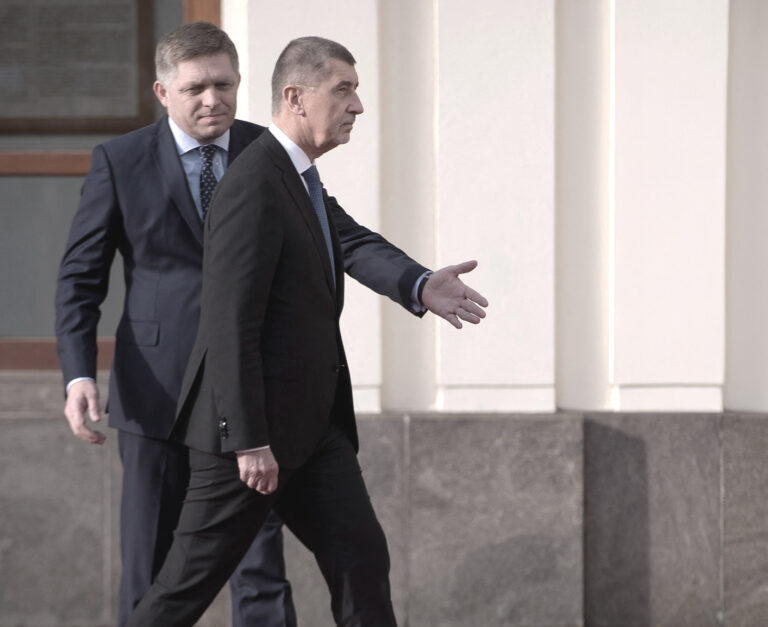
In spring 2024, Czech Prime Minister Petr Fiala made a key decision and announced the postponement of joint meetings between the Czech and Slovak governments. The reason for pulling the “handbrake” at the intergovernmental level was differing views and concrete political steps taken by the Slovak government regarding the war in Ukraine and toward Russia.
Fiala’s decision came shortly after Slovak Foreign Minister Juraj Blanár (Smer) met with Russian Foreign Minister Sergey Lavrov. Prime Minister Robert Fico (Smer) accused the Czech side of damaging mutual relations, claiming it was interested in “supporting the war in Ukraine, while the Slovak government openly speaks of peace.”
Babiš: We will work with everyone
The Czech election campaign also had an impact on Slovakia. Slovak governing parties voiced concern about the country’s orientation, its perceived closeness to Russia, and the weakening of support for Ukraine. After the election, ANO leader Andrej Babiš stated that Czech government politicians were constantly lecturing and advising the Slovaks. “The Slovaks should vote for whoever they want — we will work with whoever is there,” he remarked.
At the same time, Babiš lamented that Prime Minister Fiala “has no idea what politics means.” He pointed to the strong grouping of the V4 countries with 65 million inhabitants: “We cooperated, we had meetings with Macron and Merkel, so we were strong. We achieved great results, and Fiala destroyed that because he doesn’t understand it,” Babiš said.
Fico: We didn’t ruin it
Prime Minister Fico has already declared that mutual relations will improve after Andrej Babiš takes office and that cooperation within the V4 will also resume. He criticized Czech politicians for meddling in Slovakia’s political development.
“But we didn’t ruin it,” Fico said on RTVS’s O päť minút dvanásť program about bilateral relations, adding: “Do you think we’ve ever told the Czechs anything about their politics? On the other hand, we’ve heard all sorts of things about us, even about me.”
He added that he remained silent because, in his view, relations between people are more important than statements from politicians who come and go. Fico believes relations with the Czech Republic will calm down. In his opinion, nothing needs to change, as people-to-people ties are excellent.
“The era is over when departing Czech politicians often made us feel they were above us — still like fathers who need to lecture us. That’s behind us now,” he concluded.
Korčok on the differences between Fico and Babiš
Former foreign minister Ivan Korčok of the opposition Progressive Slovakia (PS) expects the new Czech government to resume Czech–Slovak intergovernmental consultations. However, he notes that the foreign policy differences that caused their suspension still persist.
“Babiš’s ANO, in the final weeks of the campaign, clearly supported the EU and NATO and clearly named who bears responsibility for the war in Ukraine — something our government has still failed to do — and that’s precisely what differentiates Robert Fico from Andrej Babiš,” Korčok wrote on social media.
He added that he would closely follow the new government’s European policy, as ANO is part of the eurosceptic Patriots for Europe group in the European Parliament.
Klus: A joint trip to Putin is unlikely
Political scientist Martin Klus predicts a turning point in Czech–Slovak relations.
“Yes, there will be a shift. Andrej Babiš will certainly get along better with Robert Fico, both personally and politically, than with Petr Fiala. That’s the first point. Another is undoubtedly Babiš’s Slovak roots and his business activities in Slovakia. And finally, there’s also the demand of ANO’s voters for such an improvement — something that was reflected in the campaign,” Klus told Štandard.
He considers joint government meetings a realistic starting point. According to Klus, few people are indifferent to good relations with their closest neighbors, so such talks are “relatively easy political wins early in the new Czech government’s term.”
Asked what foreign policy direction he expects from the new Czech government and whether it will focus more on domestic issues, Klus replied that it largely depends on coalition pressures.
“If the SPD pushes for a referendum on leaving NATO or the EU, and the Motorists intensify their hard eurosceptic agenda, it could create difficult situations for Andrej Babiš and his cabinet in foreign policy,” Klus said. However, he does not expect such a fundamental shift “as we saw in Slovakia when the government changed from Ľudovít Ódor to Robert Fico.”
In the Kremlin, Hungarian Prime Minister Viktor Orbán and Robert Fico met with Russian President Vladimir Putin. During the Czech campaign, Babiš stated regarding his relationship with Putin that he had “never spoken with him.”
Klus does not believe that Babiš and Fico will be fully aligned on the Russia–Ukraine conflict. He argues that Czech voters — including ANO supporters — are far less sympathetic toward Russia than Slovak voters.
“It is therefore very unlikely that Fico and Babiš will travel together to meet Vladimir Putin or that Czech dependence on Russian oil will be restored, as in Hungary or Slovakia,” Klus concluded, though he did not rule out stricter conditions for Ukrainian citizens living in the Czech Republic.
Ukrainian pragmatism
It is paradoxical that Fico succeeded with his eastern neighbor where he failed with Fiala. The joint meeting of the Slovak and Ukrainian governments took place in April last year in Michalovce. Fico wished Ukraine a swift EU accession and expressed support for finding a peaceful resolution to the war.
The two governments met again in October last year in Uzhhorod. The Slovak prime minister supported Ukraine’s European perspective but not its NATO membership. Although Fico consistently sought to maintain a friendly tone at joint meetings, his approach was more pragmatic — as Ukrainian Prime Minister Denys Shmyhal himself described it in Uzhhorod.
Another joint government meeting with the Ukrainian side is already being prepared. It is scheduled to take place soon — on October 17 in Michalovce.