
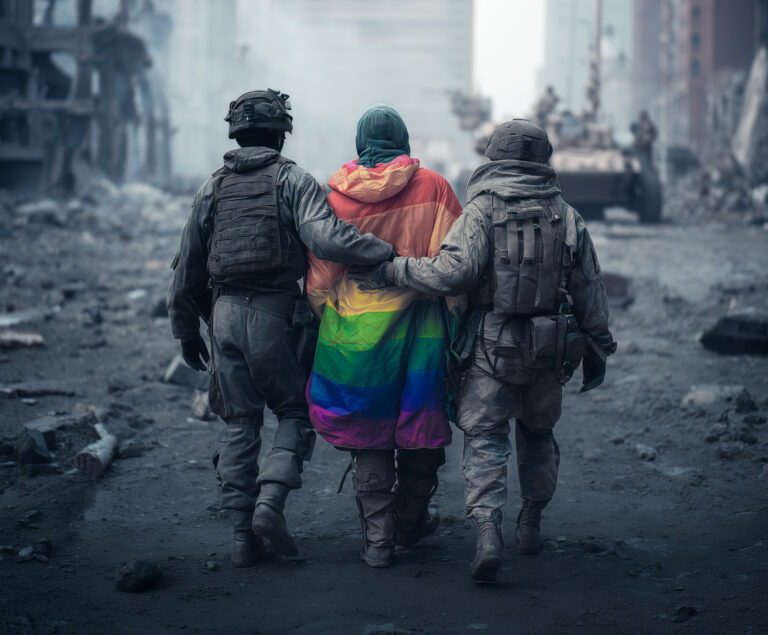
On September 3, the Ukrainian Verkhovna Rada began debating a bill that would ban “propaganda of deviations” in its autumn plenary session. The draft, numbered 6327 from 2021, was submitted by deputies from the Servant of the People party, but its inclusion in the plenary agenda was suspended in December of the same year.
The deputies later presented an alternative wording of the bill to amend the law on administrative offenses, which would also amend the criminal code and increase some fines.
Even tougher, however, is draft No. 6325, which, in the name of protecting children, motherhood, and fatherhood, would ban the use of the terms “sexual orientation” and “gender identity” in subsequent legal acts. This draft would also criminalize the “propagation of pedophilia, homosexuality, and transgenderism.”
The applicants' argument is that these statements in public “are considered a violation of public morality.” However, in response to criticism from LGBT organizations, members of President Volodymyr Zelensky's party have put forward a milder proposal.
A similar law was already passed in Hungary in March, although a “Pride Parade” took place there in the summer. The law was criticized in the media and compared to Russia's 2013 law against homosexual propaganda. It is therefore questionable how the global media will react to the Ukrainian proposal.
Fines for public expressions of homosexuality
While the non-governmental organization LGBT Consortium welcomed the watering down of some proposals, the wording currently under discussion still seems harsh. The fines are aimed at “the production, distribution, and public use of products with LGBT symbols” or “the public expression of love between persons of the same sex as the norm,” “advertising or encouraging the conclusion of an unconstitutional marriage,” or “public calls for sexual relations between persons of the same sex or advertising for them in the media.”
It should be noted that Article 51 of the Ukrainian Constitution defines marriage as “a family union between a woman and a man based on free consent.” “The family, childhood, motherhood, and fatherhood are under the protection of the state,” the constitution adds.
The fines in the draft are “one thousand minimum tax-free incomes,” which, according to The Page portal, corresponds to 17,000 hryvnia (about 325 euros) for natural persons and “three thousand minimum tax-free incomes” for legal entities—i.e., over 51,000 hryvnia (about 1,057 euros).
In the event of repeated violations, this rate is to rise to 51,000 hryvnia for individuals and up to 85,000 hryvnia (approx. 1,762 euros) for legal entities. The applicants propose the same rate for civil servants. “Denial of the increased risk of HIV among LGBT people” is also to be punishable by fines.
The main initiator is Romanian-born MP Heorhij Mazurašu from the Servant of the People party. He represents the constituency in the Chernivtsi region in parliament. His Wikipedia page states that in May 2022, he submitted a bill allowing the “killing” of soldiers who disobey the orders of their superiors.
Almighty nationalists and Richard Moore's mistake
Ukrainian nationalists who have been active in the army in recent years are openly opposed to “innovations from the West.” Commenting on last year's gay pride march in Kharkiv, the deputy commander of the 3rd Independent Assault Brigade, Maksym Žorin, said that Kharkiv Pride could be extended to cities such as Chasiv Yar, Myrnohrad, and Pokrovsk.
The former commander of the Azov Regiment is not alone in his comments about fellow citizens with different orientations. The self-proclaimed ideologist of the 3rd Army Corps, Olexiy Reyns, who goes by the pseudonym Consul, also published several derogatory status updates on the Telegram platform referring to LGBT activist Bohdan Palamarčuk.
However, he targeted him because Palamarčuk has long criticized the power with which right-wing extremists operate in Ukrainian society—even though they have virtually no representation in the Verkhovna Rada.
Zorin, Rejns, and many others still use the symbol of the so-called “wolf hook,” which can be found in the logo of the now defunct Svoboda party (changed in 2004 by its leader Oleh Ťahnybok) and in the emblems of several divisions of the Waffen-SS.
The recent protests against the presentation of a book about the radical left-wing Black Lives Matter movement in Lviv – organized a few days after the murder of Ukrainian refugee Iryna Zarucka in the US – also showed that militant Ukrainians do not really share the so-called “Western values” that the then director of the British secret service spoke of at the beginning of the war.
A few days after Russian troops invaded, the former head of the Secret Intelligence Service (SIS, also known as MI6), Richard Moore, wrote on Network X: “In light of the tragedy and destruction currently unfolding so painfully in Ukraine, we should remember the values and hard-won freedoms that distinguish us from Putin, especially the rights of LGBT+ people.”
The steps taken by Ukrainian politicians described above show that the head of the British secret service was mistaken. Ukraine is not fighting for “LGBT rights,” but for its sovereignty and its homeland, defending itself against the Russian forces that have attacked it.
As a nation, Ukrainians are predominantly Orthodox—although one of the two Orthodox churches has become the target of state persecution—and there are also Greek Catholic, Protestant, and Roman Catholic Christians. Even those in the ranks of Azov who profess to be pagans and worship solstices are not big fans of late liberalism in the form of so-called “LGBT rights.”