
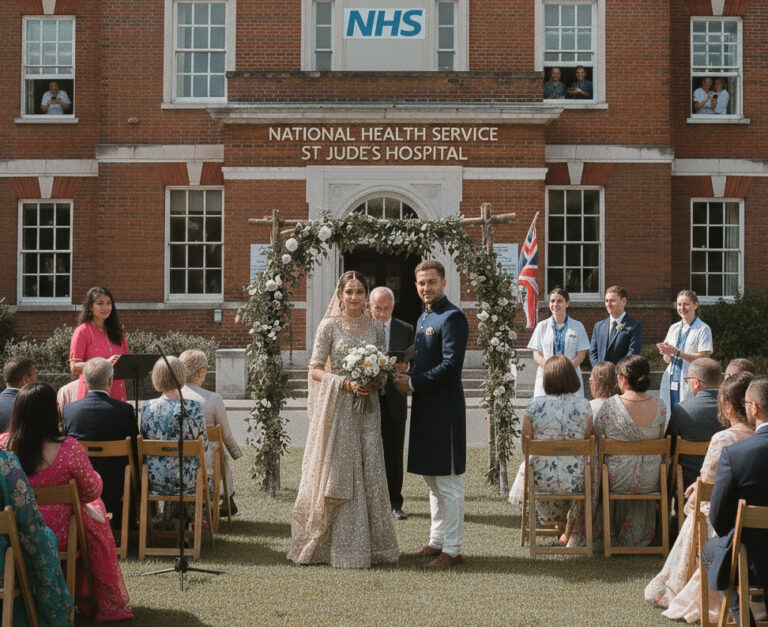
In September, the British National Health Service (NHS) published new guidelines on marriages between first cousins. Although it acknowledged that children from such unions have been found to have an increased incidence of genetic defects, it also pointed to “stronger extended family support systems and economic benefits.”
On the Genomics Education website, the agency responded to comments made by Conservative MP Richard Holden, who had warned Parliament about the potential genetic risks to children born to first cousins.
The Tory politician recalled that in the Middle Ages, Roman law prohibited marriages between family members up to the sixth generation, although current legislation already allows marriages between first cousins – technically between the children of siblings. He therefore called for a general ban.
At the same time, the NHS acknowledged that countries such as Norway have also moved toward tightening this practice in matters of public health or “women's rights.” Minorities from other cultures often practice arranged marriages, including unions between cousins.
Genetics gave way to fears of stigmatization
According to the guideline, first cousins share 12.5 percent of their parents' genetic information. As a result, significantly more children with genetic disorders were born in the Bradford area than in the rest of the UK, as reported in a BBC television report.
Sam Oddie, head of a multi-year study in Bradford, warned on public television of an increased incidence of defects in children from these unions. According to his own statement, he witnessed how the families there “lost one child after another.”
Bradford is home to a particularly strong Pakistani community that practices “intra-family” marriages. The professor himself therefore refused to condemn this practice, instead offering an explanation of the term “endogamy” – it is not a family bond, but rather the long-term cohabitation of several families, for example in a village.
At the end of the report, the NHS warned against “stigmatizing certain communities and cultural traditions.” Among Pakistanis themselves, however, this practice has been gradually declining since 2007.
As the Daily Mail pointed out, relationships between first-degree relatives account for only one percent of all white couples, while in the Pakistani community mentioned above, the figure was 37 percent at the start of the study in 2007.
In Pakistan itself, 61.2 percent of couples are blood relatives, similar to Sudan.
“Our national health service should no longer tolerate harmful and oppressive cultural practices. The Conservatives want to abolish cousin marriages, which serve as a back door for immigration, but the Labour Party is deaf to these reasonable demands,” responded MP Holden to the NHS report.
Alongside some geneticists, Labour Health Minister Wes Streeting also joined in the criticism, undermining his party's unified stance on the issue of cousin marriages.
"I heard about it for the first time when I saw the report. I immediately asked, 'What's going on here and what are they playing at? The recommendation was withdrawn, but why was it there in the first place?“ the minister asked on the LBC television program, adding that ”the medical science and evidence are clear.“
”Marriages between first-degree relatives are high-risk and dangerous. We see the genetic defects they cause and the damage they do. That's why this recommendation should never have been published,“ he added. He also called on the health authority to apologize.
The Telegraph newspaper also carried a similarly shocking report that genetic defects caused by ”inbreeding" are more deadly than drug use during pregnancy.
Up to 73 deaths of infants under one year of age were caused by a genetic defect, while only 23 were attributed to drug use, according to data from the National Database for Infant Mortality for the period 2023/2024. Genetic defects also claimed another 55 lives between the ages of one and seventeen.
Breastfeeding
However, the NHS also offers other controversial elements in its recommendations. In the section “Advice on pregnancy planning,” it gives ‘trans’ and “non-binary” potential parents advice on how to get pregnant “if pregnancy through sexual intercourse is not an option” or how to “breastfeed.”
The second piece of advice uses the term “chestfeeding.” This is a neologism in the English language, whose creators have attempted to find a more inclusive term to replace the expression “breastfeeding.”
The health service also recommends surrogacy, but points out that it “does not offer” this service. In the section on “co-parenting,” it also explains that “this is a situation in which two or more people join together to conceive and raise children.”
However, the agency did not elaborate on how “multiple people” are involved in conceiving a child, merely adding that “there are many details to consider, such as how you will share the financial costs.”