
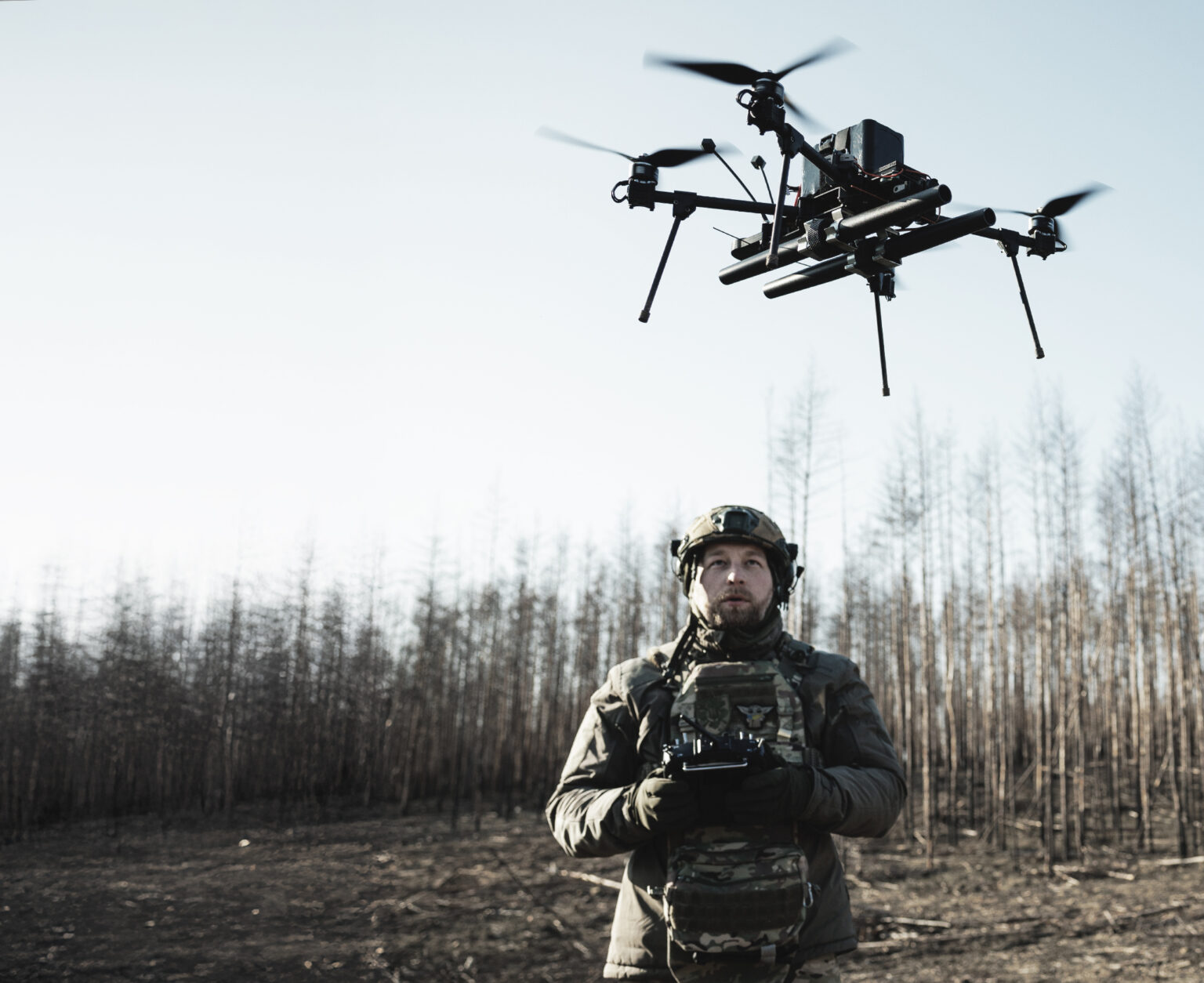
The Russian-Ukrainian war has now been going on for three years and eight months. During this time, both sides have repeatedly changed their tactics. However, the most consistently used technology is unmanned devices that move either in the air or on water—drones.
The Russians originally purchased Shahed (Martyr) drones from Iran—which Tehran repeatedly denied—but later made some modifications and renamed them Geran (Pakost). The Ukrainians initially used Turkish Bayraktars (flag bearers), but gradually increased their domestic production, which will likely make them exporters after the war.
Since the armed forces in Kyiv in particular are using “electronic warfare” devices, i.e., jammers for navigation systems, against these drones, Russian engineers have introduced another innovation. The newer generation of drones are no longer controlled by radio signal, but via a connected optical cable.
The Russians are fortifying tanks and other vehicles against Ukrainian drones by simply welding metal grids and additional layers onto the existing armor of the tank. Although the tanks converted in this way became the target of Western ridicule, the Ukrainians themselves claim that they are actually effective against drones and have since carried out identical conversions.
Military technologies are thus clearly developing in a reciprocal relationship, without any long-term shift in superiority on the battlefield to one side or the other.
The evolution of everything
Evolutionary biology distinguishes between pairs of species or other types of organisms that interact with each other, such as symbiotic (mutualism), predator-prey, or parasite-host. These pairs surpass each other in their development, so to speak, while maintaining the balance of their “powers.”
The above-mentioned principle is referred to as the “Red Queen hypothesis” according to a statement from the work Alice in Wonderland. In the chapter “The Garden of Living Flowers,” the main character of writer Lewis Carroll runs through the royal garden, but after a long run, she realizes that she has remained under the same tree where she started.
“In our country, you usually get somewhere else when you run very fast and for a long time, as we have just done,” Alice said to the Red Queen. “What a slow country! Here, you see, you have to run as fast as you can just to stay in the same place,” was the reply.
And while biologists point to changes in the physique of predators and their prey as evidence for this hypothesis, military analysts are also getting their money's worth.
Pro-Ukrainian portals openly claim that Ukraine's “drone arsenal has shocked Russia” and changed modern warfare. In an article published in June, Bloomberg reminded readers that Ukrainian drones “cost only $400 and are capable of destroying sophisticated Russian equipment worth a thousand times more.”
However, it must be added that the same is true in reverse. In July, the newspaper Štandard focused on Russian swarm attacks, which “overwhelm” Ukrainian air defenses and thus increase the accuracy of the attacks many times over. Headlines about the “biggest Russian attack” are repeated with almost iron regularity.
However, while Russian attacks are essentially based on quantity (drones) and, more recently, power (missiles) that exceed the defensive capabilities of American Patriot systems, Ukrainian attacks are primarily symbolic in nature — the bombing of targets in Siberia, the destruction of the Armavir anti-nuclear radar, or the destruction of dozens of bombers are primarily aimed at destroying the image of “invincible Russia.”
Bloomberg also acknowledges in the aforementioned article that both sides in the war are inflicting the most damage on each other with drones – about 60 to 70 percent of the damage to Russian equipment was caused by Ukrainians using unmanned aircraft, according to the British Royal United Services Institute (RUSI).
Technology has changed the course of the war in a unique way
Let's assume that the first combat technology was a stone (possibly tied to a stick) with which Cain killed his brother Abel. The motivation was basically the same as in today's wars – animalistic hatred, jealousy, the desire for power. Since those biblical, prehistoric times, only the technology has evolved.
Prehistoric times are assumed to have been a period of endless war of all against all, which, according to several genetic studies, wiped out about 95 percent of the male population in Europe. This is supposedly the reason for the mutual similarity of European peoples—we simply have the same “forefathers.”
As technology improved, humans progressed from stones to spears, later to stone or bone tips, and 64,000 years ago, the first bow appeared. Since then, killing instruments have been (and continue to be) improved at an ever-increasing rate.
According to preserved sources, the English had their famous longbows from around 1180, when “longbows” are mentioned in connection with Welsh archers in the English army.
These proved to be the dominant technology of the Hundred Years' War, especially in the battles of Crécy and Agincourt. Basically, only French crossbows could compete with them – also a new technology that reduced the speed of the arrow but had a greater range.
Cannons were used extensively, especially in the Hundred Years' War. However, the new technology based on the “recently” discovered gunpowder could not reverse the long-term trend that led to the French victory.
Other siege engines such as sliding towers and catapults have been known since ancient times. However, technological development mainly influenced cannons, which became smaller and smaller and eventually turned into handguns – rifles and pistols.
Just like cannons, they were initially loaded from the front, later from the rear, and finally from the side (from the magazine). However, it was their number that changed the balance on the battlefield, even though the Winchester repeating rifle “conquered the West,” according to a popular American saying.
It was combat tactics that changed the balance of power. Napoleon's troops were no better armed than the Prussians or Russians, but their maneuvers and evasive maneuvers were ultimately decisive. Similarly, the French Imperial Army serves as a case study for examining the effects of longer supply lines.
The most significant conflicts of modern times generally include the Thirty Years' War, the Seven Years' War (the first global conflict), the Nordic War (against Swedish hegemony), and the Crimean War (against Russian expansion into the Black Sea). The maneuvers of large armies were gradually replaced by trench warfare tactics, which culminated in World War I.
Parallel to this development, the projectiles for “handguns” also changed. Initially, they were spherical, later conical, and other engineers added new improvements. The result is a projectile with its own casing for a controlled explosion and a spiral cut for the rotation of the projectile.
In none of the wars mentioned was the new weapon a decisive factor. Even World War II—which was characterized by a change in tactics to blitzkrieg and the massive use of tanks—did not end with Germany's defeat due to technical superiority. Even the wonder weapon promised by Nazi leader Adolf Hitler at the end of the war would probably not have changed the balance of power on the battlefields.
However, this is precisely where a decisive technological advance occurred, namely in the case of Japan. Although the atomic bomb did not claim as many lives as the firestorm in Tokyo a few months earlier, the shock factor apparently prevailed, and Emperor Hirohito finally agreed to surrender.
The next war, this time a Cold War, was marked by an arms race and an increase in the number of nuclear warheads. However, the race resembled Alice's race with the Red Queen, with the major powers of the Cold War (the US and Russia) currently possessing a similar number of warheads (about 3,000 American warheads compared to about 5,500 Russian warheads). Both major powers have reduced their arsenals by about a tenth compared to the 1960s.
Present
The war in the Gaza Strip developed in Israel's favor practically from the outset. Although the Palestinian Hamas movement essentially employed guerrilla tactics, the Israeli Defense Forces (IDF) deployed a much larger number of soldiers. Once again, the infantry was decisive, although its effectiveness was weakened by the militants' combat tactics.
The IDF deployed about 450,000 soldiers, including reservists, in Gaza in May of this year. According to simple calculations, this meant that all of the armed forces were mobilized in the enclave. Hamas, i.e., its armed wing, had about 40,000 fighters, according to Israeli and American estimates.
The American Council on Foreign Relations (CFR) pointed out the balance of power between the Russian and Ukrainian armies – 1.1 million active soldiers in Moscow compared to 880,000 Ukrainian soldiers. Since, according to well-known military doctrine, the attacking army should be at least three times as strong, these figures clearly show why Moscow is proceeding so slowly.
The numbers of soldiers deployed or killed on both sides are a military secret, and exaggerated or deliberately reduced figures in newspaper articles are part of propaganda as one of many instruments of war.
Following recent incidents in which Russian fighter jets or drones allegedly entered NATO airspace, the European Union has begun a discussion about the need for a kind of “drone wall.” However, apart from further increasing the spending and debt of member states, there is no indication that this would have a long-term effect.