
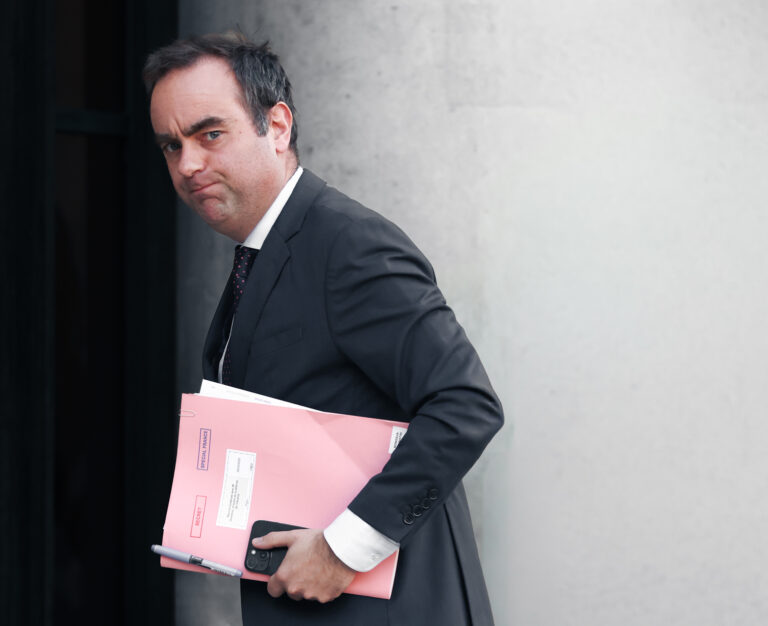
Two motions of no confidence were tabled in the French National Assembly. One came from the far left, which has rallied around the La France Insoumise (LFI) movement, and the other was submitted by the national conservative Rassemblement National (RN). Both were voted on Thursday.
The target of these votes was the re-elected Prime Minister Sébastien Lecornu. He was appointed by President Emmanuel Macron on September 9, but at the government's first meeting on October 6, the former defense minister resigned, causing the government to resign 14 hours after its official appointment.
Lecornu announced on Sunday evening the formation of a new government. Jean-Noël Barrot remains foreign minister, while the defense portfolio will be headed by Gérald Darmanin. Some of the new ministers also have no political background.
The government survived the first vote, as at least 289 members of the lower house of parliament must vote in favor of a no-confidence motion. However, at 11:40 a.m. CET, only 217 members of parliament, mainly from the extreme wings of the political spectrum, voted in favor of the motion. The National Assembly has 577 members, and a simple majority of all members must vote in favor of a no-confidence motion.
Conversely, a vote of confidence must be supported by a simple majority of the members present, which recently led to the fall of Lecornuov's predecessor François Bayrou's government.
The second vote at 12:10 p.m. CET was supported by only 144 deputies.
In an effort to convince the deputies of the Socialist Party (PS), Lecornu agreed on Tuesday to suspend Macron's pension reform. They announced that they would not support the no-confidence vote.
However, as this is a proposal from the president, it is questionable whether the government will revisit the reform or prevent Macron from pushing through one of the most important points on his agenda. The French and international media described the reform as “Macron's economic legacy.”
The head of the Élysée Palace wanted to reverse the reduction of the retirement age to 60, which had been implemented in 1952 by socialist President François Mitterrand. Under Macron's reform, the retirement age would be raised to 64 by 2030.
Lecornu had already promised him the reform of the pension law in November last year. On Wednesday, the Socialists also set a condition for next year's budget: the adoption of a tax on billionaires.
The agreements between the Macronists and the Socialists were therefore criticized by both sides of the political spectrum, but also by the Gaullist Republicans. Their deputy chairwoman, Florence Portelli, told RTL radio that she would support a vote of no confidence.
“I believe that a socialist budget is being presented to us today, and I am not a socialist. Our voters expect us to represent values,” she said.
After his first resignation, Lecornu assured the French public that this year's budget would be passed by parliament “by December 31.” However, after joining the government, he faces extremely tough negotiations with LFI deputies led by their “coordinator” Manuel Bompard, as well as with Le Pen's RN supporters.
(reuters, sab)