
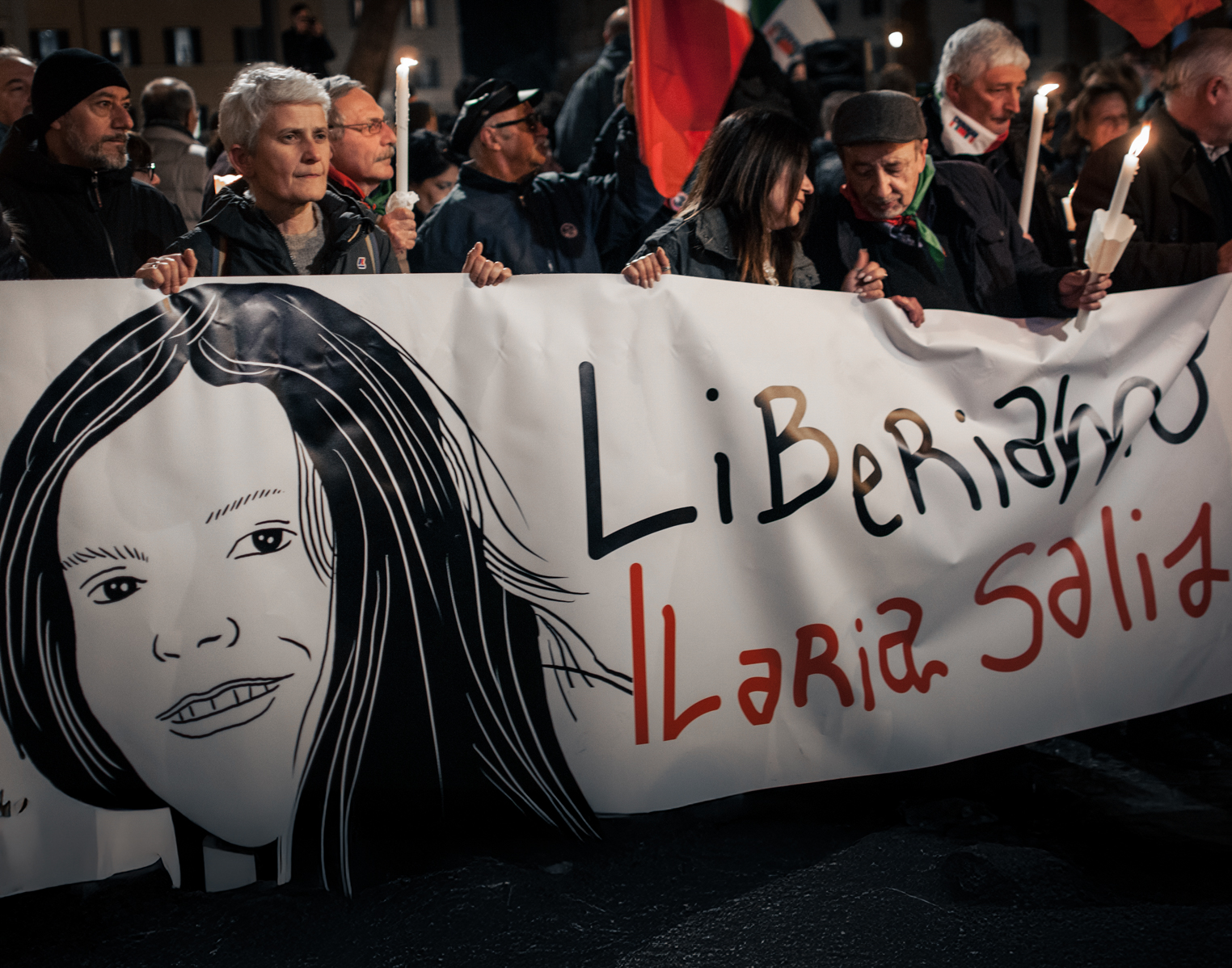
Ilaria Salis is an Italian activist and Member of the European Parliament, member of the Left Group (Group of the Left in the European Parliament), who, according to her own statements, fights against fascism and professes anti-fascist ideas.
In Hungary, she faces charges of aggravated assault allegedly committed during her participation in a demonstration in Budapest in 2023, with the incident linked to her activism against fascism. Salis traveled to Hungary to take part in a counter-demonstration against the “Day of Honor” rally, which has been described as right-wing extremist.
Hammer as a weapon against fascists
According to the indictment, Ilaria Salis allegedly attacked individuals from the “Day of Honor” gathering during the demonstration, inflicting multiple injuries on them, allegedly using a hammer. The use of the hammer as a weapon against others was also mentioned by Georg Mayer, an Austrian member of the Patriot faction.
The MP was arrested at the scene but denies the allegations. According to a statement by Salisová, the Day of Honour is “a shameful reminder that brings together thousands of neo-Nazis from all over Europe every year. The Hungarian government not only fails to prevent such an event, but even contributes to its support by providing financial assistance to some of the organising associations.”
The Italian MP added: “Without any explanation, I was pulled out of the taxi and handcuffed. I was arbitrarily charged, I am innocent, and there is no evidence against me, no victims, and no witnesses identified me among the attackers.”
Salis as a member of an extremist left-wing group
The Hungarian authorities accused her of three counts of attempted grievous bodily harm committed as part of a criminal organization. She faces up to 11 years in prison for these crimes. The Budapest Public Prosecutor's Office brought charges in this case against a total of three foreign nationals whose attacks claimed a total of nine victims, with the perpetrators allegedly founding an organization that sympathizes with extreme left-wing ideology.
According to the Hungarian public prosecutor's office, the members of the organization agreed that the ideological struggle against sympathizers of the extreme right must be waged with violence. They therefore agreed to carry out organized attacks on unsuspecting individuals whom they themselves selected and considered to be sympathizers of the extreme right.
The attacks were carefully planned, precise, and well rehearsed, which was also reflected in the division of tasks agreed upon in advance. The duration of the attacks was set at 30 seconds, which were measured by a dispatcher—he triggered the attack with commands and ended it, then helped his accomplices escape.
Six of the victims suffered serious injuries, three others minor injuries, some of which could have had life-threatening consequences. Criminal proceedings are underway in Germany against the leaders of the organization and members closely associated with them for the attacks carried out in Germany between October 2018 and February 2020.
The immunity of a Member of the European Parliament guarantees protection from prosecution
After the indictment, Ilaria Salis was taken into custody and spent more than a year under house arrest in Hungary (as a substitute for pre-trial detention), but was elected to the European Parliament in 2024 as a member of the Alliance of Greens and Leftists in Italy.
Members of the European Parliament enjoy extensive parliamentary immunity from prosecution, which is why Ilaria Salis had to be released from house arrest. Members of the European Parliament may not be subject to investigation, arrest, or prosecution for opinions expressed or votes cast in the exercise of their duties.
The immunity of a Member of the European Parliament applies in the territory of each Member State and includes both protection from arrest and immunity from prosecution. It cannot be invoked if the Member has been caught in the act. If the competent national authority requests the European Parliament to waive the immunity of a particular Member, the President of Parliament informs the plenary and refers the request to the relevant parliamentary committee.
The committee then adopts a recommendation in camera on whether to approve or reject the request. This recommendation is submitted to the full Parliament. In the plenary session following the committee's decision, Parliament decides by a simple majority whether to waive or uphold the immunity of the Member concerned.
Absurd excuses about political activities
After Salis was elected to the European Parliament and acquired parliamentary immunity, the Hungarian courts were unable to continue their prosecution. The district court in Budapest requested the waiver of her immunity in connection with the ongoing proceedings.
In its request, the court emphasized that the actions of the MEP for which she is being prosecuted are not related to the views or votes of Ilaria Salis in the exercise of her duties as a Member of the European Parliament and therefore called on Parliament to waive her parliamentary immunity.
The European Parliament's Legal Affairs Committee recommended that Parliament vote against waiving her parliamentary immunity. It noted that Salis “was subject to strict conditions and detention measures during the criminal proceedings, while the Hungarian court did not record any violent incidents on the part of the Day of Honour demonstrators and did not take any measures against them.”
On the basis of this reasoning, the committee concluded that “the fundamental aim of the proceedings and the subsequent request appears to be to silence Ilaria Salis for her long-standing political views and activism, in particular her opposition to the annual neo-Nazi commemoration, which also forms the basis of her commitment and political activity in her role as a Member of the European Parliament.”
The committee thus claims that the MEP's physical attack on others was acceptable because she was “fighting against fascists” – and that this was an expression of her political activity, which is protected by immunity.
This assertion seems all the more absurd given that the committee has backed it up with the decisions of the European Court of Justice in the Marra/De Gregorio and Clemente cases (joined cases C-200/07 and C-201/07, Grand Chamber, October 21, 2008).
These judgments analyze the limits of parliamentary immunity and explicitly emphasize the need for a direct and obvious link between the act and the exercise of parliamentary duties in order for a member of parliament to be protected by immunity.
Not only was Ilaria Salis not performing her duties as a Member of the European Parliament when she kicked people in the head during a demonstration, she was also caught red-handed at the scene of the crime. A Member who is caught red-handed cannot invoke immunity. However, this was not enough to hold her accountable.
The MEPs did not revoke Salis' immunity, and she cheered with joy.
In a close vote—306 in favor and 305 against—the European Parliament upheld the immunity of the criminally prosecuted MEP and thus also her immunity from prosecution. In her speech to the Parliament in Strasbourg, Salis said that this “vote proves that authoritarian forces can be fought and defeated when elected representatives, activists, and citizens stand together for democratic values.”
She expressed her joy by chanting “We are all anti-fascists” with her supporters in the style of soccer fans.
The European Parliament thus saved the aggressive MEP from being held accountable for her physical attacks by a margin of just one vote. In addition to the committee's conclusions, the MEPs who voted to uphold immunity also pointed out that Salis would face “politically motivated justice in Orbán's Hungary.”
Hungarian State Secretary for International Communication Zoltán Kovács strongly condemned the vote, and Hungarian MEP Enikő Győriová of the Fidesz party pointed out a contradiction: the European Parliament has long criticized Hungary on issues of the rule of law, but in this case has supported a member of parliament who is facing criminal prosecution.
The MEPs have thus decided for themselves that the courts are biased and that they themselves will decide whether their colleague should be held accountable.
This absurd reasoning made it virtually impossible to prosecute the attacker, who, in line with a radical progressive ideology, believes that physical attacks on “fascists” are justified.
The dangerous game with fascists and the hypocrisy of Parliament
Who is a “fascist” is often decided by the attacker himself. This practice of branding ideological opponents as enemies has long been used by supporters of the extreme progressive scene to justify their illegal actions with the “greater good and the fight against the dark forces.”
Few votes by European lawmakers have revealed their hypocrisy and tendency to protect radical ideas as clearly as the decision to uphold the immunity of these MEPs. Selected people “with the right views” are allowed to smash heads because it is “proper activism.” A law prohibiting physical violence against others must not stand in the way of such noble ideas.
It should be noted that the radical MEP traveled from Italy to Hungary to express herself violently.
The same MEPs who criticize the rule of law in other countries for things they do not understand or only blindly accept from the media are at the same time voting for its erosion at the European level—with laudatory remarks that they are “fighting fascism.”
The conclusion that a Member of the European Parliament can travel to a foreign country, physically attack several people, and then hide his actions behind the “exercise of his duties as a Member of the European Parliament” is beyond any legal reality. With its vote, the European Parliament has shown that legal reality has no place within its walls.
Attacks by MEPs on fascists as the norm
This has set a dangerous precedent, raising the limits of tolerance for political violence to a whole new level. Organized international groups beat people up at demonstrations, and according to the Hungarian public prosecutor's office, this is a highly organized group.
One has to wonder what would have happened if someone from the far-right parties in the European Parliament had attacked Ms. Salis in her hometown in a similar manner and caused her serious injuries—because he considered her a “fascist.”
According to a narrow majority of MEPs, this would actually be acceptable, and such a person should not be prosecuted because they enjoy immunity. The injured Salisová is actually to blame herself because she was called a “fascist” by someone, and therefore the injuries inflicted on her cannot be considered a criminal offense, but rather the exercise of her parliamentary duties.
Such a distorted view of the enforcement of politics or ideology actually goes far beyond the limits of the law. Responsibility is no longer decided by the courts, but by MEPs through voting. The right people, or “our people,” enjoy immunity.
The select caste of the extreme left, whose supporters are well represented in the European Parliament, has thus sent a clear signal: courts and the law will not prevent our people from attacking fascists. We have immunity.
Opponents of our views can suffer in silence—after all, they are fascists. This is how supporters of progressive ideology view the law. The rest of the world sees this progressive approach as extremism.