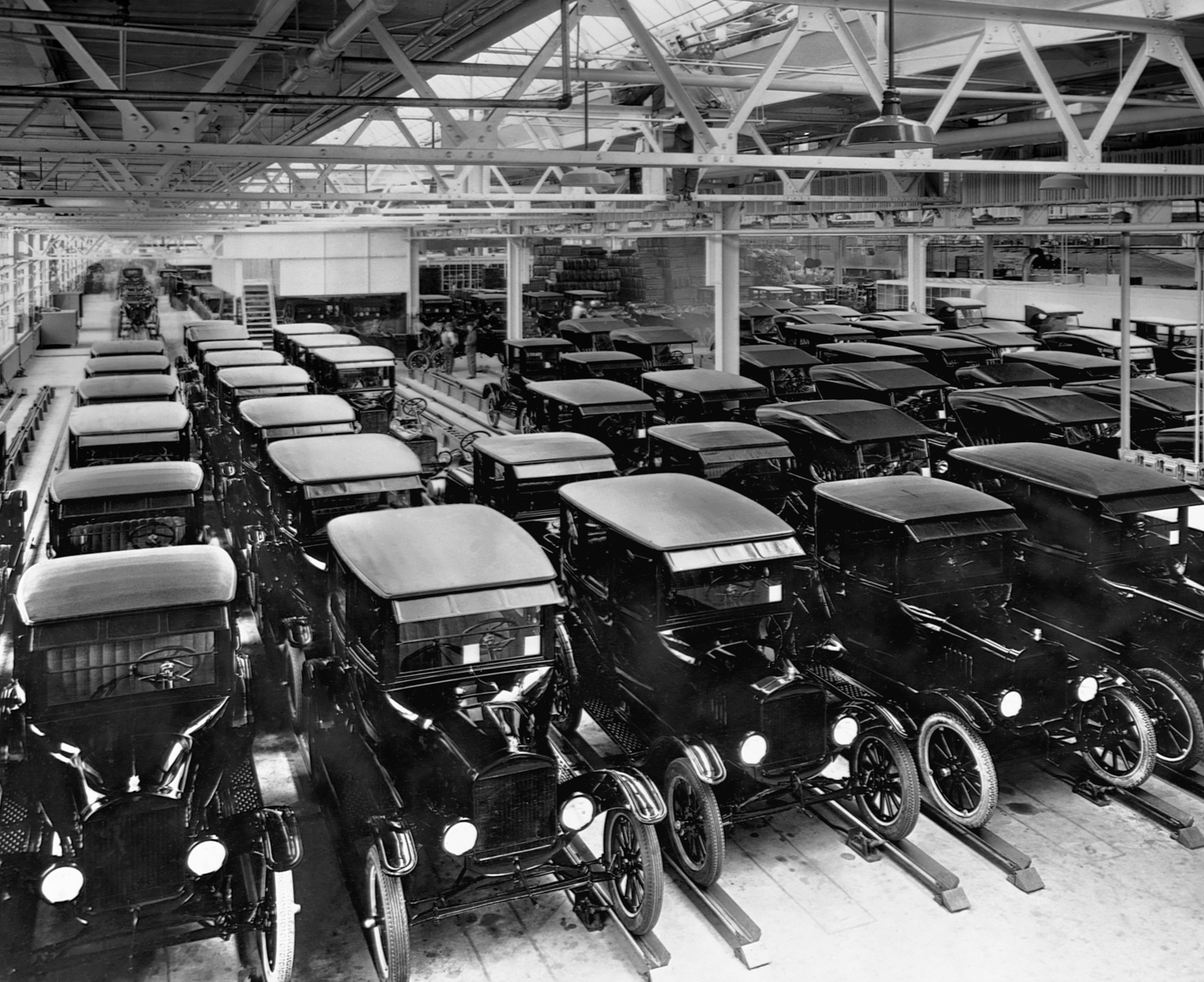
The world's first mass-produced car was the Ford Model T. Douglas Brinkley writes in his book on the history of the Ford Motor Company that “in the automotive industry, which had previously been unrestrained by anything like precise measurements, the tolerance of Ford's first mass-produced model was 1/64 inch (0.4 mm).”
Some types of manufacturing were even carried out without dimensional drawings at that time. This precise machining was “the cornerstone on which the mass production of the Model T was based.”
The precision of the machining meant that, unlike most other car manufacturers, Ford did not have to test the engine before installing it in the chassis, because “if the parts were manufactured and assembled correctly, the end product would also be fine.”
Maintenance of the Model T ultimately cost about $100 per year, while maintenance of other cars cost about $1,500 per year.
From October 1908, when the company introduced the new model, to September of the following year, Ford sold 10,607 Model T cars at a price of $900.
Construction of assembly plants
Originally, the cars were transported by railroad to Ford dealers across the country. When the automobile company realized that this wasted space on the trains, it soon began building local assembly plants. It sent Model T parts there, which were then assembled into cars, significantly reducing transportation costs.
Allan Nevins reports in his book on the early days of Ford that, by transporting the parts in disassembled form, Ford was able to load the components of 26 Model T cars into a standard freight car instead of three or four complete cars, which they could have shipped as a whole. Although the Model T was originally available in several different colors, Ford announced in 1912 that it would only be available in one color: black.
Although Ford made extensive use of machine tools, most of them were universal. After deciding to focus on a single model and the subsequent huge increase in production volume, the automobile company began to purchase or manufacture dozens of special machine tools designed specifically for the Model T.
These included, for example, a machine for automatically painting wheels and another for drilling holes in the cylinder block. These special tools not only made the production of vehicle parts cheaper, but could also be operated by less skilled machine operators, thereby reducing labor costs.
Ford constantly experimented with machines, and the factory was constantly being rebuilt as new machines were introduced and old ones were phased out. In some cases, machines that were only a month old were replaced with newer and better ones.
Thanks to these constant improvements, Ford was able to continuously lower the price. By 1911, the price of the Model T had fallen to $780, and by 1913 to $600. As costs fell, sales figures rose. In 1911, the company sold 78,000 Model T cars. In 1912, this figure had risen to 168,000, and a year later, 248,000 cars were sold.
Transition to mass production
In 1913, Ford began introducing a system that became synonymous with mass production: assembly line manufacturing. It was the first systematic method of continuously passing work on to workers during assembly.
The first assembly line was installed in the flywheel magnet department. Previously, workers stood at individual workbenches and each assembled a complete flywheel magnet. On April 1, 1913, however, Ford replaced the workbenches with a steel frame with sliding surfaces on top.
Workers were instructed to stand in a specific place and perform only a small step of the work instead of the entire magnet, then pass the work on to the next worker and repeat the process over and over again.
The results spoke for themselves. Before the assembly line, it took a worker an average of 20 minutes to assemble a flywheel magnet. With the assembly line, it took only 13 minutes.
Ford quickly found other ways to improve this process. To prevent employees from having to bend down, the height of the line was raised by a few centimeters. Moving the work into a continuous chain made it possible to synchronize it, speeding up slow employees and slowing down fast employees to an optimal pace. Over the course of the year, the assembly time for flywheel magnets was reduced to five minutes.
This experiment with magnet assembly was quickly replicated in other departments. In June 1913, Ford installed an assembly line for transmissions, reducing assembly time from 18 minutes to nine minutes. In November, the company installed an assembly line for the entire engine, reducing assembly time from 594 minutes to 226 minutes. Similar to the flywheels, further adjustments and improvements to the production lines led to even greater productivity gains.
In August, Ford began setting up an assembly line for the entire chassis. The first attempt, which used a rope and hand crank to pull along the vehicle frames, reduced assembly time from 12.5 hours to just under six hours. In April 1914, after months of experimentation, the assembly time was reduced to 93 minutes.
Not only production time, but also inventory
In addition to reducing assembly time, the assembly line also reduced inventory. Thanks to the smooth workflow along the line, parts could not accumulate in piles near the workstations. The Highland Park plant had enough parts in stock to produce 3,000 to 5,000 cars – enough for only six to ten days of production. This was only possible thanks to careful control of material deliveries and precise scheduling of the individual assembly lines.
Meanwhile, Ford continued to work on improving the design of the Model T. The body was redesigned to make it easier and cheaper to manufacture. Expensive forged parts were replaced by combinations with other components. The number of connecting elements was reduced. By 1913, comparable vehicles cost almost twice as much as the Model T. And its price continued to fall. By 1916, the price had fallen to $360, a decline of nearly two-thirds in six years.
By dividing the work process into a series of carefully coordinated steps and mechanically transporting the material through these steps, Ford was able to eliminate secondary work, reduce inventory, and increase production speed, which enabled even lower costs and greater quantities. This entire chain of improvements was made possible primarily by the development of precision-manufactured parts.
The Model T changed the world by becoming a ubiquitous part of American life, but also by quietly, yet significantly, demonstrating what could be achieved with mass production and a cascade of improvements.