
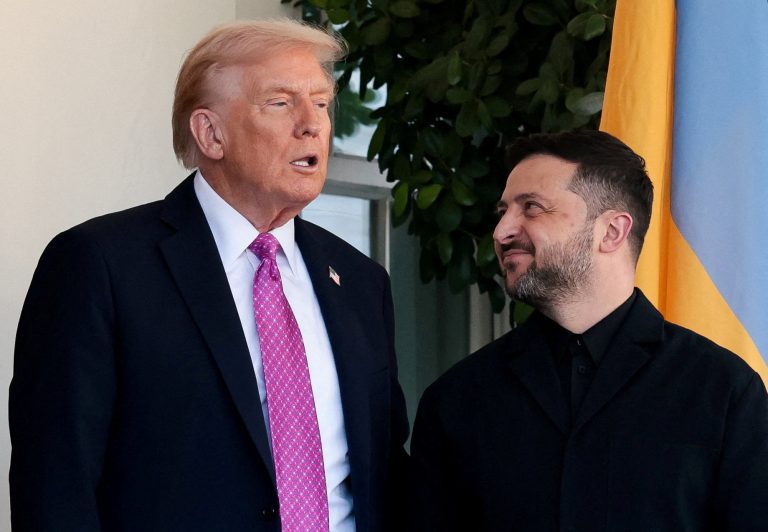
The presidents of the United States and Ukraine, Donald Trump and Volodymyr Zelensky, met at the White House on Friday at 9:00 p.m. Washington time (Saturday 3:00 a.m. CET). Among other things, the aim was to negotiate the delivery of long-range weapons for Kiev's armed forces in the war with Russia.
Trump currently has no intention of providing Ukraine with Tomahawk long-range missiles, as he prefers diplomacy, the Axios portal wrote, citing two unnamed sources familiar with the content of the meeting. They stated that, according to Trump's own words, his priority is currently diplomacy, and he believes that supplying Tomahawks to Kiev could undermine this.
One of the sources stated that the meeting between the presidents was “not easy,” while another even described it as “bad.”
“No one shouted, but Trump was tough,” said one source. At times, the conversation was “a little emotional,” they added.
Zelensky described the meeting with Trump as ‘productive’ and thanked him and his team. They also discussed security guarantees for Ukraine, air defense, and drones. The White House chief described the meeting as “very interesting and cordial.”
The Ukrainian president believes that the most sensitive and difficult issue in any negotiations with Russia will be the territories. Ukraine wants a ceasefire first and then negotiations, which Trump understands.
He acknowledged that he is ready to meet with Putin in “any format.” He is open to bilateral and trilateral meetings. “I am open to any format that can bring us closer to peace,” Zelensky said.
At the same time, he confirmed that after the conversation with Trump, he spoke with “strategic partners” in Europe from the so-called coalition of the willing, whom he thanked for their support. Among others, he mentioned European Commission President Ursula von der Leyen, Italian Prime Minister Giorgia Meloni, British Prime Minister Keir Starmer, and NATO Secretary General Mark Rutte.
Trump: The war would never have started if I were president
Trump also appealed for an end to the Russian-Ukrainian conflict in a post on social media. “I told him (Zelensky), as I have strongly recommended to President Putin, that it is time to stop the killing and make a DEAL! Enough blood has been shed,” he wrote.
He called on Ukraine and Russia to stop “where they are.”
"Let both declare themselves victors, let history decide! Enough with the shooting, enough with the killing, enough with the enormous and unsustainable spending. This is a war that would never have started if I were president. Thousands of people are being killed every week – ENOUGH IS ENOUGH, GO HOME TO YOUR FAMILIES IN PEACE!“ Trump concluded.
Zelensky had agreed shortly before that both sides must stop, but in his opinion this is a matter for Vladimir Putin, ”because we did not start the war."
When asked if he believed in the White House chief's ability to put pressure on the Russian president, Zelensky replied: “We are aware of all the signals from the Russians, they are not new, but we are relying on the president (Trump) and his pressure on Putin to end this war.”
On the issue of Tomahawks, Zelensky is a realist
Discussions about the delivery of Tomahawk missiles have been going on for two weeks, with Trump initially stating that he would make them available to Ukraine if Russia was not ready for peace negotiations. However, he later backtracked and, according to local commentators, “signaled” that he had doubts.
Zelensky has now calculated how many Tomahawks the Ukrainians need and planned to present Trump with this list of missiles (and other weapons) during his visit. To ensure that everything does not depend solely on the agreement between the presidents, Prime Minister Yulia Svyrydenková and her delegation met with representatives of the arms giants Raytheon and Lockheed Martin on Wednesday.
Raytheon manufactures Tomahawks, while Lockheed is the manufacturer of the F-16 and F-35 fighter jets.
According to Zelensky, the heads of state agreed at their meeting not to speak publicly about the deliveries for the time being. “Of course, we also talked about long-range missiles, but I don't want to comment on that because we agreed not to talk about it. The United States does not want an escalation, so I will not comment on that,” Zelensky said at an impromptu press conference after the meeting.
According to the Ukrainian head of state, the Tomahawk missiles will be negotiated, and Zelensky is “realistic” about the issue of their delivery. Russia fears that Ukraine could acquire these missiles and is therefore taking measures to prevent this.
“I believe that Russia is afraid of the Tomahawks. It is really afraid because it is a powerful weapon. And they know what we have, what kind of weapons we have, they understand the combination with the Tomahawks... And that is why they fear this combination. They understand what we are capable of,” Zelensky said.
Doubts and accusations
Last week, Trump expressed doubts about how the Ukrainians intend to use the Tomahawks that were originally promised. Missiles with a range of 2,500 kilometers could lead to a further escalation of the war, as Russian President Vladimir Putin has also pointed out. He said of the discussions about the deliveries that this could “destroy” relations between Moscow and Washington.
The Trump administration in particular has rendered outstanding services to the revival of these relations. After a period of “radio silence” during Joe Biden's term in office, talks between the leaders of the major powers were only resumed in February this year. The first negotiations in the Saudi Arabian capital Riyadh were led by Foreign Ministers Sergei Lavrov and Marco Rubio.
At the beginning of the month, it was confirmed that the US would provide Ukraine with intelligence information for the targeted attack of targets in Russia, in particular energy infrastructure such as refineries and oil pipelines.
Trump suspended the sharing of intelligence information on March 5, but lifted this measure after five days. Apart from this interruption, Kiev can therefore continue to rely on information from the American intelligence services.
Kremlin spokesman Dmitry Peskov said that the US and NATO already regularly provide Ukraine with intelligence information. “It is obvious that the entire infrastructure of NATO and the United States is being used to collect and transmit intelligence information to the Ukrainians,” he added.
Summit meeting of the major powers to take place in Budapest
Putin and Trump held a telephone conversation the day before Zelensky's arrival in the US, in which they agreed to continue talks at the highest level. Following the summit meeting in Anchorage, Alaska, the talks are to continue with our southern neighbor.
Hungarian Prime Minister Viktor Orbán responded almost immediately with a statement that Budapest was “ready” to host such a meeting. Trump himself, according to his own statements, proposed negotiations in Hungary to Putin, as Orbán had refused to enforce the arrest warrant issued by the International Criminal Court (ICC) in The Hague, as he had done during the visit of Israeli Prime Minister Benjamin Netanyahu.
Putin's foreign policy adviser Yuri Ushakov later clarified to the media that the call between the presidents had been initiated by the Kremlin chief. It was a response to the announcement of the delivery of Tomahawk missiles, to which Zelensky later remarked that Moscow was “frightened.”
(reuters, sab, luc)