
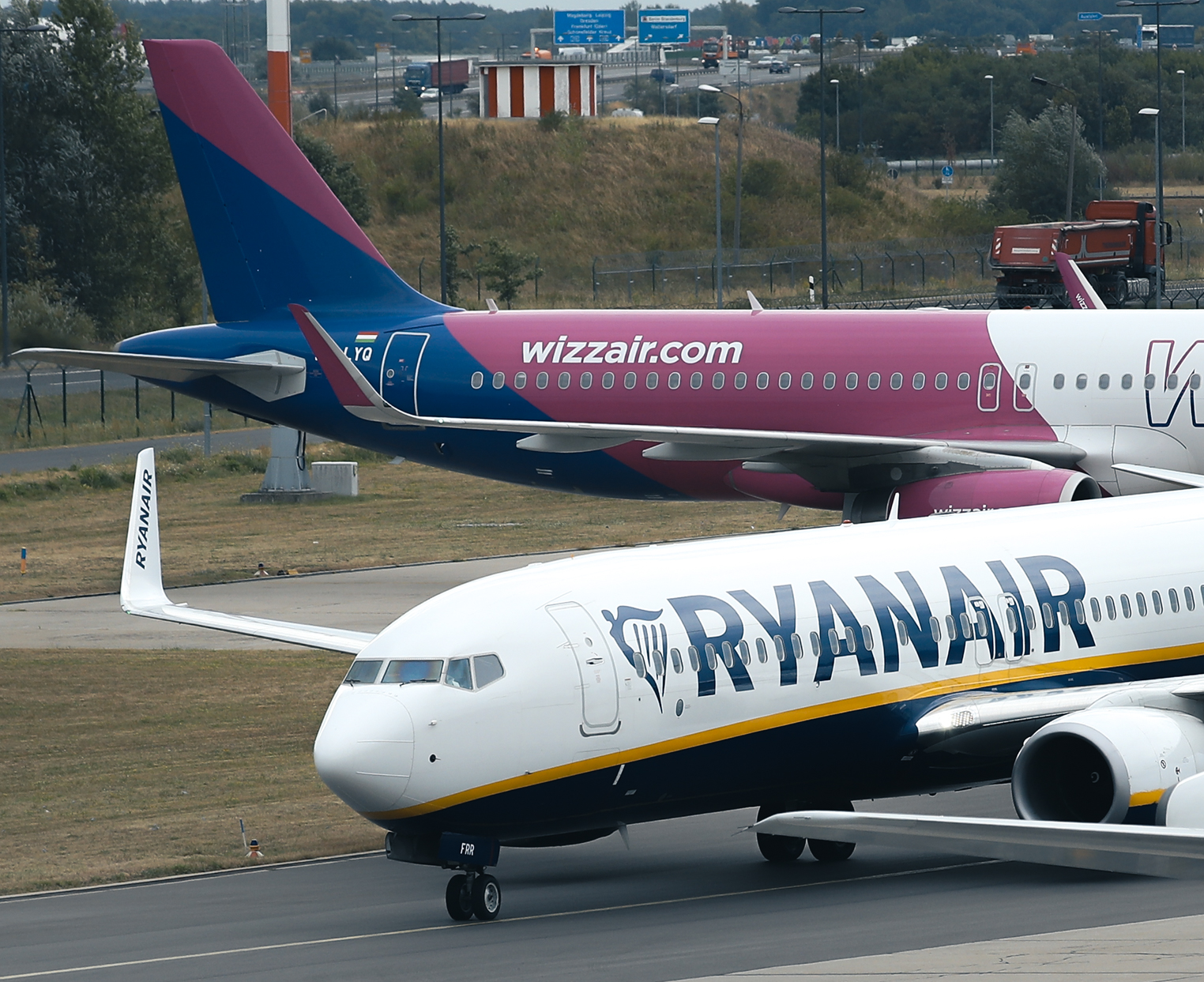
Passengers at Bratislava Airport can now also benefit from the competition between long-standing rivals Wizz Air and Ryanair, with dozens of new scheduled flights to choose from across almost the whole of Europe. This includes the resumption of the domestic connection between Bratislava and Košice.
Following the establishment of the Wizz Air base and the massive expansion of flight destinations, the number of passengers at the Slovak capital's airport is expected to rise from the current two million per year to three to four million next year.
The Hungarian airline will operate a total of 27 scheduled flights from Bratislava after the gradual introduction of further connections. This is more than has ever been offered by a single carrier before. This will also be made possible by the discontinuation of flights from Vienna Airport until March 2026.
Withdrawal from Vienna Airport
Wizz Air will gradually close its base at Vienna Airport following a review of its operations. The reason for this is the high costs. Two aircraft will be withdrawn and two routes to Bilbao and London Gatwick will be discontinued on October 26, 2025. The three remaining aircraft and the remaining routes will be discontinued on March 15, 2026. Austrian travelers can continue to use the routes from Bratislava and Budapest.
Wizz Air opened its base in Vienna in 2018, from where it operates 28 routes to 20 countries with five Airbus A321neo aircraft. Since then, according to the airline, costs and taxes have risen significantly.
“Given Wizz Air's strategic focus on expanding its key markets in Central and Eastern Europe and offering low fares, operating from Vienna is no longer compatible with the airline's ultra-low-cost business model,” Wizz Air recently announced.
Wizz Air takes the lead from Ryanair
“This is the largest expansion of a single airline in the history of Bratislava Airport. Wizz Air will become the largest airline in Bratislava, taking the lead from Ryanair,” comments Ivan Hajník from the Letectvosr.sk portal, which focuses on civil aviation.
According to Hajník, this means improved economic results for Bratislava Airport thanks to a higher number of arrivals and departures and, consequently, an increase in revenue from airport and other fees. The number of passengers could reach up to five million per year within two years, which is the airport's capacity limit.
“This could also make the airport more attractive to other airlines that have previously avoided Bratislava. For passengers, this means a significant expansion of the range of destinations on offer, so they no longer have to travel to Vienna or Budapest,” Hajník expects.
Base and new routes from October to March
“From an operational perspective, we are preparing to manage the growth smoothly and safely. We expect to handle a historic record number of three to four million passengers next year,” said Dušan Novota, CEO of Bratislava Airport.
Wizz Air will add flights to Bucharest to its two existing routes from Bratislava to London Luton Airport and Skopje starting October 28. After opening its base on November 14, the airline will initially fly from there to Barcelona, Malaga, Lamezia Terme, Varna, and Plovdiv with two Airbus A321neo aircraft with a capacity of 239 passengers.
The airline will launch its domestic connection between Bratislava and Košice on November 21 and will operate nine times a week, including twice daily on Mondays and Fridays. Flights to Athens, Oslo, Alicante, Basel, Palermo, Naples, and Niš will be offered starting December 15.
The next phase of Wizz Air's expansion from Bratislava Airport will take place early next year, when the fleet will be expanded by two more aircraft. At the same time, connections to Larnaca and Chisinau will be added from January 12, 2026.
Flights to Tirana, Berlin-Brandenburg Airport, and Rome Fiumicino Airport will be offered from March 16, to Dortmund, Tel Aviv, Pristina, and Ohrid from March 17, and to Tuzla and Warsaw F. Chopin Airport from March 29. Tickets for the new routes are already on sale.
Direct competition lowers prices
Wizz Air and Ryanair are long-standing competitors. According to Hajník, this could be good news for travelers, as direct competition usually pushes down airfares. Both airlines will compete directly with each other on eight routes – to Athens, Lamezia Terme, Naples, Palermo, Rome, Alicante, Barcelona, and Malaga.
“In the short term, this will be beneficial for passengers, but in the long term, such an oversupply of seat capacity is not sustainable given the demand. It is likely that one of the two airlines will have to adjust its offer,” Hajník predicts.
Ideally, the airlines would complement each other and not compete directly on the same routes. It is difficult to predict who will be more successful in Bratislava. “Wizz Air is known for its flexibility and ability to respond quickly to market changes – it adjusts flight frequencies, cancels or adds routes even during the season,” explains Hajník.
Ryanair, on the other hand, is a traditional airline with a long-standing base in Bratislava, where it has been operating for twenty years. The next few months will be very interesting in terms of how the competition develops.
Wizz Air may reconsider the routes
Some new routes, such as those to Tirana, Ohrid, Tel Aviv, Pristina, and Chișinău, were simply transferred from the closed base in Vienna. Passengers are likely to remain regardless of whether they land in Bratislava or Vienna.
“In contrast, routes to Berlin or Dortmund are questionable, as similar connections have not been successful in the past despite low ticket prices. Personally, I expect Wizz Air to reconsider its flight offerings from Bratislava and we can expect changes in the future,” adds Hajník. In his opinion, however, the situation is evolving and passenger preferences are also changing.