
The telephone conversation between Trump and Putin and the subsequent agreement by Kiev and European capitals to freeze the front line have raised hopes in recent weeks that peace in Europe can be restored. However, despite the West's efforts to find an acceptable solution, the fighting continues and the Kremlin is rejecting the summit in Budapest for the time being.
On Moscow's part, this seems rather hypocritical. The allies have presented a compromise proposal that is relatively lucrative for Russia. Essentially, this would mean that Russia would be allowed to keep the conquered territories, and although the Western world would (probably) not recognize them as part of Russia de jure, this is a major concession to the original maximalist positions of Ukraine and the Western hawks.
Russia has insisted on its position since the summit in Alaska, although it has made a small step—it is willing to cede to Ukraine the territories in the Kherson and Zaporizhzhia regions that it had previously claimed. However, apparently only those that the Russians have not conquered.
A peacemaker who imposes sanctions
Although Trump has many faults and his actions in the White House are painful for Europeans (trade war, pressure to rearm, abandonment of American responsibility for the war), he does not refuse to meet with the (Ukrainian) enemy and opts first for dialogue and only then for forceful measures.
Although he presented himself as a hawk and followed in Biden's footsteps, he did so in a more sophisticated way. He showed that he understands the Russians and realistically assesses Ukraine's weaker position, moved the chess piece and let Putin play.
And when the Russian president postponed the summit in Budapest on the grounds that he did not want to discuss freezing the front, he was able to impose relatively harsh sanctions on the Russian energy sector without his political opponents (and probably Putin himself) questioning his intention to achieve peace in Ukraine.
It is still unclear who will make the next move. The rejection of the summit is, for the time being, a clear signal that any possible compromise must be even more advantageous for Moscow, otherwise it will opt for war.
Bet on the fall of Pokrovsk
However, given the dynamics on the front lines in recent weeks and months, Moscow's unwillingness to negotiate is not so surprising. Although the Russian advance is slow overall, the Ukrainian line of defense could soon collapse significantly.
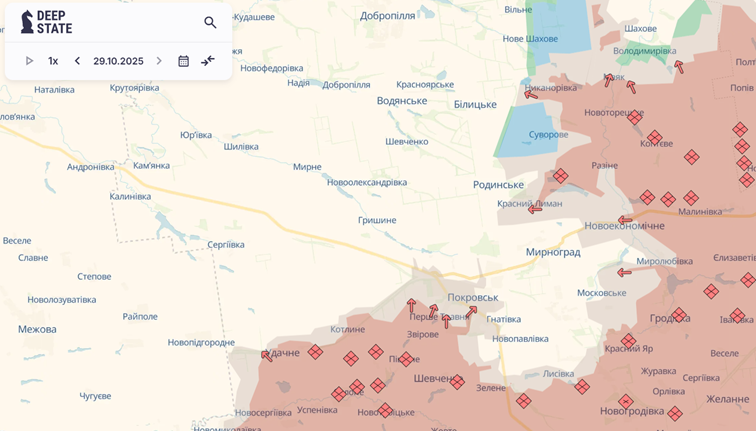
According to analysts from the Ukrainian group DeepState, numerous groups of Russian soldiers are already advancing on the strategically important city of Pokrovsk. The same is happening in the similarly sized city of Myrnohrad, which is closely linked to Pokrovsk. Analysts claim that the attackers are succeeding in disrupting supplies to the defenders in the cities.
The Kremlin even claims that the army has already surrounded the agglomeration and cut off thousands of Ukrainian soldiers from food, water, and weapons and ammunition supplies, but Kiev has so far denied this.
Although it is unlikely that there are still so many Ukrainian soldiers in the region, the noose is clearly tightening around both cities. The retreat route for the defenders has narrowed critically, and the capture of the city by the Russians is likely to be only a matter of weeks.
In the words of the DeepState group: “The situation in Pokrovsk is approaching a critical point and continues to deteriorate to such an extent that it may soon be too late to change anything.”
Putin may therefore have decided to buy time. Even if the fall of the city would probably not mean the destruction of the Ukrainian army's personnel capacity, it is still a strategic point on the front line. Its capture would open the way for the Russians to advance more quickly westward into the Dnipropetrovsk region and to the largest cities still held by Kyiv in the Donetsk region – Kramatorsk and Sloviansk.
However, military bloggers also point out that the capture of the city would not necessarily mean the collapse of the Ukrainian defense, which would simply retreat to a fortified line of defense stretching several kilometers behind Pokrovsk.
It is precisely because of this network of extensive fortifications that the rest of the Donetsk region held by the Ukrainians is particularly valuable. Not only for Moscow, of course, but also for Kyiv, which currently means a stalemate and the postponement of hopes for a speedy peace. After all, Trump also stated on Thursday that the conflict was at an impasse and that it was possible that the parties would have to “fight it out.”
Since the Kremlin's goal is to conquer the entire Donbas, it currently seems convinced that capturing Pokrovsk will give it a stronger bargaining position in the negotiations. And if the army advances beyond expectations, it may not have to make any compromises at all.