
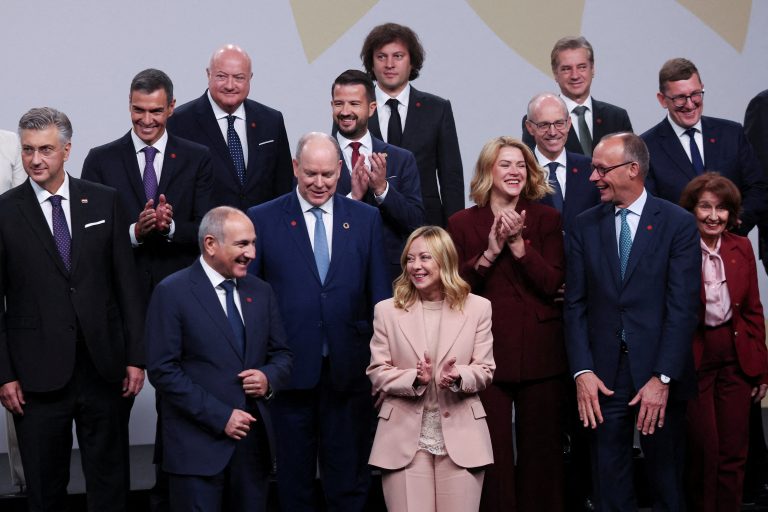
Armenian Foreign Minister Ararat Mirzoyan stated in an interview with Deutsche Welle in the second half of October that his country would soon apply for membership in the European Union. “Maybe next month, maybe next year... As I have already said, this is our official policy,” the foreign minister said.
"Maybe next month, maybe next year... But as I have already said, this is our official policy,“ said the foreign minister.
EU Foreign Affairs Representative Kaja Kallas praised Armenia's determination to implement democratic reforms in the country back in June this year, stating that the EU was ready to deepen its partnership with this Caucasian republic ”in all areas," including security and defense.
Armenian Prime Minister Nikol Pashinyan announced in June last year that the country would leave the Russian-led Collective Security Treaty Organization (CSTO). At the same time, he accused the members of the military alliance of conspiring against his country during the conflict with Azerbaijan.
Armenia had already suspended its membership in the CSTO in February 2024, with the prime minister citing the alliance's failure to support Armenia as the reason. A month later, Pashinyan said his country would leave the alliance if the security bloc did not commit to supporting Armenia's security in a satisfactory manner.
“We will leave. We will decide when we leave... Don't worry, we won't come back,” Pashinyan said on Wednesday.
It is unclear
Relations between Yerevan and Moscow deteriorated in September 2023 when Russian peacekeeping forces did not intervene in Baku's blitz offensive against ethnic Armenians in Nagorno-Karabakh.
Azerbaijan subsequently gained control of the Armenian enclave, leading to the mass exodus of around 100,000 Armenians.
During the offensive, which claimed around 400 lives, Azerbaijan, with Turkish support, used heavy artillery fire, rocket launchers, and drones against the Armenians.
The conflict in this mountainous region had been simmering since the late 1980s and escalated from time to time. Nagorno-Karabakh enjoyed de facto independence for three decades until Baku gained full control of the territory in 2023.
This was confirmed by the peace agreement reached in August 2025 on the initiative of US President Donald Trump. However, the peace agreement has yet to be signed.
Pashinyan accused at least two unnamed members of the military alliance of apparent collaboration with Azerbaijan in connection with the 44-day war between Azerbaijan and Armenia in 2020. He called on some Russian personnel stationed in Armenia to leave the country.
Although Russian “peacemaker” troops were withdrawn from Armenia shortly after the war, Armenian Parliament Speaker Alen Simonian confirmed on September 11 this year that the 102nd Russian military base of the Order of Alexander Nevsky would not be withdrawn from Armenia for the time being.
“We are not discussing this issue at the moment, we have not held any talks on it,” Simonian said of the base with garrisons in Yerevan and Gyumri, which houses about 4,000 Russian soldiers and a variety of military equipment, including aircraft.
Despite the threats and the sense of injustice, Armenia has not yet left the Collective Security Treaty Organization.
The Armenian prime minister has also been in the Georgian capital for several days and, according to available, verified information, he stayed with Bidzina Ivanishvili, the prime minister there, against whom “pro-European” Georgians have often protested as “pro-Russian.”
However, changes are noticeable
Despite the uncertainty or—in the long term—slow change of course, it is clear that the country's reorientation is a clearly defined goal of the government.
In February last year, Pashinyan declared that his country could no longer rely on Russia as its most important partner in the defense sector. In his opinion, Yerevan should consider closer security ties with other countries such as the US, France, India, or Georgia.
He added that this had not been a problem before, as 95 to 97 percent of Armenia's defense relations had been with Russia. However, this was no longer possible “for objective and subjective reasons.”
Finally, the prime minister's statement was put into action when a joint eight-day military exercise took place in August this year between members of the Armenian Peacekeeping Forces, the US Army in Europe and Africa, and the Kansas National Guard.
At the end of August, a few days after the exercise ended, Pashinyan declared that Armenia could withdraw from the Moscow-based Eurasian Economic Union (EAEU) in connection with its efforts toward European integration.
This followed on from the Armenian president's decision in April this year – Vahagn Khachaturyan signed a law passed by parliament on the country's efforts to become part of the European Union.
At the same time, he was responding to the words of Russian Foreign Minister Sergey Lavrov, who had pointed out to Yerevan that it could not be part of two economic communities. Moscow also stated that it considered the passed law to be the informal beginning of the country's withdrawal from the EAEU.
Kremlin spokesman Dmitry Peskov made a similar statement at the time, saying that Armenia could not join the EU as long as it was a member of the Eurasian Economic Union.
After the law was passed, Pashinyan made it clear that the legal regulation alone was not sufficient for EU accession. The decision on this “can only be made by referendum.” This has not yet happened in Armenia.
Until this happens, the relationship between Brussels and Armenia will be based on the Partnership and Cooperation Agreement, which has been in force since 2021. The EU is also an important partner for the reform program in Armenia and its most significant supporter.