
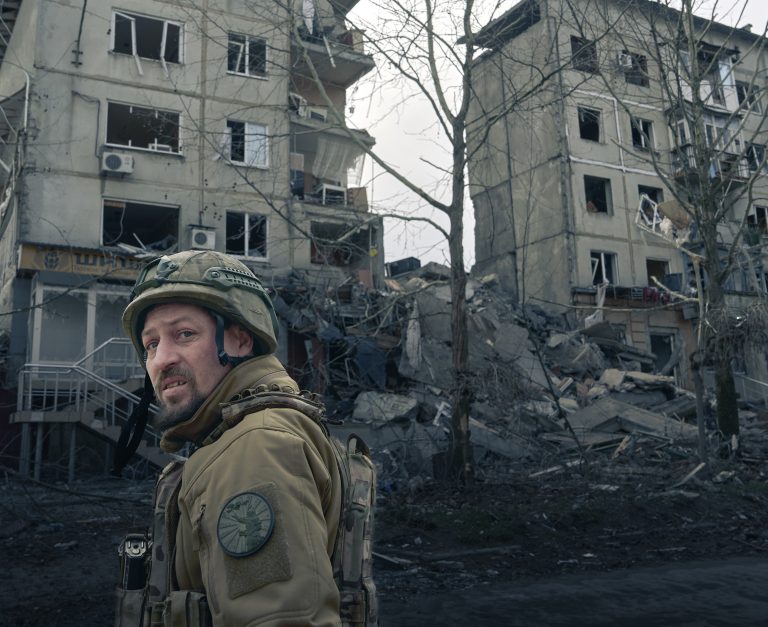
On 6 November, the Russian Ministry of Defence announced that the Russians in Pokrovsk had advanced and were waging street battles for every house in an attempt to push Ukrainian forces out of the city for good. Ukraine, in turn, is fighting to regain key high-rise buildings to ease the situation for enemy-encircled troops in the southern part of the city.
Mykhailo Kmytyuk, the commander of the separate detachment of unmanned special-purpose systems "Typhoon", told the Economist on the evening of 6 November that the Russians hold at least 60 per cent of the city, and the rest of it - that is, the northern part - is in a grey zone.
The Kremlin is aware of the strategic advantage derived from the eventual capture of the city, which the Russians call "the gateway to Donetsk." The city would provide a platform for Russian forces to advance north towards the two largest cities of the Donetsk region still under Ukrainian control - Kramatorsk and Sloviansk.
Let us recall that Ukraine still controls approximately ten percent of the territory of Donbas, consisting of Luhansk and Donetsk oblasts - that is, approximately 5 thousand square kilometres. The rest is under occupation for the time being.
The Financial Times (FT) points out that Pokrovsk was an important transport and logistics hub until 2024 - when the fighting in its immediate vicinity began - and its loss could be a serious loss for Ukraine, while it would open the way for the Russians to take new lines of attack.
According to the FT, Russian President Vladimir Putin has set the Russian military the task of capturing the city by mid-November. The Kremlin has generally stepped up operations in the Donetsk region in a bid to achieve a breakthrough on the front following the failed peace initiatives of US President Donald Trump.
Putin would use the capture of Pokrovsk to "influence" his American counterpart and convince him of "the inevitability of victory and the futility of aid to Ukraine," Mykola Bieleskov, a research fellow at the National Institute for Strategic Studies and senior analyst at the Ukrainian nonprofit Come Back Alive, told the Washington Post.
New Bakhmut
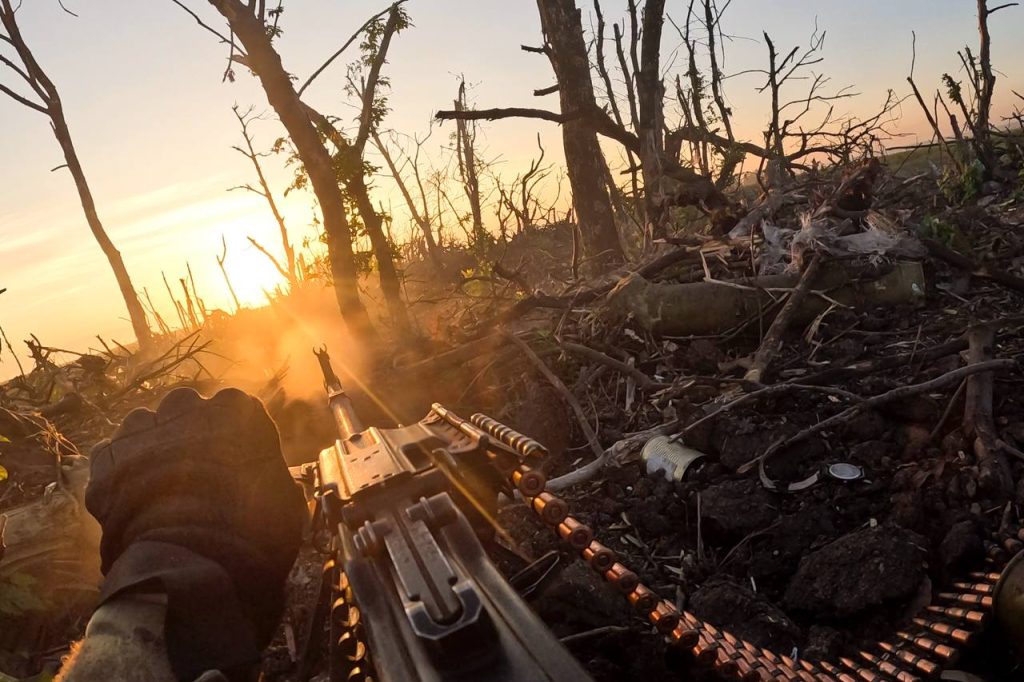
Several specialists on both sides of the front say that Pokrovsk is experiencing the fiercest fighting since the Battle of Bakhmut. Russia has been threatening Pokrovsk for more than a year, but instead of the massive frontal assaults it used to capture the town of Bakhmut in 2023, it is trying to pin Pokrovsk in a pincer, threatening supply routes and infiltrating the town itself with small groups of soldiers.
"They mainly send ambush parties of three to four soldiers - small groups, sometimes individuals. The biggest problem, though, is that almost all of them go in a continuous mode - it's an endless wave. They're looking for opportunities to infiltrate the city. Another thing is that many of them are disguised as civilians," says Ukrainian military analyst Olexandr Kovalenko.
Kiev has acknowledged that the situation in Pokrovsk has become more complicated in recent days, but says its troops are still fighting there and denies they are surrounded. However, Kovalenko reminds that Russia is heavily outnumbered in the area.
The Kremlin says its troops have captured 64 buildings in Pokrovsk in the past 24 hours and repelled Ukrainian attacks from Hryshyn in the western suburbs. In addition, Russian troops in the area are only a few kilometers short of completing a pincer attack around Pokrovsk and neighboring Myrnohrad, and will be successful.
At the same time, Russian troops are also closing in on Ukrainian forces in Kupiansk in the Kharkiv region, but for now the priority for both sides is Pokrovsk. "If Pokrovsk falls, Myrnohrad will also fall and the area will be sealed off," wrote American analyst Michael Kofman, a senior fellow at the Carnegie Endowment, on the social network X.
"The city has operational value. Its loss extends the Russian axis of advance in the Donetsk region west of the conglomerate of towns around Kramatorsk, but does not open up the possibility of a quick conquest of these towns," the analyst concluded. Already on November 3, Russian infiltration groups were noted in all parts of the city.
Successful Russian tactics
Although reports from Kiev and Moscow during the climactic phase of the battle for the city diverge fundamentally, a more objective picture can be offered by people who have been on the ground for a long time and have no reason to misrepresent the state of the situation. For the time being, Moscow and Kiev agree in principle only that heavy fighting is taking place in and around the city.
The charity PERUN - Czechs in Ukraine, whose members are present directly on the front lines, has already reported on several occasions on what is happening on the front, contrary to the official position of Kiev or the non-Russian media. On 5 November, the fund published its own analysis of events on the front.
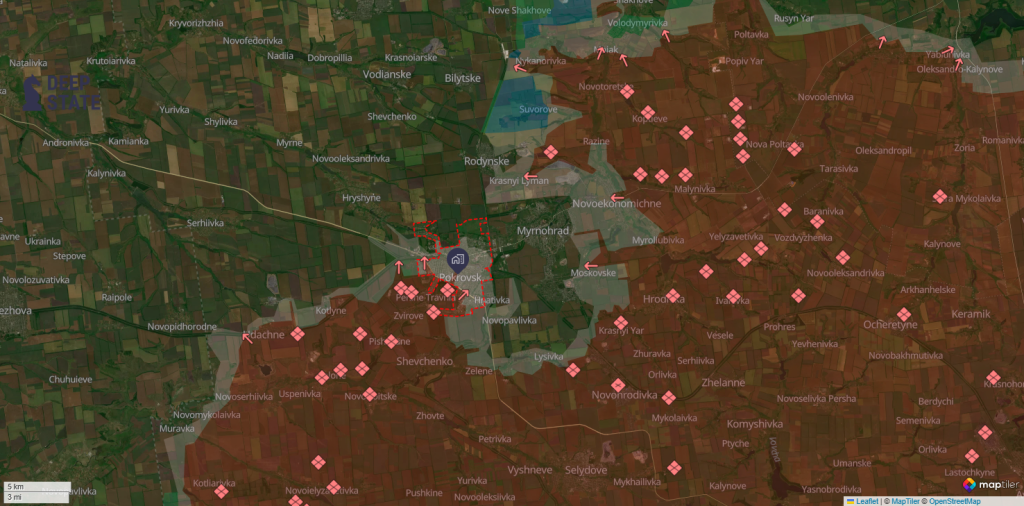
The charity's analysis states that the Russian tactics of small rogue groups - applied for several months now - are celebrating success: an entire urban area has turned into a grey zone even before Russian or Ukrainian bloggers have described it as occupied.
"Official maps are inherently late indicators. Russian tactics are expanding the grey zone much faster than conventional tactics would allow. This dissolution of the front, not just its shift, is the real manifestation of the accelerating decline of Ukraine's defenses," PERUN - Czechs in Ukraine reports.
According to the fund's data, Ukrainian soldiers continually point out that the area the maps consider to be a grey zone is in fact often territory already firmly held by the Russians, with the grey zone sometimes starting miles from their positions.
Russian forces in the area are estimated at over 100 thousand troops, while an estimate of the number of Ukrainian troops is lacking, although there is talk of Russian outnumbering them by a ratio of 8 to 1 or more. The eventual withdrawal of Ukrainian forces from the closing cauldron makes the deployment of huge numbers of FPV drones by Russian forces impossible.
"All access roads to Pokrovsk are under complete air control. Every - indeed every - vehicle is under attack by Russian suicide drones," the Czech Fund said on its social network. If Pokrovsk falls, it will be the largest city Russia has conquered since the fall of Bakhmut.