
On November 1, a direct flight from Caracas, Venezuela, landed in St. Petersburg for the first time in history. The plane flew 9,000 kilometers with a single stopover in Varadero, Cuba, to refuel.
After landing with 152 passengers on board, the pilots hung Venezuelan and Russian flags from the aircraft, and the Russian side welcomed the crew with bread and salt. Until there is increased interest in the flight, the aircraft will fly twice a month from Pulkovo Airport to Simón Bolívar Airport in Venezuela.
Sergey Melik-Bagdasarov, Russian Ambassador Extraordinary and Plenipotentiary to Venezuela and the Republic of Haiti, called the new air link an "air bridge" that will connect the hearts of the Russian and Venezuelan people.
It doesn't end with flights
In connection with US military operations in the Caribbean and the eastern Pacific, which are aimed at drug smugglers and have already claimed more than sixty lives, Kremlin spokesman Dmitry Peskov said on November 4 that Moscow is "in constant communication" with Caracas.
The Russian Federation (RF) Ministry of Foreign Affairs, in turn, expressed its support for Venezuelan President Nicolás Maduro, whose current presidential term is not recognized by Washington, which accuses him of involvement in drug trafficking and of financing the left in neighboring countries.
Although US President Donald Trump announced on November 3 that the White House does not intend to invade Venezuela, Caracas is leaving nothing to chance: it has set up an informant app to identify citizens dissatisfied with the regime and, according to the Washington Post (WP), has requested military assistance from its allies.
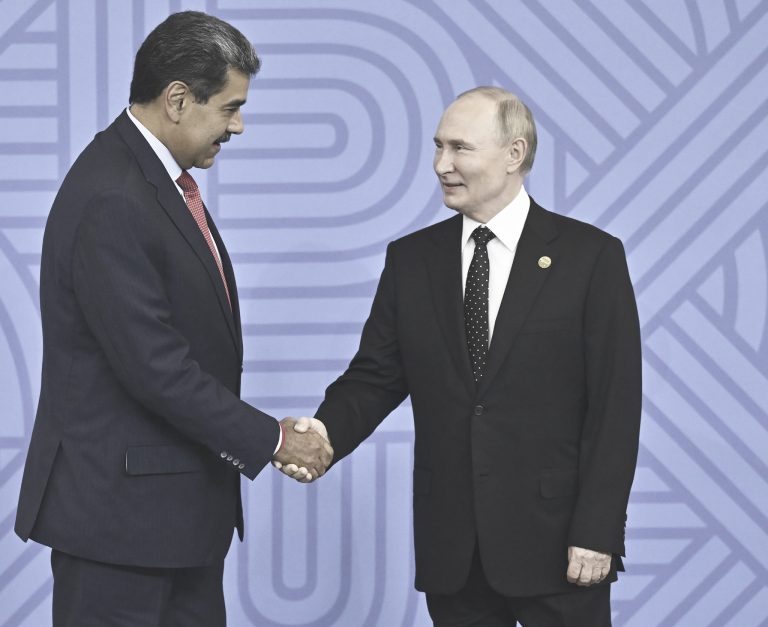
During their visit to Moscow in May, Maduro and Putin signed a strategic partnership agreement, which came into force in October, but according to available information, the agreement does not include military support. Regardless of this, according to the WP, the Venezuelan leader turned to Russia, China, and Iran in connection with the new Caribbean crisis: he reportedly expressed interest in drones with a range of 1,000 kilometers, radars, and missiles.
Ideological proximity
"In a letter [to Beijing, ed.], Maduro emphasized the seriousness of US aggression in the Caribbean and portrayed US military actions against Venezuela as actions against China, given their shared ideology," the WP reports. However, it is not just left-wing ideology that Caracas and Beijing share. The ideological framework of Russian-South American relations transcends the left-right divide.
Following a significant deterioration in relations with the West caused by Russia's invasion of Ukraine, Moscow began to deepen relations with those countries of the global South whose ideology is based, among other things, on the struggle to weaken the influence of the "collective West" and to create a new world order or multipolar world.
"We call for more active and meaningful participation by countries with emerging economies, developing and least developed countries, especially from Africa, Latin America, and the Caribbean in global decision-making processes and structures," states the declaration of the 16th BRICS summit held in Kazan, Russia, in October 2024. In addition to the member countries, nearly 30 non-members, including Venezuela, Nicaragua, and Bolivia, also participated in the summit.
While the Kazan Declaration (published in Russian and English) is primarily outward-looking, the Kremlin is also sending signals to its own population: either through well-known faces on state television, such as Vladimir Solovyov and Margarita Simonyan, or through Alexander Dugin.
"Many people do not fully understand the significance of our war, but we are defending a different world order: a just, honest one based on traditional values," Dugin said in January at a state-organized forum, adding that Russia is fighting in Ukraine "both for itself and for those boys: Chinese, Indian, Muslim, African, and Latin American boys."
As the current ideologue of the Eurasian movement in the service of the Kremlin, Dugin is campaigning on the domestic scene for China "under the leadership of the great leader Xi Jinping" and South America "in its anti-colonial struggle" to fight alongside Russia to weaken the position of the "collective West."
In line with Dugin, who presents the ideology of Moscow's alliance with the global South to Russian citizens, the BRICS countries as a whole, through the Kazan Declaration, also profess their support for the power efforts of third world countries, which should lead to the weakening of the "collective West" and the strengthening of Russia and the global South.
In addition to the "necessity of activating the fight against racism, racial discrimination, xenophobia and related intolerance," the BRICS countries also recognized at their penultimate summit "the legitimate efforts of African countries, enshrined in the Ezulwini Consensus and the Sirte Declaration" and "the legitimate efforts of developing countries in Asia and Latin America."
Tangible measures
However, alliances are not built on ideology alone. Russia's presence in South America builds on the Soviet tradition and is not limited to the BRICS grouping. For now, the only South American member of the group is Brazil, which does not want to spoil its relations with Washington for the sake of its membership.
Rio de Janeiro is thus balancing between two blocs, one of which it even chairs this year, under the slogan "Strengthening cooperation in the global South for more inclusive and sustainable governance."
Instead of Brazil, Moscow is therefore placing emphasis on Venezuela, Cuba, Bolivia, and Nicaragua. At the end of last year, Russian Chief of General Staff Valery Gerasimov declared that these countries are "strategic partners" of the Kremlin.
Former Defense Minister and current Secretary of the Security Council of the Russian Federation Sergei Shoigu clarified in May that Venezuela is one of Moscow's key allies and that it is necessary to resume the five-party Russia-Venezuela-Cuba-Bolivia-Nicaragua talks.
While China, a member of BRICS and Russia's closest ally, will soon become South America's largest trading partner, overtaking the EU and the US, Russia has focused on cooperation in the field of intelligence and security policy, although it is also deepening cooperation in the field of nuclear energy and shipbuilding.
According to some Western analysts, Moscow sees Latin America as an area where it can weaken US influence through cheap energy supplies, defense cooperation, and political support for authoritarian regimes there.
It should be noted that at the end of October, shortly after the US moved an aircraft carrier strike group to the region, a Russian Ilyushin Il-76 transport aircraft from the Moscow region landed in Caracas after several stopovers in Asia and Africa.
This type of aircraft is capable of carrying up to 50 tons of material or 200 people. The coming weeks may show how far Moscow is willing to go in supporting its Latin American allies.