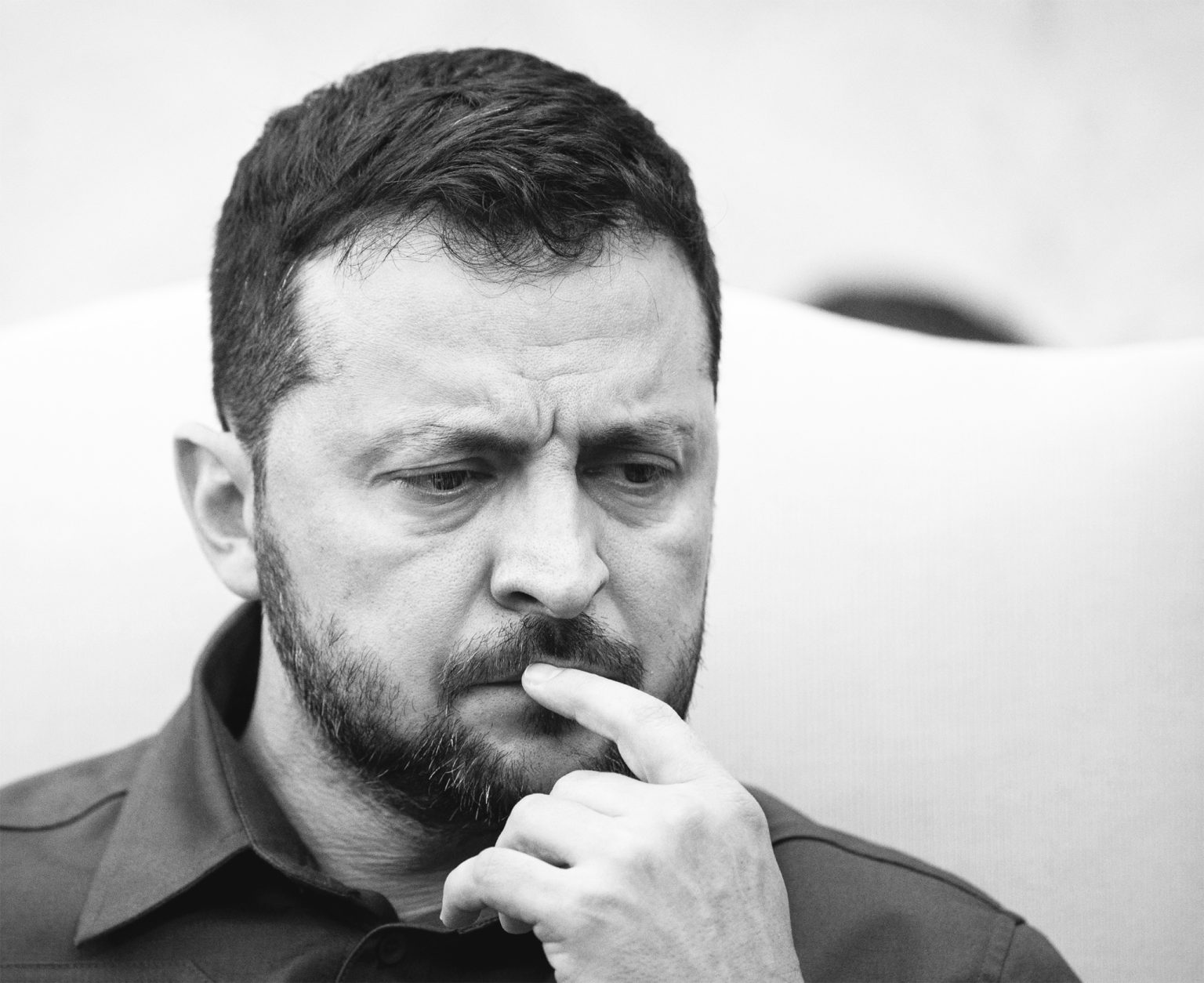
With winter approaching, which analysts say will be the harshest since the start of the war, the issue of repeatedly bombed energy infrastructure is coming to the fore—power plants and refineries owned by Ukrainian state-owned companies are targeted by Russian missiles and drones almost every night.
According to the US president, it is precisely the vulnerability of the civilian population that makes it necessary to accept the Russian-American conditions. However, if Zelensky, as the Ukrainian leader, agrees to them, he faces fierce domestic opposition from nationalists and part of the army.
The most frequently mentioned scenario is that this resistance would be led by the commander of the 3rd Army Corps, Andriy Biletsky. According to a source in Standard, he has "the greatest authority" to lead a coup, "and if he decides to do so, he has a very high chance of success," added an anonymous soldier in active reserve.
Bileckyj is one of Ukraine's prominent nationalists, also known as the founder of the Azov volunteer battalion, which grew into a regiment or brigade during the war and is now part of the Ukrainian ground forces. This fighter is the presumed leader of the armed domestic resistance against the president.
This is supported by the fact that he is not and has not been part of Zelensky's inner circle, which in recent weeks has been the target of allegations of widespread corruption. The former president's men, such as Timur Mindich and Olexandr Zukerman, have become the target of sanctions against "citizens of Israel," and former Justice Minister Herman Halushchenko has resigned.
Bileckyj did not benefit from the latest government reshuffle, which removed Denys Shmyhal from the post of prime minister and promoted Yulia Svyrydenkova, "Yermak's woman" – who, according to Ukrainian media, is a close ally of the head of the presidential office, Andriy Yermak.
If this alliance of Zelensky's loyalists accepted Russia's terms and withdrew from the unclaimed territories, the president's life could be at stake. This was most recently suggested in August by the well-known Ukrainian extremist Denys Sternenko.
A former member of the nationalist Right Sector association, who took part in clashes with pro-Russian separatists in the city of Odessa in 2014, said in an interview with the British daily The Times that if Zelensky were to cede territories that the Russians had not conquered as part of a peace agreement, "he would be a corpse—politically, and then physically."
The well-known British historian Peter Hitchens expressed a similar view in an interview with The Standard. In the interview, he recalled that even after the 2019 elections, in which Zelensky ran as a candidate for peace and a de facto supporter of the Minsk agreements, nationalists from Azov warned him against "capitulation."
"So I don't think he would have survived if he had tried to make peace. Any peace agreement he made that was realistic would have been labeled capitulation. I don't know what would have happened to him politically if he had done that," Hitchens said in the interview.
Is Zelensky's downfall approaching?
The July attempt by the Ukrainian president to restrict the independence of anti-corruption agencies sparked the largest protests since Maidan, hung a sword of Damocles over Kiev in the form of a European threat to suspend funding, and prompted an investigation targeting nuclear companies and oligarchs close to Zelensky.
Initially, the group of so-called "the president's men" in Ukraine mainly included businessmen from the film industry, such as the brothers Boris and Serhiy Shefir, the aforementioned Mindich, and the head of Zelensky's office, Yermak. However, after the publication of the Pandora Papers and the November investigation at Enerhoatom, they fell one by one—except for Yermak.
The co-founder of Inter TV is Zelensky's last "oligarch" and is currently one of the few people in the president's circle who is not the subject of a corruption investigation. His influence on the government cabinet, which in his case is slightly exaggerated, cannot be easily classified as a criminal offense, and he is not suspected of financial machinations.
Despite the fact that Yermak's influence has strengthened after the latest government reshuffle, Ukrainian sources unanimously told the British magazine The Economist that the chief of staff does nothing without the knowledge of his immediate superior. The power of the "almighty" Andriy Yermak is thus directly linked to Volodymyr Zelensky's political career.
And it is precisely this issue that is currently causing uncertainty. Zelensky's rule has so far been supported or at least "tolerated" by the aforementioned nationalists in the ranks of the Ukrainian army. However, if he were to agree to the game played by the United States and Russia, exchanging territory for peace or at least a truce, he would lose their support and, based on the aforementioned statements, could face an assassination attempt.
Zelensky's opponents, such as former President Petro Poroshenko and Kiev Mayor Vitali Klitschko, have long pointed to the president's "autocratic" tendencies. However, the West has not responded to these accusations and has continued to support Ukraine in its war with Russia.
It is therefore questionable what support Zelensky would receive in the event of a nationalist coup. The idea that, for example, the British secret service would escort him by helicopter from the presidential palace in Kyiv and take him to a secret location is not very realistic. On the other hand, theories have appeared on social media in the past that Ukraine's first couple owns residential buildings abroad, where they plan to flee.
To be fair, these claims have never been proven true and in some cases have even led to Russian propaganda. Zelensky allegedly bought a villa in Florida for $20 million, a hotel with a casino in Kyrenia in the unrecognized Turkish Republic of Northern Cyprus, and even Highgrove House, which British King Charles III allegedly sold to the president for £20 million.
Olena Zelenska did make a suspicious purchase of a three-bedroom designer apartment in 2013, but it is located on the occupied Crimean peninsula. In the event of fleeing from potential coup plotters, it would be highly unlikely that the Zelenskys would flee to territory unilaterally annexed by the hostile superpower that attacked Ukraine.
There are also documented cases of a member of Zelensky's Servant of the People party purchasing luxury residences in Dubai, and the president himself featured in the Pandora Papers scandal. In his case, it concerned ownership of companies in the British Virgin Islands and was not related to the purchase of real estate.
It was the Shefirov brothers, as partners in the Kvartal 95 film studio, who were also the main players in the Pandora Papers scandal, in which they transferred Zelensky's finances to offshore companies in the British Virgin Islands. It is therefore possible that they bought at least one property in his name as the end user of the benefits.
However, theories about his escape to some "villa in Israel," London, or anywhere else are still up in the air. As early as November 2022, information emerged that the house in Rishpon was owned by the president's parents. His father, Olexandr, and mother, Rymma, allegedly bought the property for $8 million, which turned out to be a false claim.
However, the threat of an armed uprising is real, and nothing would actually prevent Zelensky from buying an apartment on the spot after arriving in London, for example. In the past, it was common for heads of state to flee abroad after losing a war.
Let us recall that in the first week of November 1918, a general strike and a strike by shipbuilders in the ports of the Kriegsmarine military navy began in the city of Kiel. After General Erich Ludendorff's unsuccessful offensive, it was clear that the German Empire would lose the war, even though not a single Allied soldier had entered its territory.
It was the Kiel mutiny – which began on November 1 with the insubordination of German sailors – that marked the beginning of the revolution that overthrew the Hohenzollern imperial dynasty and established the system later known as the Weimar Republic. Emperor Wilhelm II fled to the Netherlands, even though he did not own any property in the neighboring country at the time.
Zelensky, on the other hand, could quite likely find refuge in Poland, from where he could head to Britain. It was there that former Prime Minister Boris Johnson, during one of his many visits to Kyiv, promised the president the unwavering support of the "collective West," which ultimately led to the rejection of the Istanbul framework for a peace agreement with Russia.
The Ukrainian leader will therefore likely soon begin reviving contacts with his "allies" who supported his side during the nearly four-year conflict. Even in the US, there are several benefactors from the neoconservative clique who would gladly host Zelensky.
People such as the son of the "godfather of neoconservatism" Bill Kristol, his colleague from the Project for the New American Century (PNAC) Robert Kagan with his wife Victoria Nuland, or his brother Frederick Kagan, founder of the Institute for the Study of War (ISW), and many others come to mind.
In any case, it remains to be seen which of Zelensky's moves will be unpopular enough with nationalists to cost him his seat—and, in extreme cases, his life.