Although there is currently no consensus, the mere possibility of Ukraine in the Alliance and the military presence of Western forces on its territory was enough for Moscow to provoke a war.
The Commission chief also drew red lines for Europe. According to von der Leyen, there can be no change of borders, i.e. no recognition of Crimea, Donbas and the lost territories in Kherson and Zaporizhia as de facto Russian.
However, her statement makes it seem as if it is Russia, which is retreating on the front line, that is asking for peace. And which is also demanding territory outside its control. However, anyone who has been following the fighting at least a little knows that the opposite is true.
Among the Ukrainians themselves, there was talk in early November of a collapse of the front. With the fall of Pokrovsk, Ukraine's defensive belt of strongholds will be eroded, the line may be significantly stirred up in the coming weeks in the Donetsk region, and soon Kramatorsk, Sloviansk, Komsantynivka and Druzhkivka, large towns that had a combined population of nearly half a million before the war, may be in the next cauldron.
The situation is also bad in the flat Zaporozhye region. And all this ahead of a winter that will be harsh and marked by prolonged power cuts, which will not only affect the morale of the Ukrainians, but also military production.
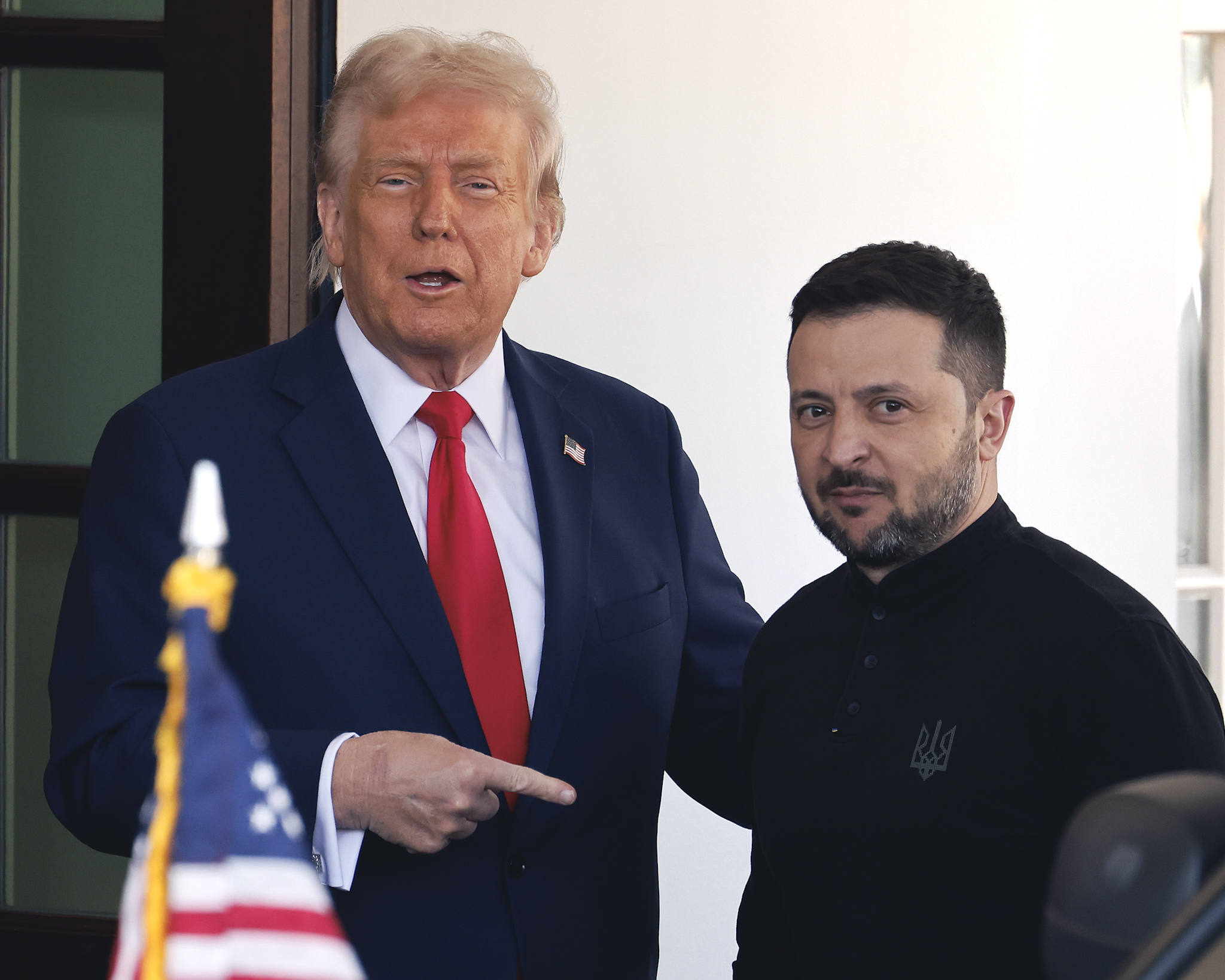
Donald Trump made it clear to reporters during a press conference aboard Air Force One: "The biggest concession" the Russians will make is that they will "stop fighting and not take more (Ukrainian) territory."
But the Old Continent, led by the Union's top leaders, cannot accept this. And it is content to declare that the starting point for negotiations is to be an improved 19-point framework.
Yet the original American one, which critics would say was pro-Russian, already contained some points that the Kremlin would have to pass with its eyes closed. For example, the part about using frozen Russian assets for Ukraine's post-war reconstruction. And that the Americans will make good money out of it.
While Moscow may regard these assets, worth hundreds of billions, as sunk costs that would be confiscated by European hawks if the war continued anyway, the idea that the side that wins (albeit slowly and expensively) will pay for the reconstruction of a defeated country is quite unprecedented.
In the end, the European peace effort was clinched by a statement from the Vice-President of the Commission. Kaja Kallas pointed out that 'if we want to prevent the continuation of this war, we should limit the Russian army and also its military budget'.
Well, for an official, albeit a senior one, of a political-economic grouping of states to dictate to (albeit the weakest) world power how it should approach security and budgetary issues is nothing short of a sigh.
Kallas has only shown that sometimes it is better to remain silent than to let out a comment worthy of a 19th century poetic dreamer. Which not only does not help anyone and is more likely to distance Ukraine from peace, but also reveals the shallow thinking of a large part of the European elites in all its nakedness.