
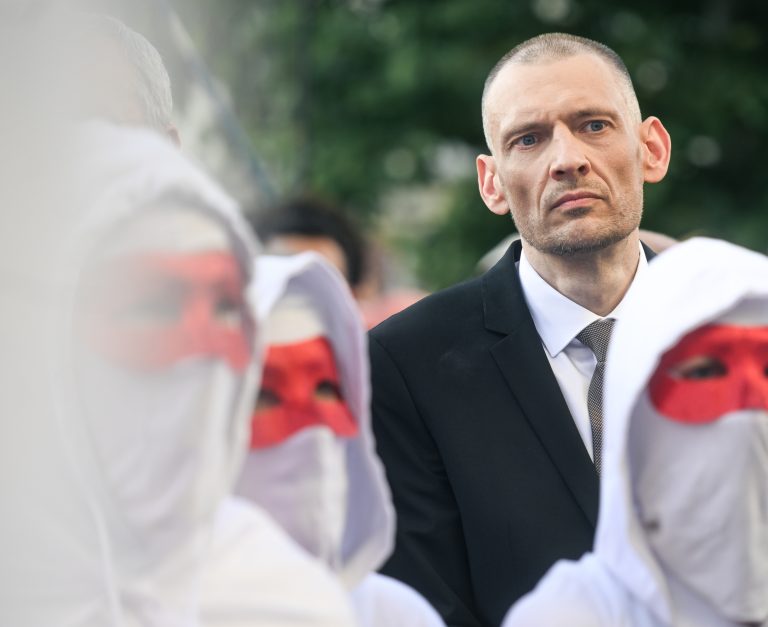
In response to the White House intervention, 14 political prisoners were released in Belarus on 21 June - among them opposition blogger Siarhei Tsyhanovsky, Radio Free Europe journalist Ihar Karnei, university teacher Natalya Dulina, and other representatives of Belarusian civil society.
Perhaps the most famous of the released non-Belarusians was Estonian Alan Royo, who years ago, with his Belarusian wife , set up a charity fund to help families disadvantaged by the Lukashenko regime.
Country for Life
The greatest expectations, however, accompanied the release of Tichanovsky. In 2019, he began to run his YouTube channel "Country for Life". He initially addressed the bureaucratic burden of restoring an ancient house, but gradually began to criticize the regime itself in Belarus.
A year later, he wanted to run in the presidential elections - his channel already had almost 300 thousand subscribers. However, the Central Election Commission refused to register him.
So his wife Sviatlana Tskikhanovskaya joined the election instead, and Siarhei began leading her election team, collecting the signatures needed to run for office. However, at the end of May 2020, he was arrested by the police during one of the events at which these signatures were collected.
The court eventually sentenced him to 18 years imprisonment, under four sections of the Criminal Code: organising a mass riot; organising and preparing an act grossly disturbing public order; obstructing the exercise of the right to vote; and inciting hatred.
At the time of his arrest, protests were at their height across the country. A particular feature of the demonstrations was that some three dozen factories and plants, including several in the capital itself, joined in with strikes.
Protesters demanded that the regime not use force during the demonstrations, release detainees and verify the counting of the presidential election results.
However, the protests did not lead to Lukashenko's downfall and more than half a million Belarusians, six to seven per cent of the total population , have since left the country. Between 1 January and 1 December 2025, 78 political prisoners were pardoned and 438 new ones were put behind bars - in total, more than 1 250 are imprisoned in Belarus.
Sobering
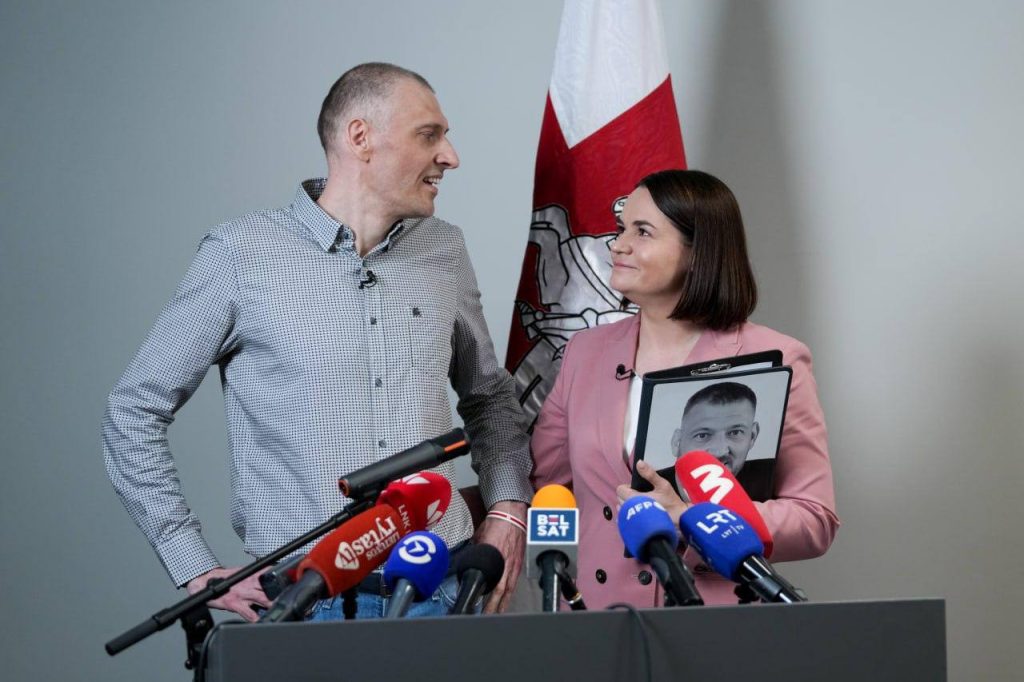
At the first press conference held the day after his release, Tskikhanovsky emphasized that he could do nothing on his own, that many Belarusians needed to be involved in opposition activities, and he could only "guide" their actions. However, the leader of the opposition, he said, was to be his wife, who had led the exile movement during his detention.
In an interview with Vot television published on 28 June, he justified his decision by saying that his wife was better suited to diplomacy, was calmer and had a better command of the English language. However, his words about his wife remaining the leader of the Belarusian exile contrast with what he said a few minutes later.
"Seb, I see my next activity as uniting the Belarusians and leading them behind me. I am the fire, the engine, the locomotive. Sviatlana and her diplomatic work is something else," the finally dismissed Belarusian declared.
On the first day of July, on his YouTube channel, Cichanovski announced a collection for the 200 thousand euros needed to strike a "strong blow to Lukashism."
Let us recall that the term 'Lukashism' originally referred to the aphorisms of the Belarusian President, but Tskikhanovski began to use this word to refer to the Lukashenko regime, exploiting the similarity with the word 'fascism', which serves to dehumanise the opponent both in the West and in the post-Soviet space.
Although he had already given a wide-ranging interview to Zerkalo on 2 July, he refused to reveal how he intended to strike a blow for 200,000 to a regime whose repressive apparatus, backed by Moscow, had staged the biggest protests in the country's history.
Subsequently, on 4 July, Tsyhanovsky chastised the Belarusians, saying that he had so far received only a thousand euros. He appeared arrogant in the video and it was clear that he would not collect more after such a speech. A few days later he announced that he had bought headphones and a watch with the money.
Although Tsikhanovsky was and still is invited to Brussels and to the USA, for Belarusians themselves - including those abroad who cannot return to their homeland because of political persecution - the opposition politician is a political corpse, and almost every new video of him is just a source of new jokes.
"I plan my actions strategically. I understand that we will not win without allies. I have decided to learn English so that I can speak the same language with my Western allies," he declared on October 8. Jokes about the "strategic decision" began to circulate, with the caveat that he could learn Belarusian first, as he also uses Russian in conversation with Belarusian speakers.
Subsequently, on 29 November, Tsakhanovsky's secretary accused his boss of blackmail, confirmed his emigration to the USA, which had already taken place in September, and declared that the Belarusian oppositionist was fighting primarily against his wife and the people around her, and not against the regime in Minsk. Although on 1 December Tskikhanovski said that he loved his wife, he made no comment on his secretary's words.
Belarusians for the Standard
The Standard reached out to a number of Belarusians to ask how they feel about the current developments in the opposition. According to Dasha, the release of Tsyhanovsky was "something unbelievable". "I had tears on the edge of my eyes when I saw him getting out of the car in Lithuania and greeting his wife... But then when he announced the collection, it was clear that he was staying alive in 2020," Dasha explains.
According to her, Belarusians willingly donate to political prisoners when they need to get back on their feet and are destitute after the amnesty, but "a 200-thousand punch of Lukashianism" sounds like a utopia in 2025.
Belarusians abroad cultivate their national culture, a Belarusianness whose many manifestations - national flag, coat of arms, language - have been branded extremist in their homeland, and they support Cichanowska's diplomatic efforts, which have facilitated their legalisation in Poland. Dasha explains that while the Russian civil opposition is focused on what will happen after the fall of the Kremlin regime, Belarusians are already focusing on the lives of Belarusians abroad.
"The opposition can say whatever it wants. Our president has lifted the country economically, Minsk is probably the cleanest city in Europe. Young people may be bothered by the fact that he is our man - from the village. I don't know," Cichanovsky's wife Sviatlana, a namesake from the Brest area, told the Standard.
"Lukashenko is destroying the Belarusian country and nation; he recently decided to bring in migrants from Pakistan[150 thousand, editor's note]. He will not be removed by the opposition from Lithuania, demanding free elections in the underbelly of Russia - Putin will never allow that. The only hope for change is the fall of the Kremlin regime, without which even Lukashenko cannot hold on. That is why I support the Belarusian Volunteer Corps [BDK fighting in Ukraine, editor's note], there is no other way," Larysa, who is in Poland, told the Standard.
"For a long time, representatives of our civil opposition have avoided answering questions about who owns Crimea. Sure, the Tsikhanovskaya cabinet is helping with the legalization, but how are the politicians? Neither fish nor crayfish. Then nobody takes us seriously - neither as allies nor as enemies. I am not afraid to say that Kosovo is Serbia or that Crimea is Ukraine, so why are the people in charge afraid of that?" asks a mother of two working in Krakow, who wished to speak anonymously.