
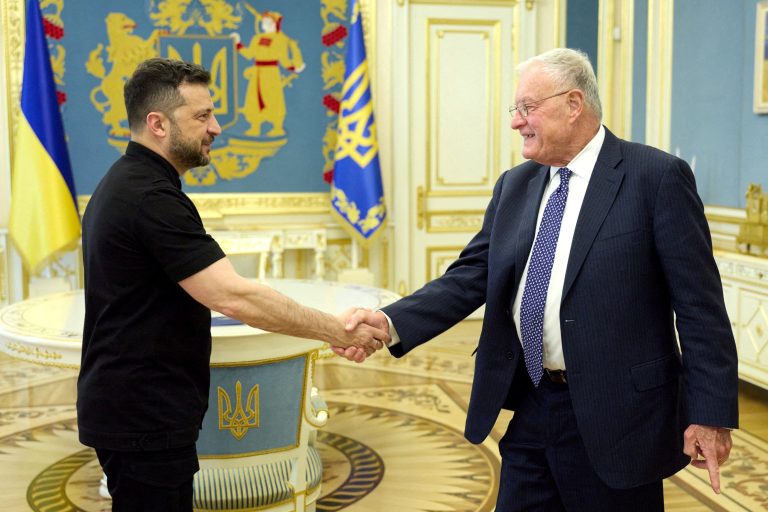
The outgoing US special envoy for Ukraine, Keith Kellogg, surprised the public with optimism when he told a security forum in California that an agreement to end the war was "within reach".
In his words, only two key issues remain open: the future status of the Donbas region and the fate of the Zaporizhzhya nuclear power plant, the largest energy complex of its kind in Europe.
Kellogg likened the current phase of the negotiations to the last, hardest leg of a marathon - just before the finish line. However, he stressed that it is these final issues that tend to be the most complicated, as they determine the political face of the post-war settlement.
Nevertheless, he expressed confidence that if a compromise can be found on both issues, "the rest will fall into place."
He estimated that the war had caused more than two million deaths and injuries to both sides combined. Although both Moscow and Kiev refuse to release exact casualty figures, U.S. estimates point to a scale of destruction that has surpassed all scenarios from the early months of the conflict.
Russian troops currently control about 19.2 percent of Ukrainian territory, including all of Luhansk, most of Donetsk, and parts of Kherson and Zaporizhzhya regions.
Donbas and nuclear energy
Part of the leaked U.S. proposals that have caused considerable uproar in recent weeks is a framework for the future settlement of Donbass and the operation of the Zaporizhzhya nuclear power plant.
According to these documents, the contents of which are not publicly known, the plant is to be restarted under the supervision of the International Atomic Energy Agency following a possible agreement.
Electricity production would then be shared equally between Ukraine and Russia. It is this proposal that has caused concern in Kiev and in some European capitals, because it would legitimise Russian control over part of Ukrainian territory.
The most sensitive point, however, remains the Donbas itself. Russia considers almost the entire region to be its territory; Ukraine rejects this and insists on restoring its territorial integrity. As Kellogg recalled, it is the question of the borders and political settlement of the Donbas that is at the heart of the whole war - and at the same time the biggest obstacle to peace.
Secret negotiations
As the conflict enters a new diplomatic phase, the importance of behind-the-scenes negotiations increases. According to Axios, US advisers to President Donald Trump, Steve Witkoff and Jared Kushner, have reached a preliminary agreement with Ukrainian and Russian officials on a series of compromises that could form the basis of a future peace treaty.
Ukrainian President Volodymyr Zelensky had a two-hour interview with the U.S. team, which he described as "long and substantive." The discussion focused on territorial issues and security guarantees.
According to diplomatic sources, both sides accepted certain proposals, although the final form of a compromise is still out of sight.
In addition to territorial issues, another major problem looms: different interpretations of security guarantees for Ukraine. The United States is prepared to provide Kiev with post-war guarantees, but it is not clear how these are perceived by the various parties to the conflict or by European allies.
Diplomats warn that without clearly defined commitments, any future agreement may be called into question. That is why, according to leaked reports, further secret negotiations are taking place, probably in Abu Dhabi. However, Ukrainian military intelligence refuses to disclose any details, indicating the sensitivity of the whole process.
European leaders are going to London
There is also an atmosphere of tense anticipation in Europe's political centres. The leaders of France, Germany, the UK and Ukraine are scheduled to meet in London on 8 December.
There, coordination of the West's common position is expected to take place, especially on the issue of security guarantors and positions on territorial concessions.
Although US negotiators speak of closeness of agreement, European countries are more cautious. They fear that too quick a compromise could weaken Ukraine and embolden Russia for future aggressions. In addition, some capitals have expressed concern that the leaked proposals allegedly give way to Moscow on crucial points.
(reuters, mja)