
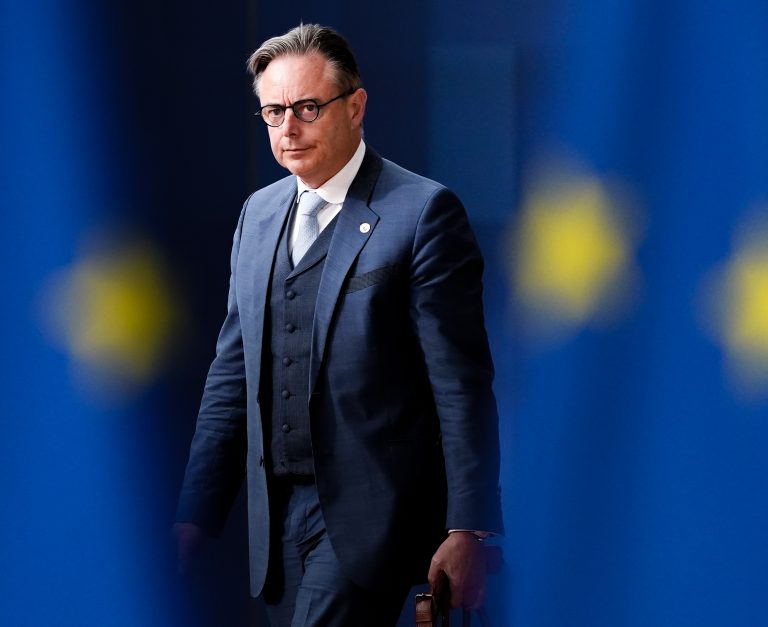
In recent weeks, Europe's top leaders have been muttering a Shakespearean version of Caesar's dictum: "Et tu, Brutus?! (And you, Brutus?!)" Resistance to their latest plan is not coming from the usual rebel corner. This time, the attention is not on Viktor Orbán, nor on Robert Fico.
A decisive 'no' is coming directly from Brussels from the Belgian Prime Minister, who otherwise supports the European institutions in almost everything. Bart De Wever rejects the European Commission's proposal to transfer frozen Russian assets to Ukraine. It is Belgium that is responsible for most of them.
De Wever, as a lifelong Europhile, is today resisting the advancing collective madness of the European elite, which wants to reach deep into the pockets of the Belgian taxpayer. On Friday, the German Chancellor cancelled a trip to Norway and he and the President of the European Commission were invited to dinner with the Belgian Prime Minister in order to convert him to the true Brussels faith.
The meeting is said to have been constructive. It remains to be seen how it really turned out at the European Council summit in December. De Wever's fight for common sense against Brussels ideology is worth paying attention to, whatever the outcome.
Europe has empty pockets but promises a full purse
Following the collapse of US support for Ukraine, Brussels has heroically pledged to keep the failing regime in Kiev afloat by its own means. But while Ukraine has been struggling for over a year to pay its debts, and its debt burden is rocketing (from 50 per cent of GDP before the war to 110 per cent today), Europe is finding that it is no longer able to cobble together the €100 billion a year that Kiev's corrupt 'otesankovs' demand.
The Council would therefore reach for the 140 billion euros that the Russian central bank has deposited with the Belgian company Euroclear. But while it is legal to freeze these assets on the grounds of war, it is not legal to seize them.
Belgium, as the host country, is responsible for upholding the law and would have to pay damages to Russia if it were violated. At the same time, it would lose a profitable business. Euroclear, which facilitates large-scale transactions for the biggest players in the financial markets, manages around four trillion dollars of assets from around the world. What will be left of it if the money deposited in Belgium is not safe from the will of the European authorities?
The Burkean conservative De Wever is against
Belgium is home to a number of similar institutions whose profits depend on the country's reputation as a safe haven. Since the summer, when these plans began to be discussed, the Belgian Prime Minister has politely but clearly repeated that he is against them. The Brussels helmsmen have been tone deaf.
German Chancellor Merz in September, after meeting De Wever, condescendingly declared that Belgium would not make trouble. His party colleague von der Leyen, who is putting forward the proposal on behalf of the European Commission, assures that everything will be done in such a way that Belgium will not be harmed.
This week, De Wever pounded the table. After reading the Commission's latest proposal, he ruled out Belgium's involvement in the theft of Russian assets. For good measure, he also dismissed the Brussels mantra of Russian defeatism on which the whole deal rests.
He recalled that it is the losers who lose assets, not the winners. At the same time , he added that Russia's defeat would not even be desirable because it would lead to the disintegration of the nuclear power. Even Orbán is not saying it so bluntly.
Ideologically blinded puppets
Most of the EU states are now led by puppets blinded either by ideology or by personal gain, and ready to sell out their own country at any time. De Wever, on the contrary, is an authentic democratic politician who subscribes to neoliberalism, Burkean conservatism and moderate Flemish nationalism.
The Flemish orientation gives this otherwise mainstream politician convictions that he has often had to defend in political struggles and for which he has had to endure all sorts of abuse. On the other hand, the Antwerp mayor's long experience leads him to seek practical solutions to concrete problems. He is both a fighter and a diplomat.
He has turned the fringe New Flemish Alliance, which he led for more than twenty years, into the country's strongest political party. It defines itself as the politically correct alternative to the radical Flemish Interest, with which it competes for the position of the strongest party in Dutch-speaking Flanders.
It is therefore invited not only into salons but also into government coalitions. One of the peculiarities of the Flemish nationalists is that they are not very anti-EU. Belgium in particular is in their stomach. If Belgium weakens as a result of Brussels' centralisation, this opens the way for a stronger Flemish government.
Neither the radicals of the Flemish Interest nor De Wever's moderates therefore have much faith in Belgium's future. De Wever wants to see further decentralisation of the country towards a confederation, talks prospectively of separate republics and can also imagine a union with Dutch neighbours with whom the Flemish share the Dutch language, often incorrectly referred to as 'Dutch'. They differ from the radicals in their diplomatic style and their ability to get along with politicians representing francophone Belgium.
Apparently, the Flemish anchorage leads De Wever to a stronger consciousness of national interest than is usual for politicians who seek to identify with the disappearing Belgian construct. Until recently, he has shown this interest with the diplomatic tact of a Belgian pragmatist who does not want to close any doors. When that was not enough, he has added more forcefulness in recent days.
If Brussels' pressure on Belgium continues, the Belgian counter-reaction may grow stronger.
It would not be the first or the last time that the Brussels elite has cultivated fierce opponents through its foresight. After all, Orbán, Fico and Zeman also started out in politics as Europhiles swearing by Brussels.
Anti-attitude from within the Western European family
On the other hand, such a Belgian can always count on being more sympathetic to his interests than someone from the East. While the former is seen by the European elite as a member of the Western European family, the latter are distant, poor and therefore inferior relatives.
The perception may be reinforced by the state of Atlantic support: plans to seize Russian assets are now being discouraged by Trump's people from Europeans.
But if Belgian Prime Minister De Wever stubbornly refuses to betray national interests, he too will eventually run up against the limits of his Western European siblings' acquiescence.