
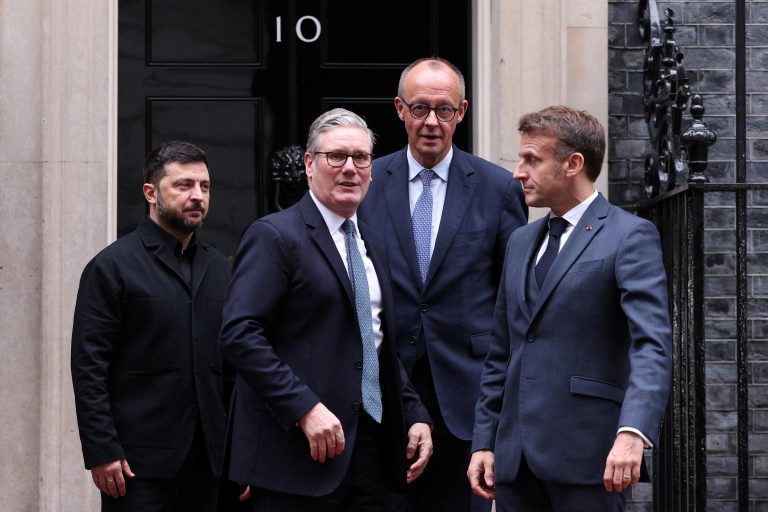
Ukrainian President Volodymyr Zelensky met with the leaders of the United Kingdom, France and Germany in London on Monday. Meanwhile, Prime Minister Keir Starmer, President Emmanuel Macron and Chancellor Friedrich Merz are Kiev's staunchest supporters in its nearly four-year war with Russia.
Russia's economy is starting to "suffer" after the latest round of sanctions, Macron said ahead of the talks. Merz is "skeptical about some of the details we see in the documents coming from the U.S. side, but we have to talk about it." "That's why we are here," he added.
"If there is to be a ceasefire, it has to be a just and lasting ceasefire. That's why it's so important that we reiterate the principle that matters relating to Ukraine are Ukraine's business," the Labour leader said of British "principles".
Unity between Europe, Ukraine and the United States is important in negotiations, Zelensky's wish sounded. He added that Kiev "can't do it" without both sponsors. "We can't do it without the Europeans. We can't do it without the Americans. That's why we have to make some important decisions," the president explained the reason for his visit to London.
The meeting, according to the Elysee Palace communiqué, allowed the Europeans to continue working together to modify the American ceasefire proposal. "Work on this plan will be intensified to provide Ukraine with solid security guarantees and to plan measures for the reconstruction of Ukraine," Macron's office added.
There have also been reports that the four European leaders are to discuss ways of using frozen Russian assets, which are stored mainly in the Belgian clearing system Euroclear. The EU as a whole has not yet come up with a way that would not be illegal, so it is unlikely that members of the E3 format will figure it out.
Revised peace plan
Ukraine on Tuesday will present the US with a revised peace plan aimed at ending the war with Russia after talks in London between President Volodymyr Zelensky and the leaders of France, Germany and Britain.
As the war nears its four-year mark, Kiev, under pressure from the White House to quickly agree to a peace deal, wants to counterbalance the U.S.-backed proposal, which is widely seen as favorable to Moscow.
Zelensky told reporters after the meeting that the revised plan contained 20 points, but there was still no agreement on the issue of surrendering territory - something Moscow had been pushing for.
"The Americans are in principle attuned to finding a compromise," he said. "Of course, there are complex issues related to the territory and a compromise has not yet been found there."
He reiterated his oft-stated position that Ukraine cannot give up any part of its territory.
The publication of the US ceasefire plan last month has to some extent intrigued European leaders, who fear that Kiev could be forced to accept many of Russia's demands, which some say could destabilise the continent.
Although U.S. officials have said they are in the final stages of reaching a deal, there is little indication so far that Ukraine or Russia would be willing to sign the framework agreement drafted by Trump's negotiators .
"We stand with Ukraine and if there is to be a ceasefire, it has to be a fair and lasting ceasefire," Starmer said after welcoming the leaders to his Downing Street residence.
Macron and Merz also expressed their determination to pursue a firm plan at a time that the German chancellor described as "crucial... for all of us".
Zelensky pointed to the delicate balancing process that European powers must achieve in trying to negotiate better terms for the proposed US plan:
"There are things that we cannot do without the Americans, things that we cannot do without Europe; therefore, we have to make some important decisions," the Ukrainian leader declared.
What have the negotiators achieved before
Zelensky's two-man negotiating team - Chief of General Staff Andriy Khnatov and National Security and Defense Council head Rustem Umerov - held talks with US envoys Steve Witkoff and Jared Kushner in Miami, Florida, on Friday. The Ukrainian leader had a joint phone call with the U.S. representatives and Ukrainian negotiators on Saturday.
President Donald Trump's golf partner and son-in-law Zelensky reported details of his talks with Russian leader Vladimir Putin at the Kremlin earlier in the week. After five hours of talks, the Americans admitted they had not reached a compromise, though both sides are open to continuing talks.
"Right now we are starting a new diplomatic week - there will be consultations with European leaders," Zelensky said in a videotaped interview on Sunday evening during a train journey. "First and foremost, these are issues of security, promoting our resilience and support packages for our defense. First and foremost, this is about air defense and long-term financing for Ukraine. Of course, we will discuss a common vision and common positions in the negotiations."
U.S. and Ukrainian negotiators "continue to disagree" on territorial concessions under the U.S. peace plan, the Ukrainian president said in a phone call with Bloomberg. "There are visions of the U.S., Russia and Ukraine - and we don't have a unified view on Donbas," Zelensky added.
Russian forces "liberated" the village of Chervone in the Donetsk region and Novodanylivka in the Zaporizhzhya region before the talks began, RIA Novosti news agency quoted the defence ministry as saying.
At the same time, the Dutch government announced military aid to Ukraine for the first quarter of 2026 worth 700 million euros. Reuters recalled that Amsterdam recently approved 3.5 billion euros for the whole of next year, although it has already consumed most of the package.
The North Atlantic Treaty Organization (NATO) will host Zelensky later in the day at Secretary General Mark Rutte's residence. At the Brussels headquarters, the Ukrainian leader also met with European Council President Antonio Costa and European Commission chief Ursula von der Leyen.
Trump: Zelensky hasn't even read the draft peace deal
After negotiations with the Russians in mid-November, the Americans drew up a 28-point plan for a Russian-Ukrainian ceasefire and subsequent peace. The Europeans reacted with dismay and later with their own 19-point plan, from which they scrapped all possible concessions to Russia.
Putin described the original American plan as a "good basis"; the leaders of the old continent, on the other hand, branded it "pro-Russian." Suspicions of Russian influence in the document's creation stem from alleged Russian wording that is said to have been translated verbatim in the English text.
Zelensky said Saturday after a phone call with Witkoff and Kushner that the topic of discussions was mainly security guarantees aimed at preventing another possible invasion by Russia. Sources close to the Axios portal said that the Ukrainians and the Americans also discussed the possibility of swapping territories.
Russia has already unilaterally [without Ukraine's consent and despite existing international law, ed.] annexed four Ukrainian regions on the shores of the Sea of Azov in September 2022. It is these areas that have been the scene of the fiercest fighting and, more recently, the fastest Russian advance.
It is not clear, however, to what extent Hnatov and Umerov stuck to the US proposal as a basis for negotiations. Trump therefore expressed doubts on Sunday whether Zelensky was even willing to agree to the deal, as he reportedly "hasn't even read it."
The outgoing U.S. special envoy for Russia and Ukraine, Keith Kellogg, also weighed in on this information scramble on Sunday. The retired general said bluntly that all parties involved are "the last ten meters" from reaching peace, and that overcoming them hinges on two issues: the future status of the Donbass and the governance of the Zaporizhzhya nuclear power plant.
Zelensky was briefed by his negotiators on all the conclusions of the talks with the Americans, and the Ukrainian leader received "all the documents" regarding the peace plan, Umerov said. Apparently, Zelensky brought them to the talks with Macron, Merz and with Starmer.
Putin's foreign policy adviser Yuri Ushakov said Washington would "strictly adhere" to all agreements made during the Trump era. Witkoff and Kushner, he said, are distancing themselves from the previous administration of Joe Biden, whom the Kremlin accuses of starting a war.
Who is the coalition of the willing
The unofficial alliance of countries that declare their support for Ukraine even in the event of a US withdrawal from Europe has already met several times in Paris or London. It is these capitals, together with Berlin, that are acting as leaders of the coalition and have repeatedly proclaimed unwavering support and continued arms for Kiev.
As the coalition of the willing steps outside the official framework of NATO or the EU, states outside the alliance criticize it for fracturing the alliance. In June, after the NATO summit in The Hague, Slovak President Peter Pellegrini reiterated this stance, saying that nowadays "we don't even know who they are anymore." Indeed, apart from Britain, France and Germany, few states are so regularly involved in these negotiations.
(reuters, sab)