According to Ukraine's DeepState project, Moscow doubled the speed of its territorial seizures in November compared to October, appropriating some 518 square kilometres.
"The Russians have the upper hand," Emil Kastehelmi, a military analyst with the Finnish Black Bird Group, told The New York Times (NYT). Ukraine, he said, is not yet at the point where it would have to capitulate, but "looks weakened enough for the Russians to think they can dictate their demands."
Russia currently controls 19.2 percent of Ukraine's territory, including Crimea, which it annexed in 2014, and the Luhansk region. It also controls more than eighty per cent of Donetsk Oblast, about three-quarters of Kherson and Zaporizhzhya Oblasts, as well as small parts of Kharkiv, Sumy, Mykolayiv and Dnipropetrovsk Oblasts.
The front in Donetsk oblast
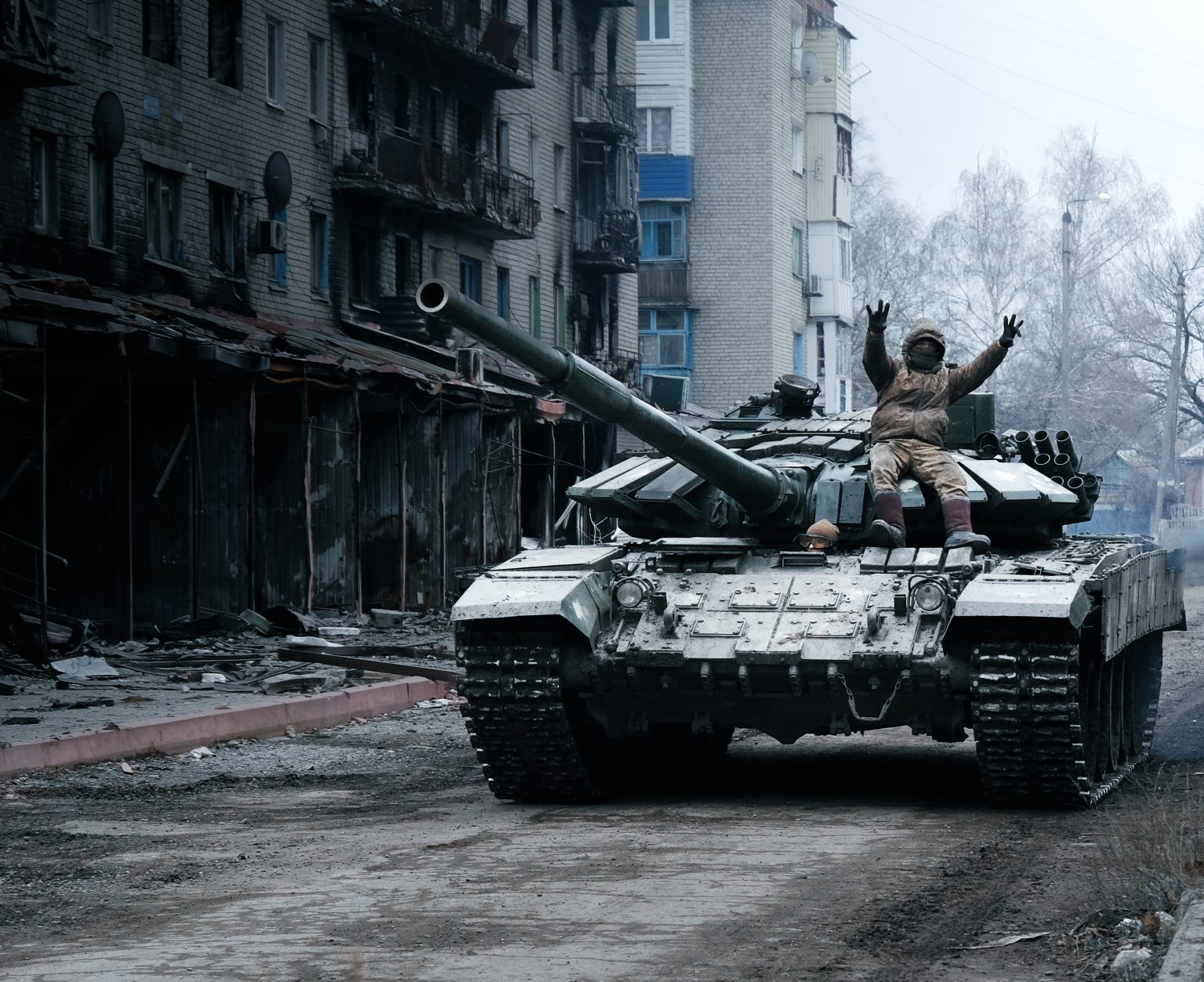
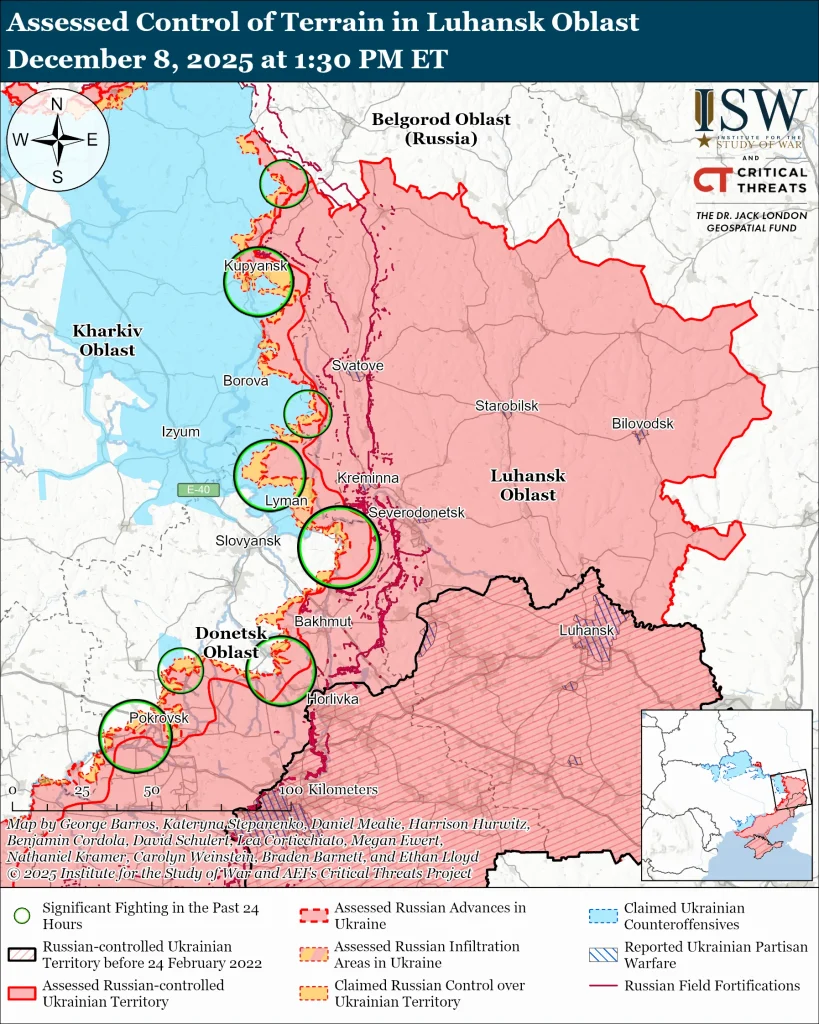
The media's gaze is focused mainly on the Donetsk region, where the Russians have already captured most of the logistics hub of Pokrovsk and claim to have encircled Ukrainian troops in neighbouring Myrnohrad.
Their advances near both towns have been confirmed by Ukrainian sources. In order to avoid a complete encirclement, the soldiers withdrew from the area near the villages of Sukhy Yar and Lysivka.
According to the statements of those involved in the fighting, the Russian troops control the access routes to both towns with the help of numerous drones and attack in small groups, which makes it impossible for the Ukrainians to supply and rotate troops. They describe this strategy as a "death trap".
"If we have three people, they have 30. The amount of manpower they have is just unbelievable," Oleh, a platoon commander in the area, told the NYT.
The US-based Institute for the Study of War (ISW) has assessed that the Russians are also advancing north of Pokrovsk near Rodynskoye and a little further east in the Rivne section.
Some analysts criticize Ukraine's efforts to hold Pokrovsk at all costs, but from the perspective of peace negotiations, this strategy makes sense. They describe Pokrovsk as a stepping stone to the two major towns in Donetsk - Sloviansk and Kramatorsk - that Ukraine still controls.
According to several sources, the US is pressing Ukraine to hand over all of Donetsk to Moscow as part of a peace deal. A loss in the key city could intensify their pressure and take some of the cards out of the hands of the embattled state.
In addition, Moscow is also making gains around the Donetsk city of Siversk, where foggy weather and poor weather conditions make it easier for the Russians to advance, complicating logistics and hampering Ukrainian drone operations.
It is also concentrating forces on other key towns in Donetsk, including Kostyantynivka and Lyman.
Russian forces are attacking in the Donetsk region. Photo: ISW
North and south
The NYT notes that the diversion to the defense of Pokrovsk allows the Russians toadvance more quickly in the south and southeast of the Zaporizhzhya region.
Russian troops there captured about 194 square kilometers around the town of Hulaypol in November, accounting for nearly 40 percent of all of Moscow's territorial gains last month, according to the DeepState project.
In addition, Russian troops arepushing closer to the northeastern city of Kupiansk in Kharkiv Oblast, which borders Russia. Russia says it controls all major routes in that district.
Russia announces further fighting
Both the Russian and US sides describe the peace talks as "good", but they disagree with Ukraine on one issue - the territory that should go to Russia.
Zelensky said on Monday night that Ukraine will not give up any territory because its constitution, international law and even moral principles do not allow it. He also rejected a proposal that included the "exchange" of the Zaporizhzhya nuclear power plant, which is controlled by Russia, and other occupied territories for parts of the Donetsk region that are still under Ukrainian control.
Putin is also adamant. He has ordered troops to prepare for winter fighting and told Zelensky that if negotiations fail, he will take Donbas militarily.
A disgruntled Trump
The US position remains the same - it wants to make peace, which, from its point of view, is being obstructed by Europe in particular, as it is negotiating a different peace plan in parallel with Zelensky, insisting that the war must end on the current front line and that Russia must not gain an extra inch of land.
The United States' dissatisfaction with the old continent is also outlined in the new security strategy, which accuses Europe of having 'unrealistic expectations' about the war.
"Russia, I suppose, would rather have the whole country, when you think about it. But I think Russia is OK with it [the US plan], but I'm not sure Zelensky is OK with it. His people love it, but he hasn't read it," Trump said on Sunday, adding that he was "a little disappointed" in Zelensky.
On Tuesday, in an interview with Politico , he hardened his stance further. He reiterated that Zelensky still hasn't read the peace proposal and should do so because "a lot of people are dying."
He also indicated that he was unwilling to meet Ukraine's other condition, namely NATO membership. Trump claimed that an informal understanding that Ukraine would never become a NATO member existed "long before" Vladimir Putin took office.
The US president also responded positively to a reporter's question about whether Ukraine should hold presidential elections. Without elections, according to Trump, the country is heading towards "no longer being a democracy".
As martial law has been in force in Ukraine since February 2022, last year's presidential elections were not held. Putin recently reiterated that he does not consider Zelensky to be a legitimate president because his term expires in May 2024. The Kremlin noted that even if a deal could be struck between the two sides in the conflict, Russia would have no one to sign it with legally.
Placeholder For Topreaded Placeholder For Topreaded
Placeholder
Placeholder
Placeholder For Topreaded Placeholder For Topreaded
Placeholder
Placeholder
Placeholder For Topreaded Placeholder For Topreaded
Placeholder
Placeholder
Placeholder For Topreaded Placeholder For Topreaded
Placeholder
Placeholder
Placeholder For Topreaded Placeholder For Topreaded
Here is placeholder for Article excerpt Here is placeholder for Article excerpt Here is placeholder for Article excerpt Here is placeholder for Article excerpt
Here is placeholder for Article excerpt Here is placeholder for Article excerpt Here is placeholder for Article excerpt Here is placeholder for Article excerpt
Here is placeholder for Article excerpt Here is placeholder for Article excerpt Here is placeholder for Article excerpt Here is placeholder for Article excerpt
Welcome to the comments section of the Štandard daily. Please take note of our guidelines, comments are moderated by us. You can contact the moderators at [email protected].
Participate in the discussion
Comments are available to subscribers only. If you'd like to join the discussion, choose a subscription starting at €6.72 per month.
All comments 0
Register
Comments are available to registered users only. If you'd like to join the discussion, register here.