However, this concerned the property of private individuals, similar to how the government of Franklin D. Roosevelt confiscated the property of Americans of Japanese origin, at the latest since the attack on the Hawaiian port of Pearl Harbor on December 7, 1941.
Even in World War I, the warring powers seized the property of so-called "enemies of the state," regardless of whether they were citizens of enemy states or suspected traitors. Austria-Hungary routinely confiscated the property of Russians, which, of course, was also true in reverse. The same relationship undoubtedly existed between Germany on the one hand and Britain, France, and Russia on the other.
In 1917, the US federal government passed the Trading with the Enemy Act, which froze German assets in the US and confiscated several chemical and pharmaceutical patents, including those of companies such as Bayer and Merck.
After World War II, American troops seized German and Italian assets located in the country, but left the Reich's gold stored in Switzerland untouched. The victorious Allies considered the property taken from the German state to be "reparations" or "restitution."
Later, during the Korean War (1950 to 1953), the United States froze Chinese and North Korean assets abroad, and Beijing and Pyongyang in turn confiscated the assets of the South. However, these were still "only" confiscations of private property and immobilization of state assets. Neither side dared to take the enemy's property without compensation as spoils and use it as their own.
Even during the Vietnam War, the communist North and the nationalist South froze each other's assets, and the frozen assets in the US were later mobilized after mutual diplomatic recognition.
The West continued to freeze assets even after the end of the Cold War. In the case of Iraq's invasion of Kuwait, it immobilized the assets of Saddam Hussein's government members in Western clearing institutions, although it released them again after the end of the occupation. The US and NATO countries took the same approach to Serbian political representatives during the war in Yugoslavia.
After Russia's annexation of Crimea, which was supposed to be a response to the overthrow of the legitimately elected President Viktor Yanukovych and the restriction of the linguistic rights of the Russian minority, the West and Ukraine imposed sanctions on Moscow, which in turn froze Ukrainian assets in Russia.
German gold in the US is currently considered a deposit, while Congress plans to essentially steal Russian assets. In both world wars, the value of mutually confiscated property ranged from tens to hundreds of millions of dollars at today's exchange rate. The Western confiscation thus represents the largest bite in history, operating with a sum of nearly $350 billion.
The words of Belgian Prime Minister Bart De Wever at the October EU summit, that "we did not even do this to Nazi Germany," are therefore closer to the truth than they might seem.
At first, it was just the proceeds...
In addition to being frozen, central bank assets were protected by a kind of aura of inviolability—even the warring parties of World War II could not imagine seizing all of the enemy's assets and the total destruction of the country that would inevitably follow.
Although comparisons to Hitler, Nazism, or the "embodiment of evil" are used in current wars, this is more of a propaganda shortcut. The real World War II can easily be categorized as a kind of "religious war" between the Christian-Enlightenment West, revitalized paganism in Germany, and Soviet state atheism. It was therefore an exception to normal military conflicts, which is also why it is so deeply engraved in the collective memory.
That is why Ukrainian President Volodymyr Zelensky's February 2024 statement on the seizure of Russian central bank assets came as a shock that alarmed all parties involved. After two years of war, the leader of the attacked country came out with the statement that the assets of the "terrorist state" should be transferred to Ukrainian hands.
However, the former US administration of President Joe Biden took a similarly strict approach to Russian assets. Although the White House and the Senate were held by the Democratic Party at the time, Republicans had a narrow majority in the lower house of Congress.
The then "opposition leader" Donald Trump rejected deeper US involvement in the Russian-Ukrainian war, but his ally in the House of Representatives, Mike Johnson, put the confiscation of Russian assets to a vote in April 2024, which Congressmen approved.
Last year, the G7 group of "economically most powerful" countries also discussed the possibility of seizing Russian assets, which would then be used for the post-war reconstruction of Ukraine. At the end of February 2024, a group of experts on international law commented on this possibility, declaring that such a move would be "in accordance with international law." .
The G7, some of whose members have been overtaken by China and India in terms of economic development, considered setting up a fund with Russian revenues at the end of 2023.
Later, it actually created this fund and transferred the proceeds from frozen assets to it, which it plans to use for post-war reconstruction. In essence, this is a plan for post-war reparations, although the war has been developing in the opposite direction, especially in recent months.
Last May, discussions on confiscation were also taking place at the European level. On May 21, 2024, EU member states approved a plan to confiscate revenues (interest) from Russian assets held mainly by the Belgian clearing bank Euroclear.
The change was that Ukraine also received the net profits from these revenues in the form of military aid. In July 2024, Brussels handed over the first tranche worth €1.5 billion to Ukraine.
Ukrainian Prime Minister Denys Shmyhal, in connection with the G7 fund managed by the World Bank, announced the receipt of a "Christmas gift" when, on December 24, 2024, Kiev received $1 billion from Russian revenues. This was part of a loan provided by the United States, which was to be repaid from the proceeds of Russian assets.
A few days before the end of his term, Biden made headlines again when he allegedly pushed for the seizure of more than $300 billion in Russian assets across the "collective West." Just a few days earlier, Kyiv received the first $3 billion tranche of a European loan, which, according to the G7 plan, is to be secured by Russian revenues.
... and then the assets themselves
EU member states eagerly awaited the Commission's proposal in connection with the much-publicized efforts to confiscate the assets themselves—not just the interest they generate. Belgian Foreign Minister Maxime Prévot therefore warned on September 5 of a "systemic shock" and a potential weakening of the euro.
Five days later, Commission President Ursula von der Leyen addressed the European Parliament in Strasbourg with a report on the state of the Union. The former German defense minister announced a massive loan to Ukraine, which Kiev will use to rebuild its infrastructure and which it will reportedly repay only after receiving reparations from Russia.
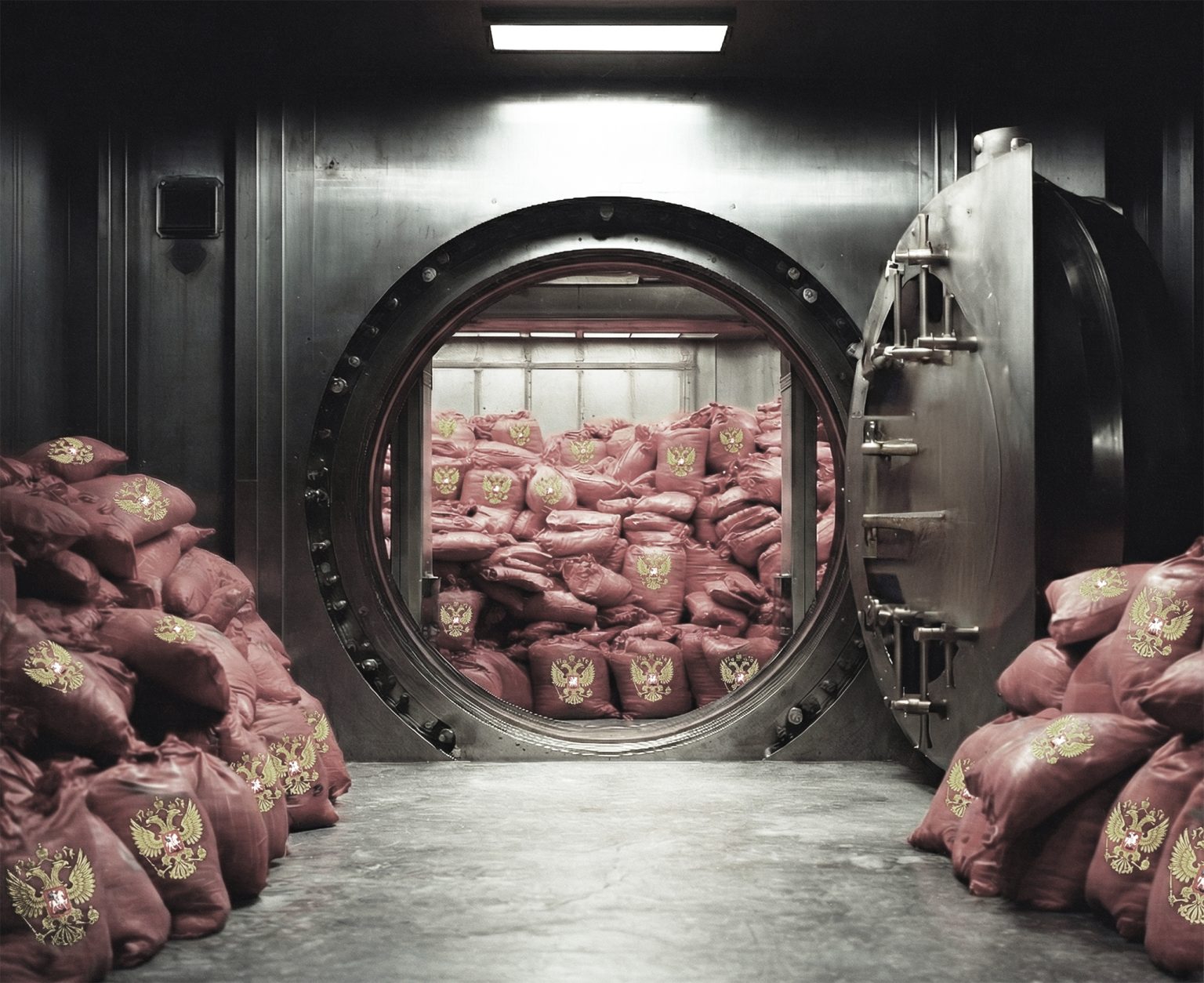
Just a month later, plans were already on the table to lend Ukraine an incredible €140 billion directly from Russian assets. However, this would mean that the assets would no longer be "frozen" or "immobilized," but outright stolen.
At the October meeting of the European Council, the Union's highest body, the Commission proposed this staggering sum, and as always, Slovakia and Hungary were the main opponents of the proposal. This time, Belgium joined them for a prosaic reason: Euroclear is a Belgian bank.
Any Russian measures punishing Euroclear for the outright theft of Russian assets would thus have to be borne by the Belgian government. The position of Bart De Wever's government was not changed even by the "guarantees" offered by von der Leyen in November.
The reason why the European Commission is pushing for a massive loan is also understandable. Ukraine is facing the threat of losing funding from the International Monetary Fund. In early November, the IMF announced a loan of $8 billion for the next three years, but Kiev must have "financial stability," which would be supported by the European loan.
At the end of November, Belgian institutions once again opposed the planned seizure of Russian assets. Euroclear warned of a loss of confidence in the European financial sector, and De Wever even suggested that Western peace efforts were at risk.
This is not helped by statements by von der Leyen or the "High Representative of the Union for Foreign Affairs and Security Policy" Kaja Kallas, who said at a meeting of the EU Council at the level of foreign ministers that the peace agreement should limit the size of the Russian army.
The former Estonian prime minister was responding to part of the US 28-point plan, which allegedly sought to limit the Ukrainian army to 600,000 men. Kiev has never deployed that many troops on the battlefield.
In early December, the Commission president tried again, but this time she proposed "only" €90 billion for two years. Five days later, up to seven EU member states called for the confiscation to be approved: Estonia, Finland, Ireland, Lithuania, Latvia, Poland, and Sweden, according to which it is not only a "moral obligation" but also "European interests" without further clarification.
They made this argument in a letter they sent jointly to von der Leyen and European Council President António Costa. Costa is to chair the EU summit scheduled for December 18 and 19. Neither has German Chancellor Friedrich Merz, who has set aside time in his schedule to meet with De Wever, been able to convince the Belgians.
The pre-Christmas summit of the highest representatives of the member states will thus be attended by "leaders" who have more bloodshot eyes and foam around their mouths than in the 1940s—a time when several European nations were threatened with extermination or at least "Germanization."
At their meeting on December 12, the majority of EU member states agreed to an "indefinite freeze" on Russian assets in Europe. Hungarian Prime Minister Viktor Orbán called it "crossing the Rubicon," but this is an inaccurate comparison, as Gaius Julius Caesar had already crossed the river in northern Italy.
Equally bizarre is the fact that the assets to be confiscated belong to a power that has been victorious in recent months. The Council is to vote in writing, and according to the proposal, a qualified majority is reportedly sufficient for approval.