
After the introduction of the Russian state messenger or the Kremlin's efforts to restrict foreign phone calls, and after the enforcement of Chat Control in Brussels, the old continent has also seen measures in the field of digital technologies from Berlin.
In early December, the German portal Heise, which covers news related to information and telecommunications technology, provided an analysis of the Berlin Senate's proposal and the amendments proposed by MEPs. The German news has already resonated in Iran and Azerbaijan.
On 4 December, the Chamber of Deputies of Berlin (Abgeordnetenhaus von Berlin), Germany's third smallest state, passed a sweeping amendment to Berlin's police and order law. The proposal was backed by the coalition Social Democratic Party of Germany (SPD) and the Christian Democratic Union of Germany (CDU), of which the current chancellor, Friedrich Merz, is the chairman.

An alternative to the coalition?
As we have already outlined on the Standard, the AfD's membership, its presidency and its electoral programme place the party - in contrast to its media image - among the standard political parties.
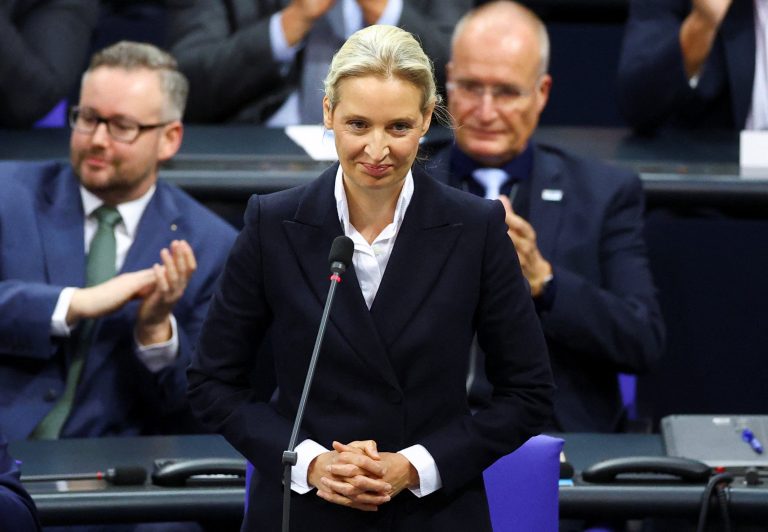
The standard nature of the party was reaffirmed by the opposition AfD MPs who voted in favour of the coalition motion in the Berlin parliament, unlike the opposition Greens and Left parties. It will be recalled that Alice Weidel's party is represented by 16 MEPs in the 159-member Berlin parliament.
Meanwhile, the coalition of CDU and SPD parties has a comfortable majority and did not even need the votes of the AfD to pass the proposals - the Alternative for Germany MEPs supported the controversial motion anyway.
Strong criticism
Both the initial coalition's proposals and the amendments to the amendment to the General Law on Security and Order (ASOG) contain a number of points that are now facing public criticism.
Thanks to the amendment, the police have acquired powers that, according to Heise, "significantly infringe on fundamental rights and go beyond the existing red lines of the capital's security policy".
The opposition on the floor of the Berlin parliament reacted with open rejection during the debate on the law. MEP Niklas Schrader (Left) spoke of a "black day for civil rights" and Vasili Franco (Greens) considered the amendment to be legally extremely risky.
"What is being sold as 'security policy' is in fact the building of an authoritarian police state," the noASOG initiative assesses the new law.
However, in 2020, a similar law - also with the support of AfD MPs - was passed by the state of Mecklenburg-Vorpommern and the law has so far not been repealed despite criticism, so expecting a retreat by lawmakers in Berlin is probably futile, even though critics see similar laws as a violation of the German constitution.

Unthinkable elsewhere
Security forces are now not only allowed to hack into mobile phones and computers, but also to enter apartments surreptitiously
of "suspects" who are not defined in the law. In fact, sections 26a and 26b regulate the so-called source interception of telecommunications (Quellen-TKÜ).
Section 26 explicitly allows investigators to 'covertly enter and search premises' - i.e. a house or apartment. There, they install the necessary equipment directly on the device and leave the dwelling without a trace. Physical entry into the suspects' dwellings is to be allowed by the authorities when the remote installation of the spy software fails.
In practice, this means that the police will be able to access a person's communications without their knowledge before or after they have been encrypted or decrypted on a device, and can also use malicious software - for example, using a USB stick to install so-called state Trojans. Police officers will also be able to install hidden cameras in the homes of Berliners.
The law also makes it easier to access mobile operators' data, for example to create a motion profile of selected people. Under Section 26e, the operator will not be able to refuse a request from the security forces.
Section 28a, in turn, allows 'biometric matching of faces and voices against publicly available data on the internet'. According to the amendment, this will not do without artificial intelligence. In fact, under Section 42d, personal data will be used for 'training and testing artificial intelligence systems'.

There is no right like the right
Like any controversial law, the Berlin law has not escaped the ideological labeling without which public debate is now virtually unimaginable.
According to the noASOG initiative, the new law fits in with the "strong right-populist and far-right" tendencies of German politics. The initiative also suggests that Berlin is moving closer to the National Socialist Germany of Chancellor Adolf Hitler's time with the new law.
For example, the genuinely far-right German organisation Dritte Weg (Third Way), which has long referred to the AfD as a 'so-called alternative for Germany' and criticised its co-chair for, among other things, her strongly pro-Israeli views, takes a different view.
On the aforementioned amendment of the law in relation to the AfD, Third Way representatives pointed out that "right-wing populists can at any time side with the government in order to undermine system-critical citizens and opposition groups".