
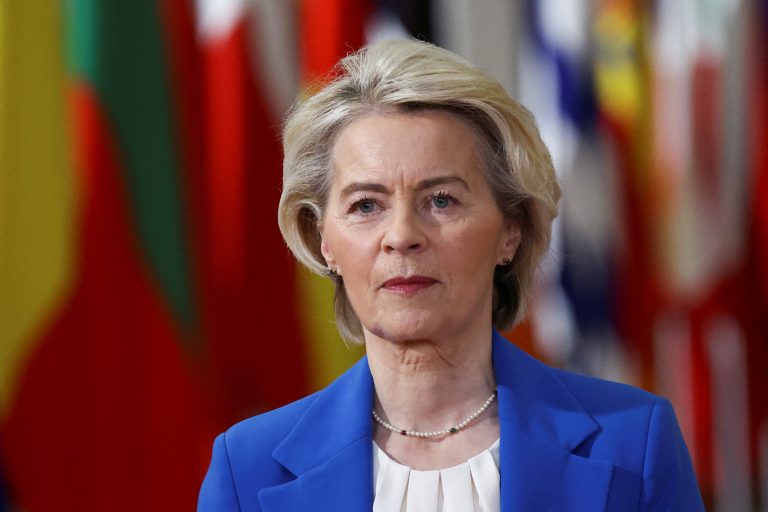
European Commission President Ursula von der Leyen expressed confidence that EU Member States would reach an agreement at the summit. She stressed to journalists that she would not leave the European Council without a solution for Ukraine. The President of the European Council, António Costa, took the same position.
Von der Leyen also sided with Belgium, which refuses to use frozen Russian assets to help Kiev unless other countries share the financial risk of such a move.
A crucial choice
EU diplomacy chief Kaja Kallas says the Union has already dealt with Belgian concerns and is hopeful that the negotiations can be brought to a successful conclusion.
Polish Prime Minister Donald Tusk said Europe faces a crucial choice. "Either money today or blood tomorrow," he said, adding that it was not just about Ukraine, but about the security of the whole of Europe. He called on European leaders to recognise the gravity of the situation and finally face it head on.
Dutch Prime Minister Dick Schoof expects the negotiations to produce an agreement with the support of Belgium. He said that he understood Belgian Prime Minister Bart De Wever's request to share the risks associated with the use of Russian assets, as most of them are located in Brussels.
German Chancellor Friedrich Merz also took a more optimistic tone. According to him, there is a way to reach an agreement on the use of frozen Russian assets to finance Ukraine's needs. He acknowledged the concerns of some countries, particularly Belgium, but expressed the hope that they could be resolved together.
Greek Prime Minister Kyriakos Mitsotakis supports a reparation loan for Ukraine. He said European leaders should reach a solution at Thursday's meeting in Brussels that is "legally correct" and will solve Ukraine's financial problems.
Orbán and Fico
Hungarian Prime Minister Viktor Orbán says the idea of using frozen Russian assets is "dead" as there is a blocking minority against it. He has also rejected funding Ukraine through a joint EU loan, which he says Hungary cannot support.
The Swedish government is also sceptical. Prime Minister Ulf Kristersson has pointed out that he sees no sign yet of an agreement between member states on the use of Russian assets.
Slovak Prime Minister Robert Fico said before his departure that he would not support the use of proceeds from frozen Russian assets to finance the war. "I refuse in principle to support anything that would lead to money for war. For me, it's a simple position, a principled position," he said.
We will update the report.
(reuters, lud)