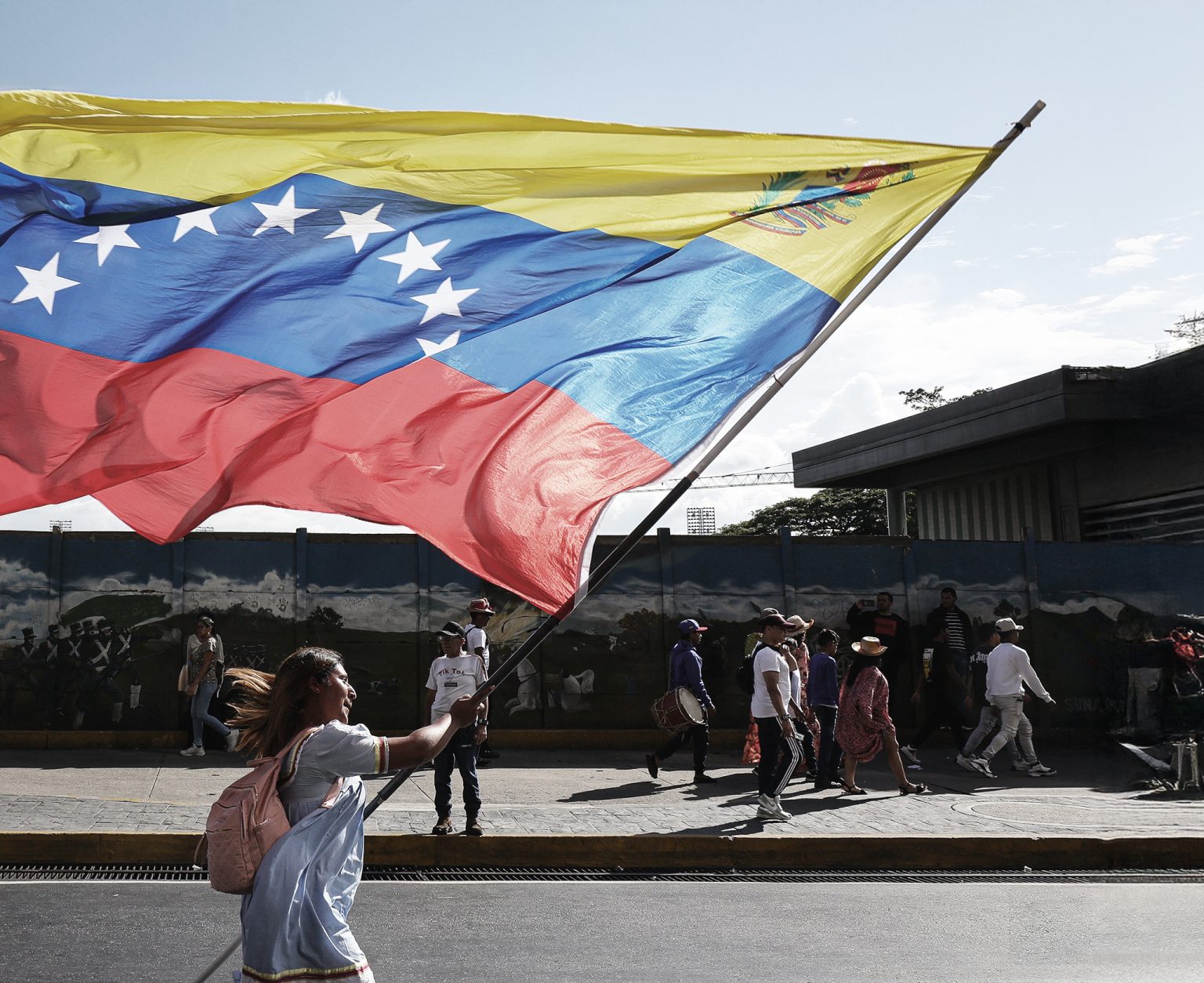
In the 19th century, Venezuela ruled over a large part of neighboring Guyana—this resource-rich region is called Esequibo, and the former British colony acquired it in arbitration in 1899. However, in 2023, the current Venezuelan leader Nicolás Maduro questioned the arbitration ruling and declared that the province, which covers two-thirds of Guyana, belongs to Caracas.
However, Maduro may not have much time left for this kind of pocket imperialism. Since the end of August, an American war has been approaching his country.
Geopolitical world war
Since the end of August, an amphibious group with the cruiser Iwo Jima and 4,500 marines has been gathering in the southern Caribbean Sea. On September 1, they launched Operation Southern Spear and attacked at least 21 vessels by December.
These "lethal kinetic strikes" resulted in at least 82 deaths, one of the vessels being a smuggling submarine. In November, the crew of the Iwo Jima was reinforced by a group from the largest aircraft carrier, the USS Gerald Ford.
Although Trump labeled Latin American drug cartels "narco-terrorists" back in January, Maduro, for understandable reasons, fears for his place in the sun. The steps taken by sailors in the Caribbean appear to be preparations for war.
Equally disturbing for the Chavista regime is the fact that Maduro himself appears as the leader of the Sun Cartel in the announcement classifying it as a "narco-terrorist" organization. The cartel's name and symbolism refer to the insignia of the Bolivarian army, and according to the testimony of the former head of the military secret service, it cooperated with the government in exporting drugs and sending drug and oil money to American and European allies.
At the end of November, Trump announced the closure of Venezuelan airspace, and on December 10, the coast guard seized an oil tanker. Maduro described it as an act of piracy, to which the White House chief responded by ordering a naval blockade.
In a post on Truth Social on December 16, he added that intimidation by the "greatest Armada" [a reference to the extensive Spanish colonial navy, ed. note] would continue until Caracas "returns to the United States all the oil, land, and other assets they previously stole from us."
The aspirant to the title of American emperor thus recalled Venezuela's nationalization of American mining capacities in the early 1970s. However, it should be noted that this did not bother companies such as Chevron and Conoco, which have continued to buy Venezuelan oil to this day.
Since the launch of Operation Southern Spear, opposition leaders from the Democratic Party have criticized Trump for bypassing Congress, which, as with tariffs, has supreme authority over the deployment of troops. However, as three senators admitted in an interview with the New York Times, the legislature is playing dead and is subordinate to the White House in everything.
The individual steps and statements of Trump and his administration are based on two principles – "return to greatness" and "peace through strength." The revival of the Monroe Doctrine as part of Trump's ascension to the throne is thus directed at its first victim: Venezuela.