
Colombia's leftist militias have been a threat to the country's public security since the outbreak of the conflict in 1964. They joined this quasi-civil war in order to control the smuggling routes, and have been fighting intermittently to this day against government troops, far-right militias and other drug cartels.
Despite Colombian President Gustavo Petro's regular advocacy of neighbouring Venezuelan President Nicolás Maduro, it is the chavista regime there that provides the space for unhindered coca cultivation, cocaine production and arms storage - paradoxically in the border regions.
Investigative think tank InSight Crime has long been working on criminal groups in Latin America. Its latest investigative report reveals deep ideological and 'business' links between the Maduro regime and the National Liberation Army (ELN).
History of the ELN
InSight Crime lists the city of Medellín, Colombia as one of its headquarters. This city is famous for the founding of the cartel of the same name in 1976 under the leadership of the 'drug king' Pablo Escobar. It can therefore be said that the NGO has first-hand knowledge of what is happening in South America.
In its historical overview, the organisation describes the ELN as 'originally a nationalist movement inspired by the Cuban Revolution' which initially 'refused to engage in the drug trade'. Gradually, however, the militants began collecting ransoms from coca growers, later offering protection, and eventually taking over the entire large-scale drug trade.
The ELN has been active in Colombia since 1964, but nine years later, after initial 'successes' (the capture of the town of Simacota), the army attacked their positions and decimated their ranks. The leadership of the original militias included representatives of the local Catholic Church, who preached a theology of liberation. As early as 1999, however, the ELN kidnapped 150 people from the church in order to extract ransom money.
Following these crimes, the ELN began to build infrastructure in western Venezuela, with the blessing of then President Hugo Chávez. He also supported the rival Revolutionary Armed Forces of Colombia (FARC), although the clashes between the militias took place only on Colombian territory.
Militants against the regime at home, in favour of the government next door
Chávez's successor, Nicolás Maduro, also treated the ELN militias "doing business" in the drug sector with a certain amount of indifference. After the demobilisation of the FARC in 2017, the ELN became a major player in the field of asymmetric struggle, but in strictly socialist Venezuela, despite the Colombian example, it supported the Chavista government.
Between January and May this year, the ELN repeatedly attacked FARC positions in Venezuela's exile, using as a pretext the murder of a gravedigger who was helping the militants dispose of bodies and cross the border. In the first five months of 2025, the ELN killed 117 people, putting an end to the negotiation of 'total peace', which is President Petro's agenda.
The ELN operates in all provinces along the entire Colombian-Venezuelan border, and in all sectors it is involved in drug trafficking, bailing or mining in illegal mines.
The 31 January attack by the Venezuelan Bolivarian army, in which they attacked FARC positions while ELN centres remained outside the combat zone, also appeared suspicious. This was further circumstantial evidence of collaboration between the Maduro regime and the self-proclaimed national liberation army.
Eleven towns and municipalities of Catatumbo province on the common border form a cultivation base for 55 thousand hectares of coca, "from which up to 400 tons of cocaine can be produced," InSight Crime recalled.
"In Colombia, a kilogram of cocaine sells for 1,500 dollars, which means that cocaine production in Catatumbo can generate 600 million dollars a year," the organization explained, adding that when exported, the price rises to 25 thousand dollars per kilogram - so Catatumbo's production can reach a staggering ten billion dollars.
They are thus probably involved in the financial scheme of the Maduro government, as described by the former head of military intelligence, Hugo Armando Carvajal. His testimony was covered by the Standard in a separate article; the former head of the DGCIM agency confessed to U.S. narcotics investigators that it was in collaboration with the ELN and FARC that the Maduro regime smuggled millions of dollars to allied leftist leaders in South America and Europe.
The left's defeats all around
Geographically, too, Maduro is increasingly isolated. This weekend saw the second round of presidential elections in Chile. As expected from the first round, the nationalist José António Cast won it with 58.2 per cent of the valid votes, while the winner of the first round, Jeannette Jara of the Communist Party, received 41.8 per cent of the votes.
Following Kast's victory, Argentine President Javier Milei published a map of South America on the X network showing the retreat of left-wing governments towards the north-east. Petro shared the image with a call for "Greater Colombians" - a reference to the historic state of Greater Colombia, which at the height of its power occupied Venezuela, Ecuador, Colombia and present-day Panama.
Por el sur y por el norte vienen los vientos de la muerte.
Gustavo Petro (@petrogustavo) December 15, 2025
Atenti Grancolombianos, vienen por nosotros y debemos resistir con la espada de Bolívar en alto y paso de vencedores.
Me han bloqueado mi trino sobre la derrota progresista en Chile, espero se recupere. https://t.co/iRWu5fmZjI-
He thus implicitly called for a closer alliance that may result in re-federalization. This would be opposed, for obvious reasons, by the hard-right president of Ecuador, Daniel Noboa, who, among other things, has made himself visible with overt military actions against drug smugglers and has never once condemned US attacks on smugglers' boats and submarines in the Pacific Ocean.
However, as long as Maduro and his government support the ELN, there will be no ceasefire between the militants and the government in Bogotá. "Petro has failed to understand that the ELN is now a Colombian-Venezuelan group and that any peace deal must necessarily include Venezuela," InSight Crime reminded in the conclusion of its five-part report.
In Cuba - whose socialist revolution triggered a series of uprisings against U.S. domination stemming from the Monroe Doctrine - the tables are turning as well. President Miguel Díaz-Canel and his government, which he inherited from Raúl Castro in 2018, have allowed the use of the U.S. dollar in internal transactions.
Government Decree 113/2025 also authorizes the central bank to accept foreign currencies as legal tender and reserve commodities, and empowers the Ministry of Economy to decide who can trade in those currencies. This means that the ministry will grant licences to money changers.
"From 17 December, small businesses, cooperatives and economic entities can open accounts in foreign currencies, withhold income and pay in foreign currencies, in a model completely controlled by the state, confirming the peso crisis and the progressive hidden dollarization," the Spanish-language portal UHN Plus explained.
At the plenary session of the Communist Party of Cuba, Díaz-Canel openly acknowledged the dire situation of the state economy. He spoke of an "economic collapse", rampant inflation, a paralysed economy and a "deep crisis" in the thermal energy sector, and also touched on the "serious" food shortages.
This leaves Maduro with Iran among his allies, with whom Venezuela has been cooperating since 2022 in the domestic production of oil and its export by illegal means. Tehran, according to the Argentine daily Infobae, is "an expert in smuggling oil by 'ghost fleet' - tankers without records".
In an earlier investigative report, Infobae carried a cursory list of Iranians transported by the state oil company Petróleos de Venezuela (PDVSA) via the state-owned Conviasa airline.
The leading men were Ali Akbar Purebrahimi, the deputy minister of petroleum who accepted the oil itself as "payment" for helping PDVSA, Khojaatollah Ghoreishi, the deputy minister of defense for logistics and a key man in thefunding the elite Quds Force of the Islamic Revolutionary Guard Corps, who "can turn anything into gold", which he smuggled into Iran, and the "commander of the Quds' secret black market oil sales unit", Azeem Monzawi.
Defence in words
As in recent weeks and months, Maduro is resorting to shocking statements. He is also known for postponing public and other holidays in the country at will, and has become particularly famous for 'Christmas in October'.
Against the backdrop of Venezuela's further weakening and isolation, he issued a presidential decree on 11 December, according to which the new year, 2026, had already begun. Almost immediately, he became a laughing stock on social media, with themes such as 'time travel', 'prolonging the mandate' and the desire to 'get the war with America over with as soon as possible'.
🟡 #VENEZUELA | El dictador Nicolás Maduro adelanto año nuevo por decreto y en toda venezuela ya es 2026. ¡Feliz año nuevo! 🎉 pic.twitter.com/kJX7frNcFq-
La Posta Diario (@LaPostaDiarioAR) December 11, 2025
Already last month, he tried to dissuade U.S. President Donald Trump from allegedly planning an invasion by singing. He tried this with John Lennon's Imagine - which is seen by the US right as a "quasi-anthem of communism" with references to a world without borders and without religion - as well as his own AI production and chant of "yes, peace, peace, peace".
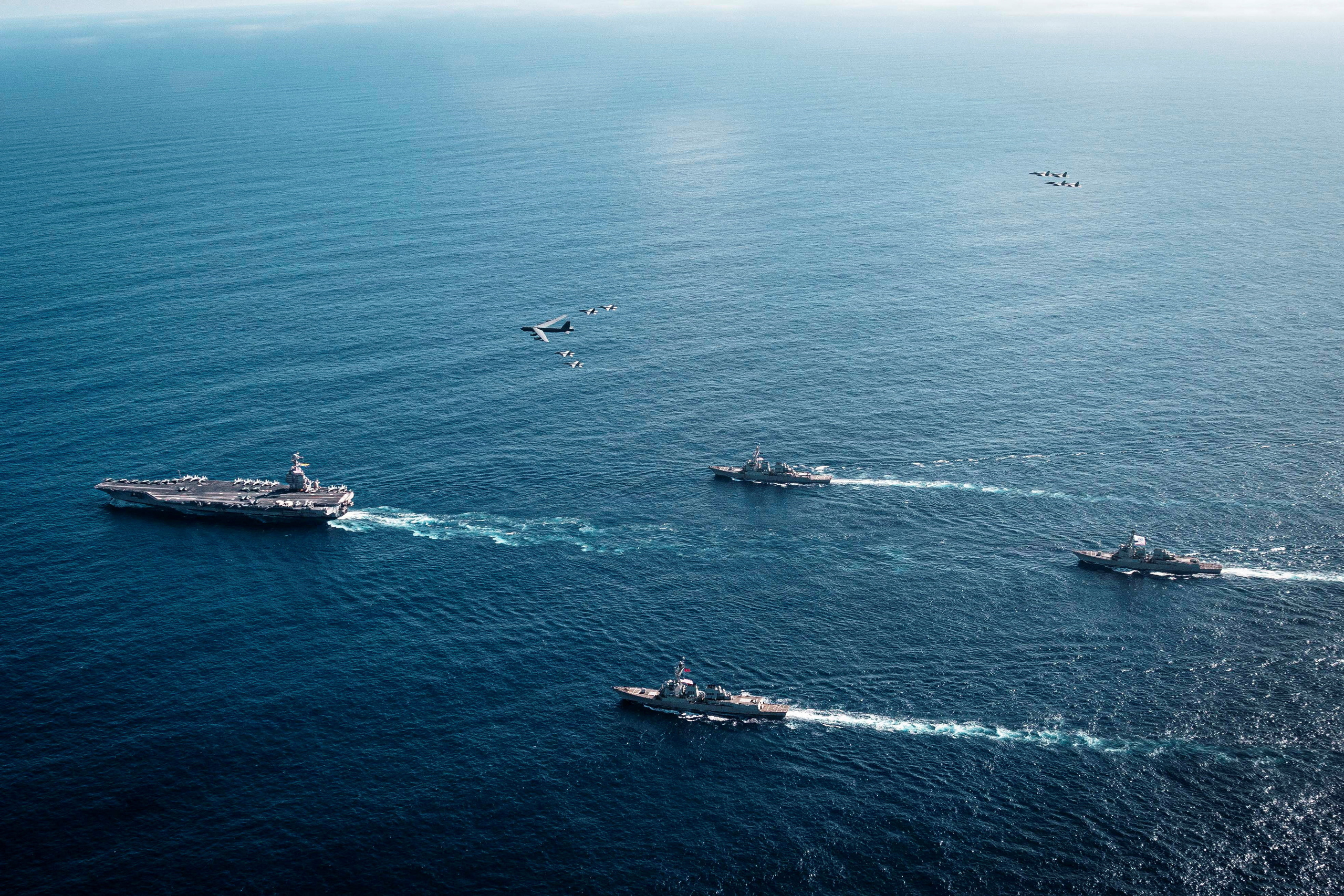
In early December, the U.S. War Department released an official accounting of strikes against "narco-submarines," including one submarine. The amphibious group around the cruiser Iwo Jima and the USS Gerald Ford, the largest aircraft carrier, has carried out a total of 21 attacks since the start of Operation Southern Spear, resulting in 82 confirmed kills.
In light of this information, Maduro's singing does not seem to have impressed the war hawks in the Pentagon or on the White House staff. After the seizure of the Venezuelan tanker by the US Navy, the presumed next steps are thus a naval blockade and invasion, which Trump has so far rejected.
However, several plans for a US troop incursion into Venezuela reportedly exist, and the rule known as Chekhov's rifle suggests that one will inevitably be implemented. There are, however, a number of people who reject the idea of 'US soldiers dying fighting Nicolás Maduro'.
As noted commentator Tucker Carlson noted on Monday, "Israel's desire to undermine Russian support for Iran is one of the main reasons neoconservatives support Ukraine." The Fox News ex-moderator, with a nine-year history of prime-time broadcasting, has a number of contacts in what he calls a "permanent Washington" environment.
"Venezuela must be different, right? How could Washington's desire to overthrow the government of that South American country be related to America's 'special ally' in the Middle East?" he asked rhetorically, citing an interview opposition leader and Nobel Peace Prize laureate María Corina Machado gave to the hard-right daily Israel Hayom.
"Since Hugo Chávez came to power, Venezuela has become one of the Latin American countries most hostile to Israel and Zionism," declared the vice-president-designate, the right-hand man of election winner Edmundo González Urrutia. "His successor has continued his anti-Israel course even more intensely," she continued, referring to Maduro.
It is Venezuela and Iran's long-standing contacts and joint ventures that are the answer to Carlson's assumptions regarding the talks. Israel, in its quest for great power status, intends to weaken countries that are in any alliance with Tehran - through anti-Russian lobbying in the US or support for the Venezuelan opposition.
We will have to wait for confirmation of this theory, just as we will have to wait for the much-delayed invasion by the United States. However, the latter has a whole history of interfering in Latin American states, and one Israel will not tip the balance.