
What is human nature? What we have in common as human beings is covered by virtually everything that comes from living together - from basic human dignity to legal capacity. Yet we are unable to answer the initial question plausibly, which is why there is a plethora of philosophical schools that offer their own partial answers.
The famous ancient Greek philosopher Aristotle defined man in two ways: as a social animal (zoón politikón) and as an animal capable of speech and hearing (zoón logón echón). However, he described the essence with the word soul, which he explained as the "form" of the body - the body in this example would be the "substance" of the soul.
This bodily and non-bodily (mental or spiritual) aspect is shared by all of us without distinction, so he comes quite precisely close to answering the question about human essence. But to what extent is the essence of man defined by genes?
It was during the administration of US President Bill Clinton (1993-2001) that the first complete sequence of the human genome was revealed. The Human Genome Project and the Celera Genomics Corporation thus showed the world the physical side of "human nature" a year before the fall of the Twin Towers, although the complete genome was not made public until 2022.
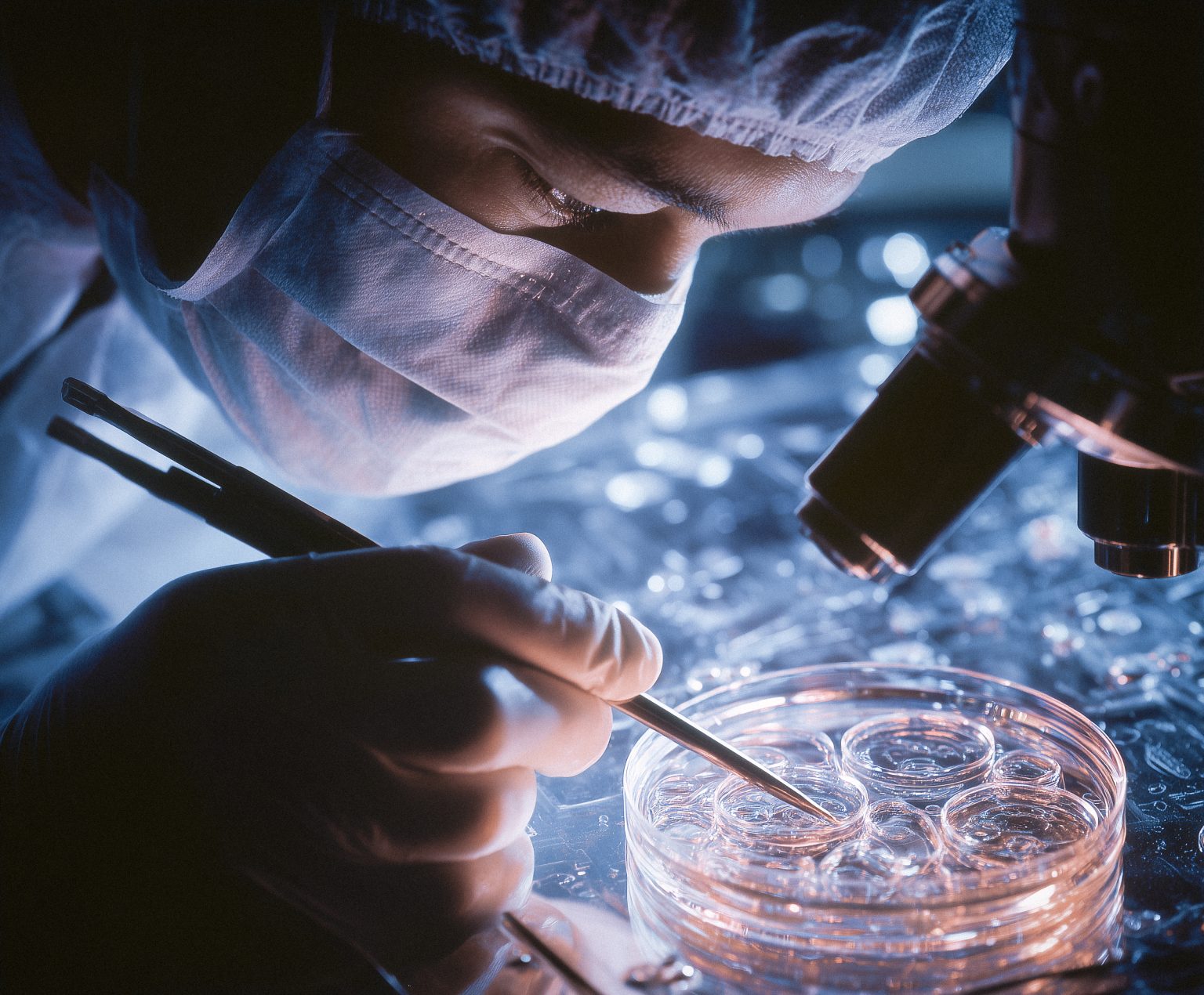
Is it possible that the transcription (editing) of these sequences could produce a being fundamentally different from humans? This ethical dilemma is likely to give sleepless nights to the leaders in the field of artificial insemination, who have gene editing tools such as CRISPR.Cas9 at their disposal.
Another dilemma is the practical application of editing in rare genetic diseases. Ultimately, this also offers commercial applications that are currently almost unimaginable from an ethical point of view. Indeed, scientists have been faced with the question of "not if, but when" since the early days of CRISPR.
And that 'when' is inexorably approaching.
Genetic optimisation
Since its inception in 2021, the American company Nucleus Genomics has started offering basic services for artificial insemination, known in the US as IVF (in vitro fertilization). Its founder, Kian Sadeghi, founded the company after the death of his brother due to a rare genetic disease.
In early December, Sadeghi appeared on a CBS News morning show, in which he recalled the existence of the IVF+ programme. The latter costs 30 thousand dollars and offers a complete sequence of both parents and 20 selected embryos "grown" in test tubes.
These embryos can then be genetically modified according to the parents' wishes. "We provide all the information parents need to know about the future child. We really think parents have a right to know," said the 25-year-old pioneer.
"They want us to play sports and go to the best schools. They want us to have a good education. They want us to prosper. I think a parent's life doesn't just stop at 'I want my child to be healthy'," he said.
Nucleus Genomics is studying more than 2-thousand genetically determined traits in these embryos, ranging from eye and hair color to acne. Sadeghi claims they can discern a predisposition to higher intelligence, but it's probably just a marketing ploy.
The company can, however, detect predispositions for medical conditions such as clinical depression, autism and bipolar disorder. The fact that editing can "scratch out" unwanted genes from a future child has understandably been met with accusations of eugenics, which Sadeghi dismissed.
CBS News has admitted that one of Nucleus Genomics' investors is well-known billionaire Peter Thiel. The latter, according to an Inc magazine report, is a big believer in "parabiosis" - a theory that promises rejuvenation through transfusions of children's blood. He also regularly invests in longevity research.
Americans were not the first
This serious move to design our own babies is just the next in a line. Pandora's Box was apparently opened by Chinese geneticists, back in 2018, when He Jiankui recoded a child with the CCR5 gene, whose receptor is supposedly responsible for the response to the HIV virus. However, this gene also encodes some properties of nerve cells and specifically an area of the brain called the hippocampus - the centre of memory.
Both the Chinese Academy of Medical Sciences and the National Health Commission have distanced themselves from Chea. While the academy argued "ethical issues", the commission directly warned against the investigation's conclusions of "illegal behaviour".
"Although the intent may be to create perfect human beings, the result may be a monster," the US National Institutes of Health joined in the criticism.
In 2019, gene-editing tools also began to be used in the United States, but authorities have not allowed stem cell editing. Official figures speak of 500 to 1,000 cases of "somatic" editing, in which only selected cells are recoded - their effect on the offspring is therefore nil.
In February this year, doctors used "personalised" CRISPR in a maternity ward in Philadelphia, Pennsylvania, and the baby they cured was only seven months old. The reason for using gene editing was a rare metabolic disorder, and the boy is virtually healthy after the procedure.
The worms have spread
It is the Americans who have an appropriate saying on this subject, namely "can of worms". It means that any well thought out step can lead to a "can of worms", which has an effect on everything around.
In medicine, since the 1970s, there has been a substance known as erythropoietin. This is a hormone that is made by the kidneys when oxygen levels drop, and activates the bone marrow to produce more red blood cells. In 1987, synthetic erythropoietin (EPO) was first used to treat sickle cell anemia.
Almost immediately, it began to be abused by athletes as part of doping to promote blood flow to the muscles. Yet this type of doping is banned worldwide.
The example, however, shows exactly the pitfalls of human behaviour. Although EPO was originally synthesized as a drug to alleviate a worse-than-normal condition (health), it began to be used to improve that condition (a kind of "super-health").
It is therefore only a matter of time before tools like CRISPR start to be used commercially, i.e. to "enhance" already existing and healthy properties or abilities.
How many genes does one have to change to stop being human? A common answer would be something along the lines of "after all, one or two genes aren't that bad". But it is the scale that is crucial.
The last natural changes in the human genome date back to about 8,000 years before Christ. The indigenous inhabitants of the Andes naturally developed a resistance to oxygen deprivation at high altitudes, and their blood contains many times more red blood cells. Resistance to arsenic has also been discovered in these Indians in Bolivia.
The difference in individual genes or sequences between humans (Homo sapiens) and the learned chimpanzee (Pan troglodytes) has been reported at 1.2 per cent of the total genome. It would therefore theoretically be possible to "breed" a chimpanzee in a human womb or test tube - simply by modifying different genes.
Understandably, it would not be so simple. A single gene is often responsible for coding for several traits at the same time, so virtually anything could be created instead of a chimpanzee. And that is the threat we currently face.