
In mid-December, Russia's state-run TASS news agency reported on a "follower of a destructive youth movement" who attacked his school in the village of Gorki-2 in the Odintsovo urban district of the Moscow region.
He managed to kill a 10-year-old Tajik, Kobildjon Aliyev, with a knife and injure three people, including a security guard who approached him at the start of the attack, before being detained on the spot by security forces. According to videos released on the day of the attack, 15-year-old Timofey Kulyamov walked around the school with a knife in his hand and asked pupils about their nationality.
Racial attack
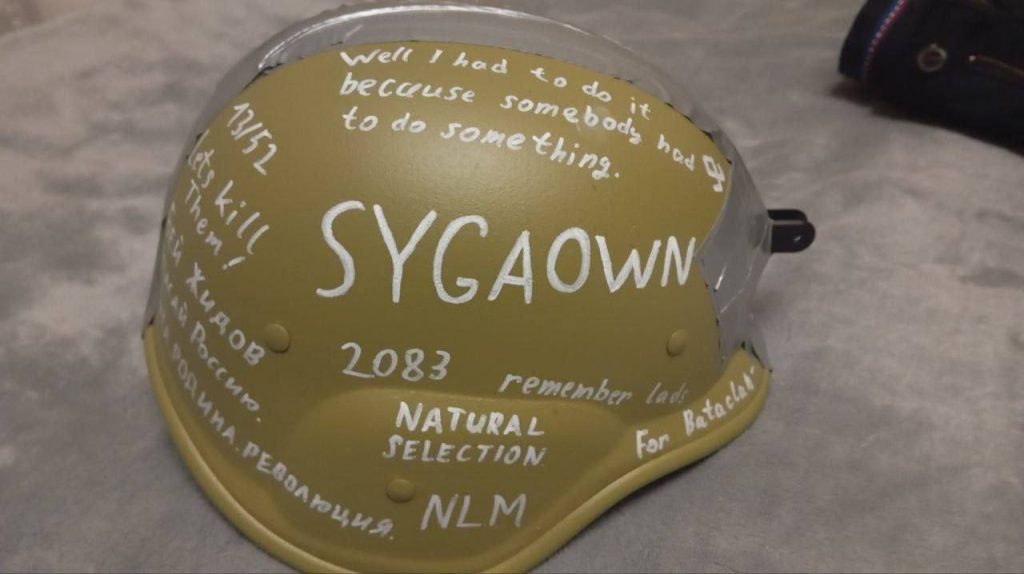
While the attacker awaits trial, police are investigating possible motives for the attack. The helmet in which Kulyamov arrived at the school bears several inscriptions in Russian and English. According to available photographs, the reverse side of the helmet also contains additional inscriptions, but a photograph of it has not been released.
"Well, I had to do it because someone had to do something," is written in English on the helmet, with the text complemented by the Odal (ᛟ) rune of an elderly Futhark, the meaning of which is related to the blood bond of ancestors and descendants. As it appears on the helmet, it may also be the so-called winged Odal, which came into use in National Socialist Germany during the reign of Adolf Hitler.
It also bears the acronym SYGAOWN, or 'Stop your genocide against our white nations', which refers, among other things, to the racial attack in New York in 2022.
However, the helmet also displays the English inscription "natural selection", the Russian inscription "Rasa. Homeland. Revolution" or one of the slogans of the Bolshevik opponents during the Russian Civil War: "Kill the Jews, save Russia!".
The fact that the signs are white, according to Russian "extremism expert" Peter Korotayev, refers to the 2019 attack at the New Zealand mosque.

Church wants to eradicate paganism
"There was symbolism on the schoolboy who committed the Odintsovo attack that pointed to his ties to the neopagans. We have long called for a ban on this abomination. I think the time has come to take decisive decisions and deal with the neopagans once and for all," a source close to the Patriarch of the Russian Orthodox Church (ROC) told the Kremlinskaya Tabakerka (KT) channel.
The Kremlin source did not rule out that a draft law banning paganism of European traditions - Slavic, Germanic, Baltic or Finno-Ugric - in Russia will soon be drawn up.
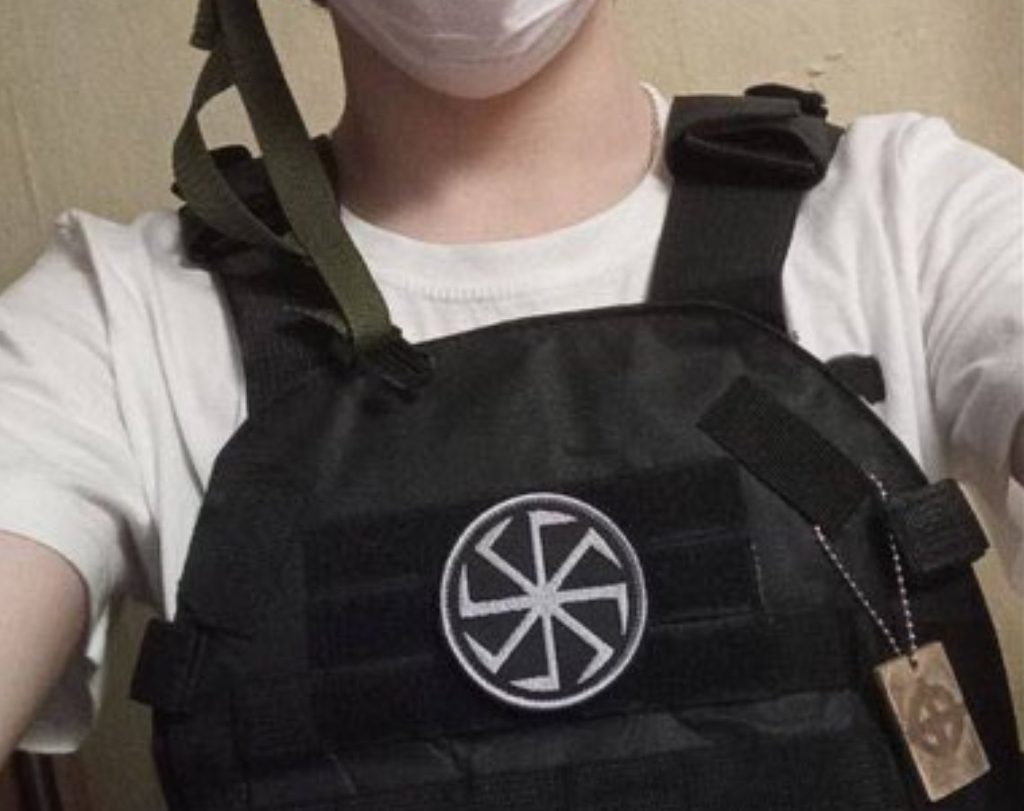
The reason for this is said to be the cartwheel patch on the tactical vest of the assailant - on which also hung a Celtic cross, which is now also used as a symbol of the unity of the white race. The kolovrat is a type of swastika widespread among pagans of Slavic tradition, whose history dates back at least to the early Middle Ages.
Let us recall that the Slovak musician Jaroslav "Reborn" Pagac was also tried for several years for the use of the kolovrat, but was legally acquitted in early 2025. In Russia, as in Slovakia, the spinning wheel is not banned, but the Russian court has already fined for wearing it several times.
Back in September 2024, Patriarch Kirill warned that paganism was linked to force and violence, and thus threatened to spread among Russian soldiers taking part in Russia's invasion of Ukraine.
In February 2025, he again called for a fight against pagans. "Who would have thought that in the 21st century there would be strange people in the territory of Holy Russia who would revive paganism?" Kirill asked at a gathering of Moscow clergy.
"Neo-Paganism will certainly be banned, since the Patriarch himself is asking for it. However, it is difficult to say yet whether the ban will happen this year or next year," a source from the presidential office told KT in September 2025.
Recall that the term neopaganism is mainly used by its opponents, who try to use the prefix novo- to point out that it is only an imitation of pre-Christian beliefs.
Pagans themselves use either the neutral designation "pagan" or "native", while the term "native faith", which gave rise to the current term "native religion", was introduced in 1934 by the Ukrainian philologist Volodymyr Shayan.
Pagans at the front
It is common knowledge that the Russian Volunteer Corps (RDK), which is fighting on the side of Kiev in the Russo-Ukrainian war, is manned by a number of figures from the Russian pagan scene and, according to its commander, consists mostly of pagans.
"In the RDK, most of the guys profess native religion," Denis Nikitin, the corps' commander, said in an interview in April 2025. While pagans in the RDK are not affected by the laws in Russia, a possible ban on paganism would affect pagans in the Russian military, who are represented in the RPC patriarch's words in the invading army in a non-negligible proportion.
The editors of the Standard contacted the soldiers of the Russian army and asked them to comment on a possible ban on paganism. A volunteer from an air defense unit (PVO) with a focus on drones said that as an Orthodox, the ban would not affect him, but there are soldiers among his comrades who do not like the RPC's efforts in the Kremlin.
"Are they fighting for Russia? They are fighting. Do they want to ban their faith? They want to. In short, I can imagine they don't like it," the volunteer assesses.
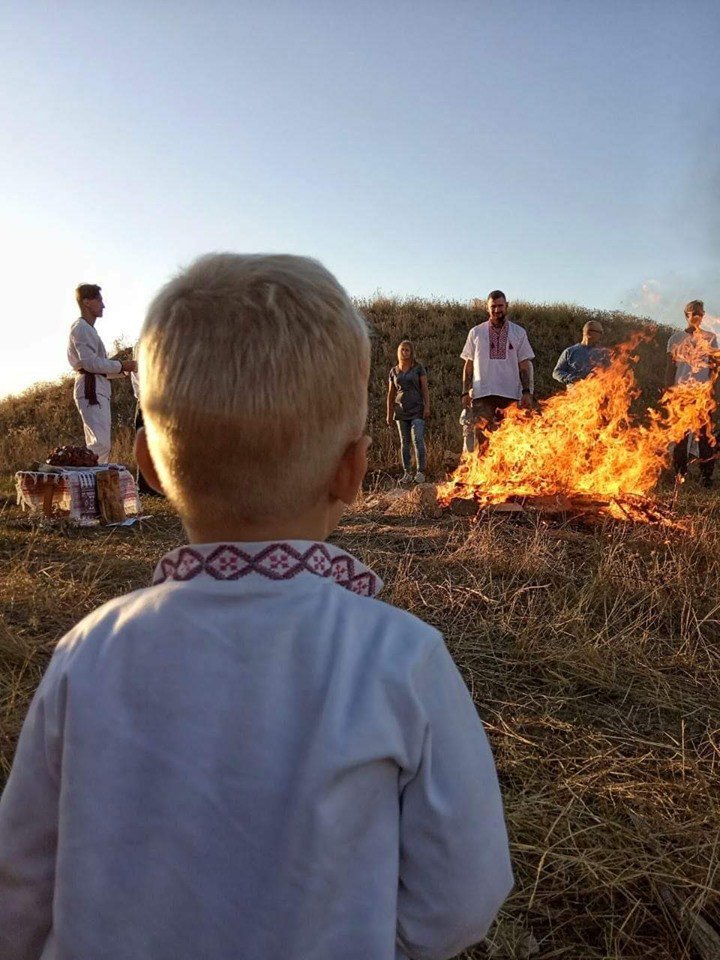
Pagans in Russia associate within communes, with more than one commune having its own page or social media channel. The Standard reached out to a commune of Russian pagans of Slavic tradition in the Leningrad region, whose leadership was willing to comment on condition of anonymity.
"The attacker was wearing a spinning wheel, which can be bought anywhere. That's the only thing that connects him with the native religion. Bullying, fights and various racial conflicts are nothing new in Podmoskovy. However, I don't remember Orthodoxy, Islam or Judaism being banned," says a representative of the North Russian community.
The commune's pagans explain that although ethnic Russians were attacked, a ban on paganism would also affect non-Russian pagans, such as those in the Russian part of Karelia, with whom they maintain friendly relations. "The RPC claims it will destroy paganism. And if we continue to glorify their gods, what will they do? Maybe we will have conditions here like in the Middle Ages," concludes the community leader.
According to Roman Shizhensky, a candidate of historical sciences and head of a research laboratory in the field of religious studies, associate professor at the Baltic Federal University in Kaliningrad, paganism is widespread among Russians fighting in Ukraine, with about one million people in Russia alone professing it.
Nevertheless, a ban on native religion is not ruled out, although for the time being it would contradict Article 28 of the Russian constitution, which guarantees freedom of religion.