
A lot of time has passed since exoplanets were first discovered in the 1990s, but astronomers are still surprised time and time again. The latest example came from the James Webb Space Telescope, which captured one of the strangest planets with atmospheres yet discovered, according to Space.
It bears the designation PSR J2322-2650b and orbits a pulsar - an extremely dense dead star that emits regular streams of radiation. Although planets near pulsars have been observed before, PSR J2322-2650b differs in several crucial ways.
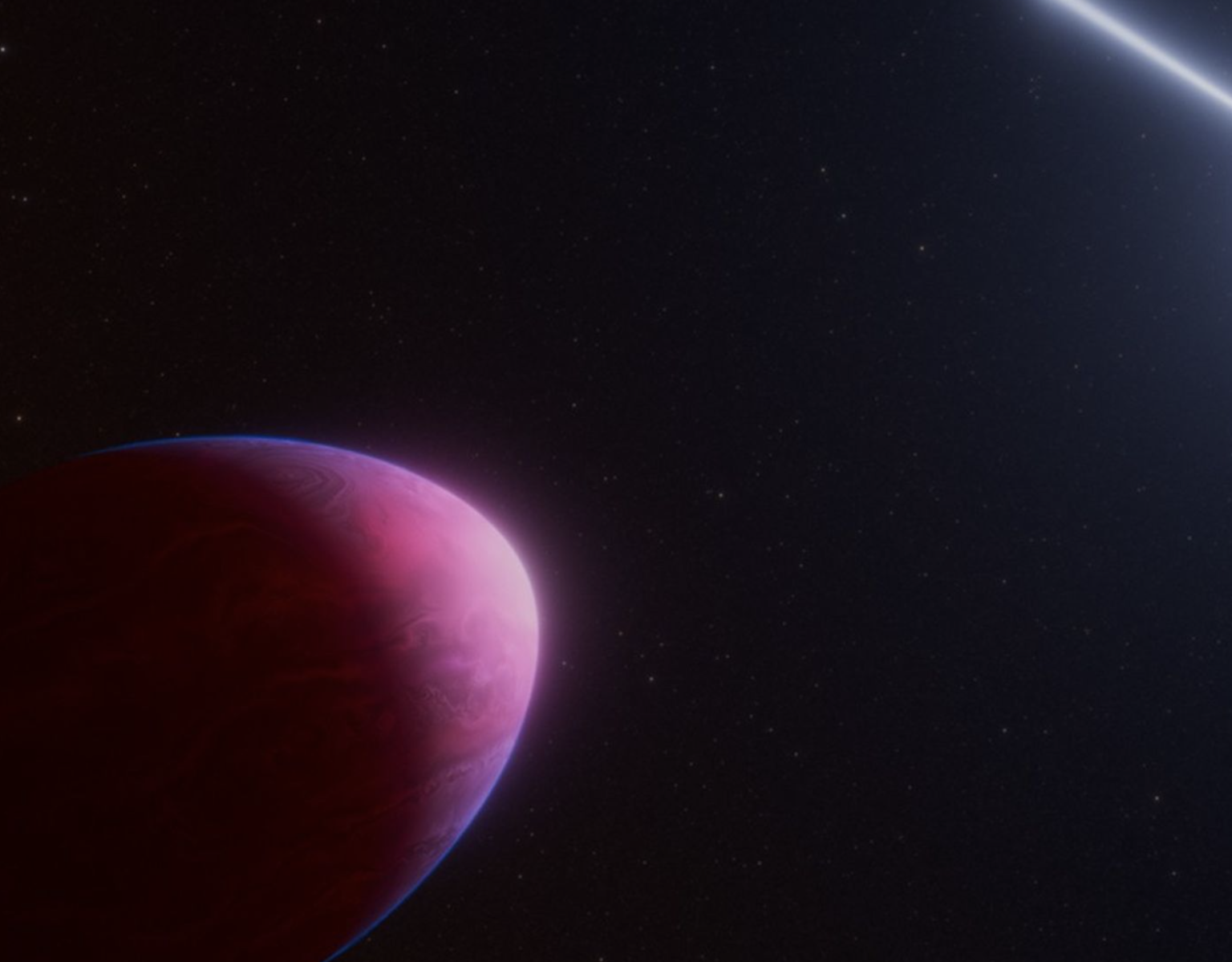
It has a mass about that of Jupiter, but its proximity to the star and physical properties make it resemble a planetary curiosity. It is only 1.6 million kilometers from its star (by comparison, Earth is hundreds of times farther from the Sun), and a single orbit takes only eight hours. Due to the pulsar's strong gravity, the planet has an elliptical shape similar to a lemon or rugby ball.
Scientists have been struck by the planet's atmosphere
According to the team of researchers from Carnegie Lab and the University of Chicago who analysed the discovery, the atmosphere of the newly discovered planet is made up of helium and carbon. It does not contain common molecules such as water, methane or carbon dioxide.
Instead, they spotted forms of molecular carbon, namely carbon-3 and carbon-2. This phenomenon is an absolute novelty. Of the 150 exoplanets studied so far, none had such an atmosphere.
Moreover, the atmosphere of PSR J2322-2650b probably contains soot clouds, which can condense into diamond form under extreme conditions. These then literally "rain down" on the planet's surface.
🪐 @NASAWebb has found an exoplanet that defies explanation.
- NASA Marshall (@NASA_Marshall) December 19, 2025
PSR J2322-2650b appears to have an exotic helium-and-carbon-dominated atmosphere potentially with clouds that can condense and form diamonds. Scientists have never seen anything like it before: https://t.co/Flb6hThLjo pic.twitter.com/6L2GA87QlC
On the pulsar-facing side of the planet, temperatures reach up to 2,040 degrees Celsius, while the night side, which never faces the star, is around 650 degrees Celsius. This so-called tidal coupling is due to the gravitational pull of the pulsar.
The millisecond pulsar, around which the planet orbits, itself emits little infrared light, allowing the James Webb Telescope to observe the planet's atmosphere relatively undisturbed. This led to a careful analysis that showed a chemical composition quite different from anything astronomers had expected.
With no answers to planet formation
Scientists have no idea yet how such a planet formed. Although various scenarios are being considered, all known mechanisms of planet formation so far rule out the possibility of an object with such an extreme carbon content and almost no oxygen or nitrogen.
According to one of the researchers, Roger Romani of Stanford, the crystallization of a mixture of carbon and oxygen inside the original body may have been behind the origin of the atmosphere, with pure carbon crystals mixing with helium to form a strange layer of atmosphere. However, it still remains a mystery why there is no oxygen or nitrogen, which are present in normal stellar processes.
The discovery of PSR J2322-2650b thus poses a scientific challenge, not only because of its unusual atmosphere and structure, but also because it raises new questions about planet formation under extreme conditions. Scientists admit they don't yet know the answers, but it is mysteries like these that push the boundaries of knowledge.
As Michael Zhang, team leader at the University of Chicago, noted, "It's great to have a puzzle we can investigate. And maybe this planet will one day show us something fundamental about what the universe might look like beyond our imagination."
(max)