
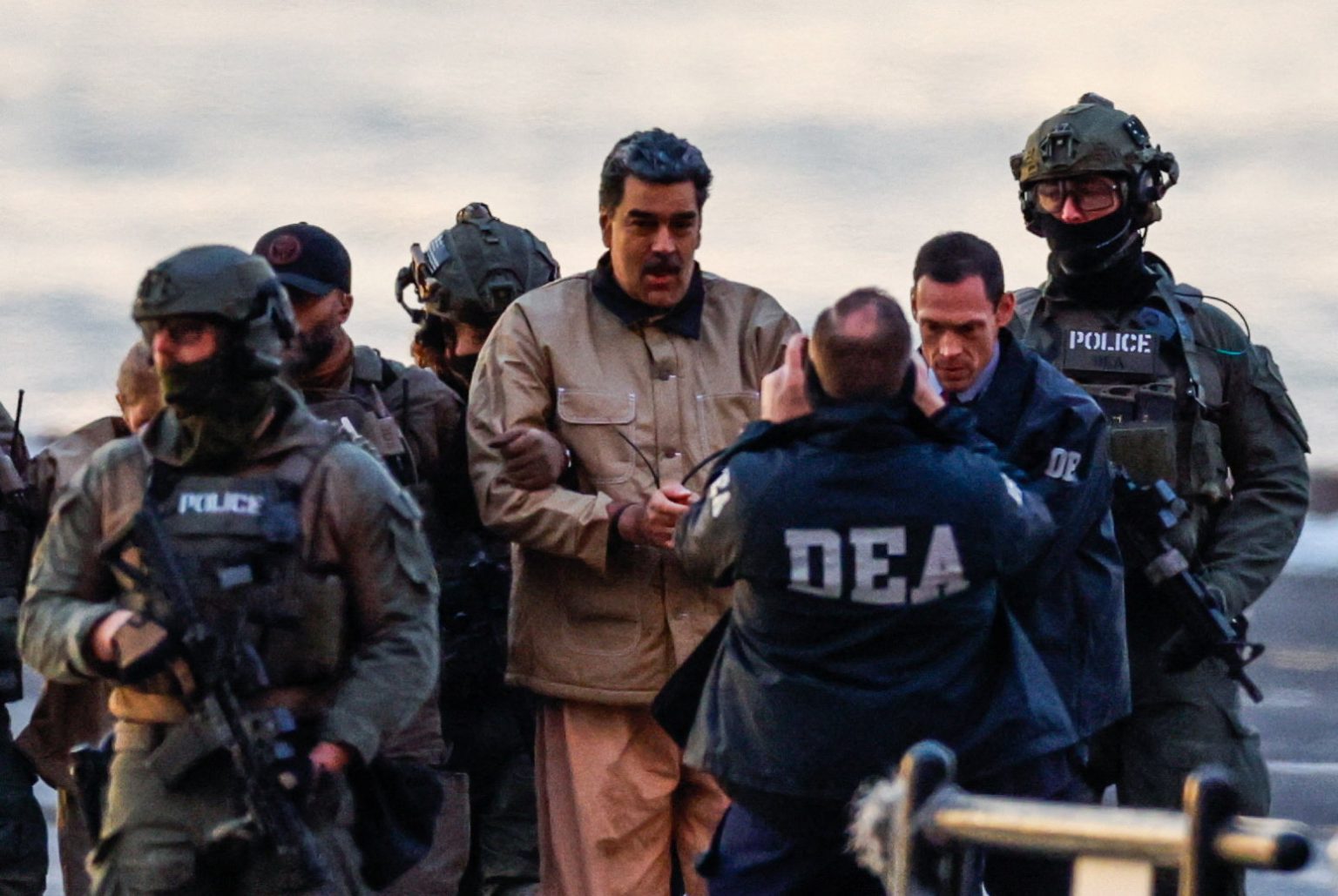
Ousted Venezuelan President Nicolás Maduro and his wife Cilia Flores arrive at the federal courthouse in Manhattan, New York, on Monday, where they were escorted from a Brooklyn jail under tight security. The head of state faces charges of narcoterrorism.
They appeared outside the courthouse in beige prison garb, surrounded by DEA agents. It's a historic moment - the first time Maduro will appear before the U.S. judiciary, CNN reports.
The two are scheduled to attend a hearing scheduled for noon local time (5 p.m.) before U.S. Federal District Court Judge Alvin K. Hellerstein. It is unclear whether either has secured legal representation or whether they will plead guilty to the charges.
"Illegitimate dictator"
The United States has considered Maduro an illegitimate dictator since he claimed victory in the 2018 presidential election, which was marred by allegations of widespread fraud. His capture represents Washington's most controversial intervention in Latin America since the invasion of Panama 37 years ago.
Prosecutors say he is the ringleader of a cartel made up of Venezuelan political and military officials who for decades conspired with drug gangs and organizations designated as terrorist by the U.S. to flood the United States with thousands of tons of cocaine.
He was first indicted in 2020 as part of a long-running narcotics trafficking investigation involving current and former Venezuelan officials and Colombian guerrillas.
Drug lord
In a new indictment unsealed on January 3, prosecutors allege that Maduro personally oversaw a state-sponsored cocaine trafficking network that worked with some of the world's most violent and prolific drug groups, including Mexico's Sinaloa and Los Zetas cartels, Colombia's FARC paramilitary group, and Venezuela's Tren de Aragua gang.
"As President of Venezuela and now de facto ruler, Maduro has allowed cocaine-fueled corruption to flourish for his own benefit, for the benefit of members of his ruling regime, and for the benefit of members of his family," reads the indictment filed by prosecutors from the U.S. Attorney's Office for the Southern District of New York.
He is charged with narco-terrorism, conspiracy to import cocaine, possession of machine guns and destructive devices, and conspiracy to possess machine guns and destructive devices. If convicted, he faces a sentence of several decades to life imprisonment for each count of the indictment.
Prosecutors allege that he has been involved in drug trafficking since his election to Venezuela's National Assembly in 2000, during his tenure as foreign minister from 2006 to 2013, and after he was chosen to succeed the late President Hugo Chávez in 2013.
According to the indictment, while serving as Foreign Minister, he sold diplomatic passports to known drug traffickers and personally provided diplomatic cover for flights carrying drug proceeds from Mexico to Venezuela.
Between 2004 and 2015, prosecutors say he and his wife used state-sponsored criminal gangs to smuggle cocaine seized by Venezuelan authorities and ordered kidnappings, beatings and murders to protect their operations and collect debts.
Prosecutors allege that as president, he directed cocaine smuggling routes, used the military to protect shipments, provided sanctuary for violent drug groups, and used presidential facilities to move drugs.
The indictment cites an example from a few months after Maduro's inauguration in April 2013, when he allegedly ordered his main accomplices to find a new smuggling route to replace the one uncovered by French authorities. At the same time, he should have authorised the arrest of low-ranking military officers in order to divert attention and shift blame.
Legal experts said prosecutors would have to show evidence of his direct involvement in drug trafficking to get a conviction, which could be difficult if he isolated himself from the actual decision-making.
Oil background
Although US President Donald Trump has branded Maduro a dictator and drug lord who has flooded the US with cocaine, he has openly admitted an interest in sharing in Venezuela's oil wealth.
Venezuela has the world's largest oil reserves - some 303 billion barrels of mostly heavy crude in the Orinoco region.
However, the industry has been in long-term decline due to poor management, underinvestment and US sanctions. Last year, production averaged 1.1 million barrels a day, just a third of the level of the 1970s.
After Venezuela's interim president, Delcy Rodríguez, initially described the president's capture as a colonial oil haul and a "kidnapping", she changed her tune on Sunday, saying her priority was to have a mutually respectful relationship with Washington.
"We invite the U.S. government to work together on a cooperative agenda," Rodríguez said. "President Donald Trump, our peoples and our region deserve peace and dialogue, not war."
The White House chief, who ordered the crackdown, did not rule out another attack on Venezuela after the action if he deemed it necessary.
At the same time, Trump sharply warned Rodríguez. In an interview with the Atlantic magazine, he said that if she does not act "right" she could face even harsher punishment than the detained Maduro.