
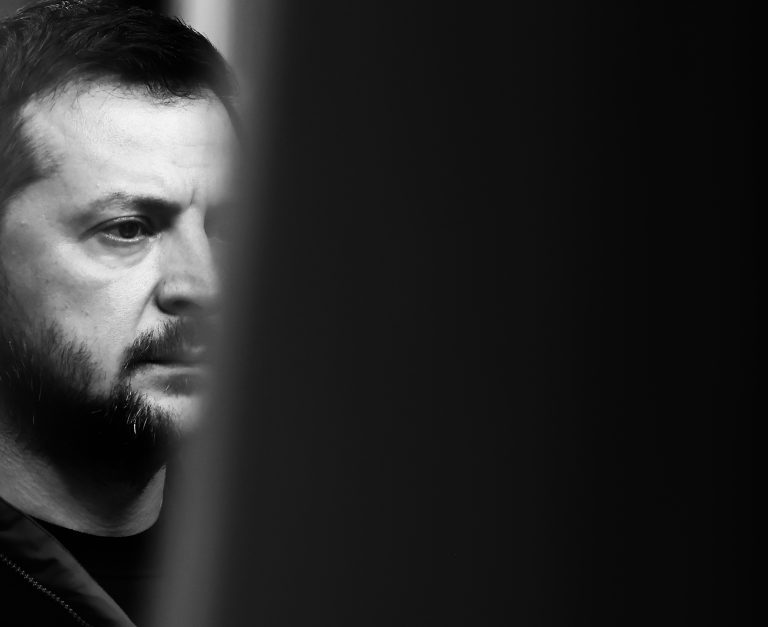
The German magazine Spiegel described it nicely when it got hold of leaked recordings of conversations between European leaders. They talk about Zelensky as a little boy who needs to be protected from Trump and who must not be left alone in a room with "those guys."
In 2026, it will be a tough nut to crack for foreign and domestic propaganda to come to terms with their hero.
I remember a public event in Pezinok about heroes from the days of dissent, which was also attended by a well-known poet and publicist who, after reciting his poem, became emotional and asked himself who the current hero was, and immediately answered his own question. He began to gush over the Ukrainian president.
I sat in the front row and wondered what disillusionment sensitive artistic souls would face when propaganda finally revealed the truth about Zelensky.
We have cultivated this image of him for a long time. It will be very difficult to dismantle this bucolic, romanticized image after contact with reality, and for many people who still need their heroes today, it may be a one-way ticket to cynicism.
The massive corruption surrounding Zelensky is nothing new. It only became public when the US president decided to replace Zelensky with someone more compliant. The US used its agencies in Ukraine—specifically the anti-corruption office and the prosecutor's office—which cooperate with CIA agents. These had to be established in Ukraine because of foreign aid; the Americans and Europeans insisted on this so that they would have at least some control over their massive donations.
Corruption as leverage for peace
According to the Financial Times, Trump gave Zelensky until Christmas to recognize the loss of territory for the purposes of realistic peace negotiations. Although it is unlikely that he will agree to this so easily, it is clear that Trump will increase pressure on the Ukrainian president by all means.
Arestovych, once one of Zelensky's closest associates, also says today that the Americans have bags full of compromising material on Zelensky.
Europeans fear that Trump may use corruption to pressure Zelensky and push him towards that scary thing that Europe fears like a demon, namely peace. The Washington Post recently wrote about a secret meeting between Ukrainian peace negotiator Umerov and FBI officials. Umerov allegedly even met with the FBI director behind closed doors in Washington. Such reports do not allow Macron, Merz, and von der Leyen to sleep peacefully.
Zelensky responded to the pressure by saying he was willing to hold elections in Ukraine. His European bodyguards got scared again and responded with an unbelievable promise that Ukraine would join the EU by 2027.
The panic of European leaders that Ukraine could make peace before the "last Ukrainian is alive" is palpable in their every move.
When Donald Trump wanted to show Zelensky who was boss, the American president used these offices as leverage. However, this is not the first time he has made such threats.
How corruption was hidden – for pious reasons of war
Two years ago, American investigative journalist Seymour Hersh, who has a track record of exposing Guantanamo and manipulation in the Korean War, wrote about how CIA chief Robert Gates flew to Kiev and presented Zelensky with a list of the most corrupt generals in the Ukrainian command. He also reportedly told him that these generals were angry with their president because they were unable to steal on the same scale as Zelensky's immediate entourage.
Gates then recommended that Zelensky "get rid of" at least some of these people. At that time, we watched as Ukrainska Pravda wrote articles about corrupt front-line officials in ministries who were driving around war-torn Kyiv in expensive Mercedes cars and whose corruption had been "exposed" – which is why the president had to dismiss them.
Later, we read about the non-existent defensive line near Kharkiv, the construction of which was awarded in a tender to companies connected to Zelensky's circle. They received a nice sum for this, but when the Russians invaded, Ukrainian officers suddenly discovered, with their eyes wide open, that no defensive line had been built there.
In other words, it is not only Russian military successes that are behind the decline in morale in the Ukrainian army.
Hersh's sources also suggest that the CIA knew very precisely and very early on who was stealing foreign aid and how, and also knew the massive scale on which this was happening.
Several Western media outlets have reported that Western politicians are reluctant to talk about this publicly, but the reason they do not want to send money to Ukraine, preferring instead to send finished goods (especially weapons), is because they are fully aware of the massive corruption. Every dollar or euro sent to Ukraine to help the bombed-out country in need will be stolen in tens of cents by leaders who represent Ukrainian war heroism on Instagram and embody it on Western television screens.
However, Ukrainian leaders have found their own ways. And so, American secret services found their donated weapons with guerrillas in southern Africa. In the US, several Republican senators and congressmen brought this to the attention of Congress, but the parliament, for understandable reasons, preferred not to deal with it. At least under Biden.
We knew all this for years, but we turned a blind eye to it. The image of Zelensky as a fearless Old Shatterhand fighting against the bloodthirsty Kiowas was balm for the soul, so we believed it, just like every other illusion about this war. We believed it because we wanted to believe it.
The time has come to make information available
Today, even major American media outlets, such as the New York Times, are openly talking about this corruption. According to the newspaper, the government has systematically sabotaged foreign oversight for four years so that corruption could flourish and thrive even during the war. The NYT cites two dozen sources among Ukrainian and Western officials with whom it discussed the issue. The newspaper also has access to documents, presumably provided by the CIA.
When the war began, Ukraine's allies faced a dilemma: how to give Ukraine billions while ensuring that a large part of it would not be stolen. In an effort to protect their money, the US insisted on establishing oversight, for example on corporate supervisory boards, the New York Times writes today, noting that Zelensky blocked these efforts from the outset. Why? Because of Timur Mindič's golden toilet, who is considered Zelensky's property manager in the Bahamas and other tax havens.
Today, even arguments that Ukraine is at war and that Ukrainians freely elected him as president, and therefore we had to respect him for better or worse, will not help. It is clear that Zelensky cannot stay in Ukraine for too long after the war ends. Even his security guards will not help him; his own people will shoot him. Banderism, supported by the West as the closest ally of the Western political elites in Ukraine, is too strong and has occupied the highest echelons.
However, his adolescent fans need not worry about the health of the outgoing Ukrainian president. That is, as long as he leaves Ukraine in time. He will either go to Israel, Britain, or the US. His Western "allies" have their reasons for taking care of him.
As long as he is under their protection, there is no danger that Zelensky will "take it out on Arestovych." In other words, that he will tell the whole world how the Anglo-Saxons first deceived him and then betrayed him.