
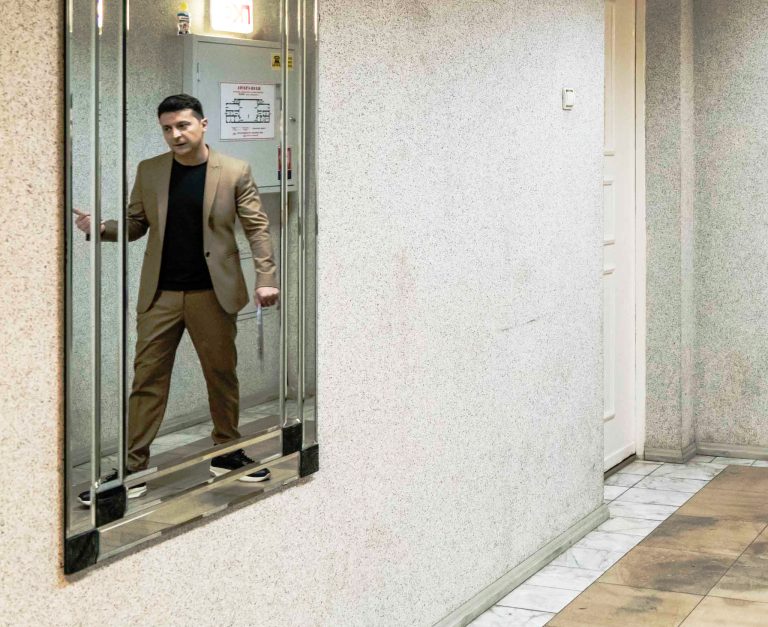
The current president of Ukraine has had a difficult time. In addition to the prospect of an early peace agreement, but at the cost of extraordinary territorial losses, he must also deal with widespread corruption scandals and secure foreign funding for the war-torn country. His artistic and political beginnings suggested relatively easy governance with overwhelming popular support.
Zelensky was born on January 25, 1978, in Kryvyi Rih, Ukraine. He grew up in the Dnipropetrovsk region of Ukraine, where Russian was the typical local language. He studied law, but his career took an artistic turn, focusing on comedy performances.
He presented his role as a comedian as part of his theater group Kvartal 95 and gradually began to appear on television screens, for example in the popular improvisational comedy competition "Club of Funny and Resourceful People." He appeared as a regular participant in this program until 2003.
The actor's comedy performances
As part of his entertaining performances, Zelensky played characters such as Vladimir Putin's mistress, performed belly dances, played the guitar in his underwear, parodied Cossack dances in leather clothing and boats, but it was the series "Servant of the People" that brought him the most fame.
Despite appearing in several films, it was the series Servant of the People in which he literally played his future political role. In the series, he played the character of Vasyl Petrovych Holoborodko, a teacher fighting against corruption who is unexpectedly elected president.
The series' enormous success was also due to the fact that it took place during the presidency of Petro Poroshenko, when a Russian-backed uprising was raging in eastern Ukraine (Donbas) and there was a high level of corruption in the country.
Media popularity with an oligarch in the background
The popularity of the series was reflected in his ambition to become a player on the political scene, and in 2018, a political party with the same name as the successful series was formed – Servant of the People. He became the favorite in the elections, even though he had no political experience, but his fame from the series and his anti-corruption image secured him massive public support.
Behind this success was Ukrainian oligarch Ihor Kolomoyskyi, owner of 1+1 TV, which broadcast Servant of the People and provided him with extensive media coverage in his presidential campaign against Petro Poroshenko. It is precisely the massive media support of the Ukrainian oligarch that is considered a significant factor in the early stages of Zelensky's political career.
Oligarch Kolomoyskyi himself had business disputes with Petro Poroshenko after Poroshenko nationalized PrivatBank, a financial institution that Kolomoyskyi co-founded. It was therefore quite logical for Kolomoyskyi to support a candidate who stood against his business rival.
Kolomoyskyi was later accused of stealing $5.5 billion from PrivatBank, a key financial institution holding the deposits of up to a third of Ukrainians, and the president distanced himself from his former ally.
A huge win with promises of peace and action against corruption
Zelensky ran for president on an anti-corruption platform, promising to end the conflict in eastern Ukraine, implement economic reforms, and move closer to the EU and NATO. In April 2019, he was elected president of Ukraine with more than 73 percent of the vote against incumbent President Petro Poroshenko.
In the spirit of his election program, he began his presidential term by announcing the dissolution of parliament in his inaugural speech. Early elections were held in July 2019, and the Servant of the People party won a majority—254 of the 450 seats in the Ukrainian parliament.
His personal popularity, including that of his party, began to decline with the onset of the COVID-19 pandemic in December 2019, during which the state introduced measures to restrict movement and close businesses.
In addition, people saw no significant fulfillment of Zelensky's promises to tackle corruption (which ran into constitutional and legal limits) or to resolve the conflict in Donbas.
Hidden assets in the Pandora Papers
Another problem was the revelation of his background in the Pandora Papers case as part of an investigation by the International Consortium of Investigative Journalists (ICIJ), based on leaked documents relating to the secret hiding of assets by politicians and wealthy individuals in tax havens.
The documents showed that the president and his partners from Kvartal 95 had owned a network of foreign companies based in the British Virgin Islands, Cyprus, and Belize since 2012, through which they purchased expensive real estate in London worth several million pounds.
After his election, he transferred his shares in a key offshore company to his chief adviser, Serhiy Shefirov, but the documents show that there was an agreement under which the offshore company paid dividends to his wife's company.
The documents also revealed that ten companies that received $41 million in support from PrivatBank before the 2019 presidential election belonged to Zelensky and his associates.
Russian invasion and heroic resistance
Instead of calming the situation in eastern Ukraine, as he promised in the elections, the opposite happened. On February 24, 2022, Russian troops attacked Ukraine as part of an invasion that Vladimir Putin called a "special military operation" and which continues to this day.
He transformed himself into a wartime president, and a state of emergency was declared in the country, during which no elections are held. Officially, he is already serving beyond his term as president, as no elections have been held in Ukraine since 2019.
The president's decision to remain in the Ukrainian capital after Russia's invasion, despite the threat of occupation and subsequent capture, can be described as truly heroic. This act of defiance, when the president remained in Kyiv despite appeals from the West, inspired the Ukrainian soldiers to fight, who resisted the Russians in the crucial first week with virtually no help from their Western allies. The latter hesitated to support Ukraine at all, as it was in danger of being quickly taken over by the Russian Federation.
After the initial resistance of Ukrainian soldiers, the West began to strongly support the country in its war with Russia, with Zelensky negotiating many agreements. However, even joint economic and military aid failed to defeat Russia or drive it out of the occupied areas of Ukraine.
The promise of peace and Johnson's alleged sabotage
According to an article in Foreign Affairs magazine, the military conflict was close to ending in 2022, but peace talks were allegedly sabotaged by then-British Prime Minister Boris Johnson.
Johnson allegedly convinced Zelensky not to agree to an "unfair peace," saying that the West would support Ukraine until victory. Boris Johnson denied these claims and called them "utter nonsense."
Peace talks are currently at the point of a possible peace agreement. The war of attrition, which has destroyed much of Ukraine and claimed the lives of many soldiers and civilians, has reached a stage where the army is facing a critical shortage of manpower. This confirms the predictions of some analysts at the beginning of the conflict that the war cannot be won on the battlefield and that negotiations are necessary.
Slogans such as "no discussion with Putin" and attempts to "starve" Russia with economic sanctions, which were also promoted by the Ukrainian president, have failed. Today, even the most ardent opponents of military reality must admit that an agreement will be inevitable and that Ukraine will probably lose part of its territory.
Massive corruption in Ukraine
Corruption scandals in Ukraine, involving the theft of international financial and material aid, as well as corruption in the energy sector, have also proved to be a huge problem. Chief of Staff Andriy Yermak was forced to resign after anti-corruption raids.
It was the Ukrainian president who had previously attempted to restrict the functioning of anti-corruption bodies such as the National Anti-Corruption Bureau (NABU), but he abandoned these efforts after pressure from the West. Today, these authorities are arresting Zelensky's closest associates and accusing them of widespread corruption.
During a search of his property, police found a gold toilet belonging to one of the most influential men in Ukraine and his long-time business partner, Timur Mindič. However, Mindič himself fled to Israel before his arrest.
Ukrainian Justice Minister Herman Halushchenko and former Deputy Prime Minister Oleksiy Chernyshov are suspected of embezzling $100 million from the state energy company Enerhoatom, the country's largest electricity supplier.
The revelations of widespread corruption in his immediate circle, as well as the exhaustion of war-torn Ukraine, have revealed a reality different from the one he presented during his election campaign. Corruption continues to flourish at the highest levels, even among people who won elections on an anti-corruption platform, and peace has been replaced by a war that cannot be won on the battlefield.
Peace and an uncertain future
This is one of the reasons why it was necessary to enter into a peace agreement. According to statements by the Ukrainian president, the agreement is "90 percent complete." However, the agreement may still be threatened by events such as the alleged Ukrainian drone attack on Putin's residence, as claimed by Russia. As a result of this incident, the Russian Federation is reevaluating its position on the ongoing peace negotiations.
However, even if a peace agreement is concluded (which should be preceded by elections necessary for the legitimate separation of Ukrainian territory), his future is far from certain. It is not just about his political future and ambition to become president again, even though he still enjoys 20 to 30 percent public support.
Former Chief of the General Staff of the Armed Forces of Ukraine Valery Zaluzhny is a serious contender for the presidency, maintaining popularity ratings just behind the president. It is therefore questionable what would happen to Zelensky if he lost his political influence and protection in the country, as he has faced threats from radical right-wing militant groups in the past for his policies.
A realistic scenario in such a case would suggest a life in exile outside Ukraine, but even that may not mean a safe life for him and his family. The recent kidnapping of Venezuelan President Nicolás Maduro by the US has opened Pandora's box, and Russia could take a cue from this act.
Russian Security Council Deputy Chairman Dmitry Medvedev has stated that a similar fate could befall Zelensky, and that even German Chancellor Friedrich Merz is reportedly not safe.
Russia is a major player in the Eastern Hemisphere, which does not hesitate to achieve its goals by means that are reprehensible from the point of view of ordinary people, but which are commonly used methods from the point of view of a world power.
There are well-known cases of various "accidents" or poisonings of opponents of Putin's regime, and Zelensky, as a prominent representative of the resistance against Putin, is undoubtedly in the crosshairs of the Russian armed forces or secret services. Even exile in one of the Western countries may not mean a safe life for him.
Paradoxically, Ukraine offers the president the greatest security—provided he remains in power during peacetime. This means maneuvering between the needs of a devastated country and the interests of Western powers (the US and its trade agreements) while resisting pressure from the Russian Federation to subjugate at least politically the unconquered parts of Ukraine.
Any other scenario would be extremely complicated and unlikely for a comedian who has turned his television role as president into reality.