
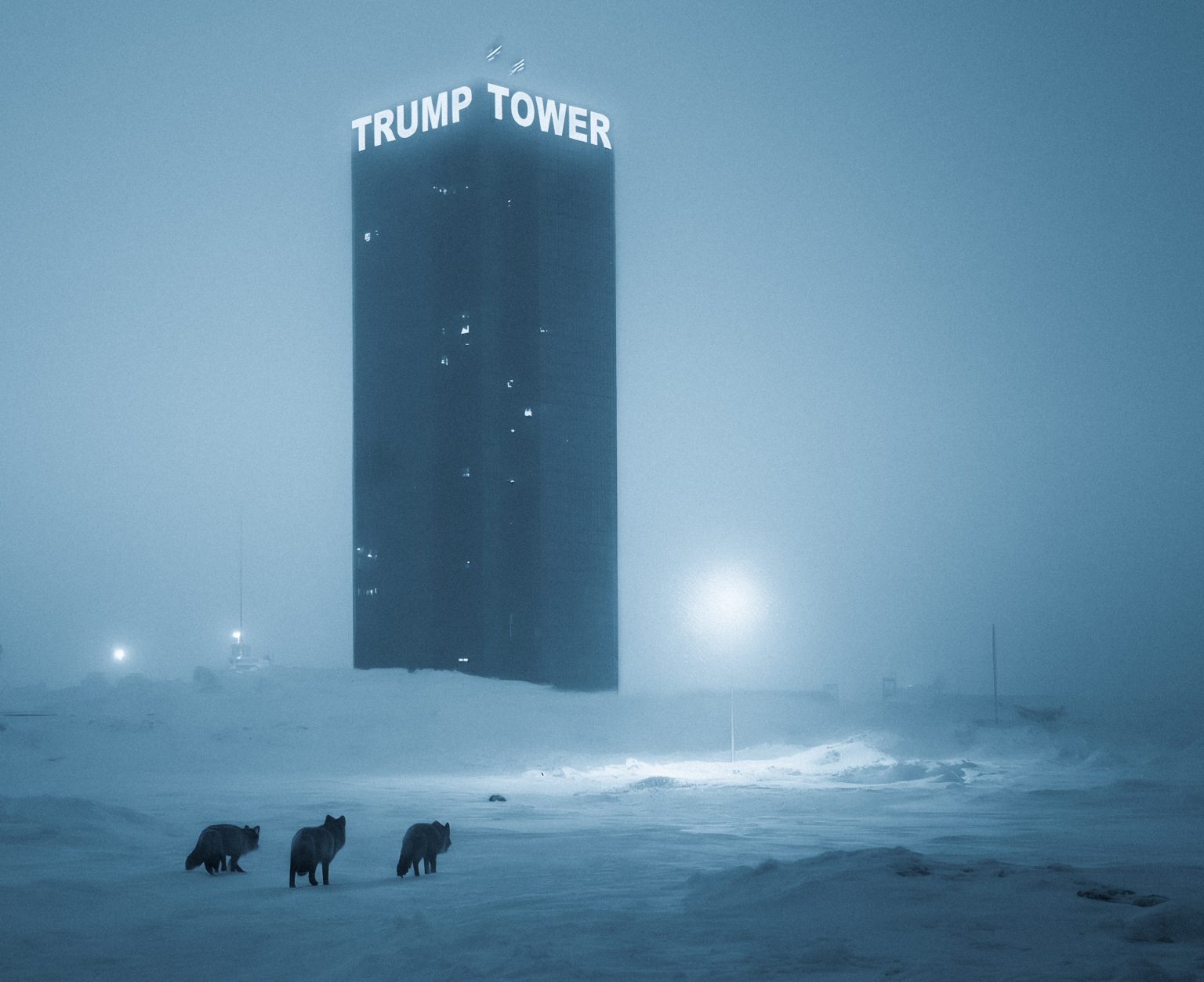
Greenland's Foreign Minister Vivian Motzfeldt would like to negotiate with the Americans separately, without her Danish counterpart being present. Donald Trump is thus succeeding in driving a wedge between Greenland and Denmark, the Financial Times reported over the weekend.
The likelihood of Greenland being acquired by the administration of US President Donald Trump thus appears to be increasing, which is likely to be reflected on the stock markets this week. However, the events surrounding Greenland have already been factored into share prices in recent days, particularly after the US intervention in Venezuela.
Important Tanbreez rare earth deposit
The Trump administration's increasingly clear claims to Greenland are benefiting shareholders of US rare earth metals miner Critical Metals, which owns the Tanbreez deposits in southern Greenland. The company's shares have risen by 116 percent since the beginning of the month. Tanbreez is one of the largest rare earth metal deposits in the world.
This year's significant increase in Critical Metals' share price is linked to the Trump administration's increasingly apparent plan to acquire Greenland. But it is also linked to restrictions on exports of rare earth metals from China to Japan after the Land of the Rising Sun did not rule out possible military intervention to defend Taiwan.
Beijing is also clearly expressing its displeasure with the United States' intervention in Venezuela. For investors, this is another reminder that China can quite arbitrarily, as an expression of its displeasure with this situation, restrict its own exports of rare earth metals, in whose production it dominates globally.
With every Chinese "concern" or "shock" about current developments, the price of deposits outside China, such as Tanbreez in Greenland, rises, as does the Trump administration's motivation to acquire and fully exploit them.
Keep an eye on Scandinavian arms manufacturers
Scandinavian arms manufacturers such as Norway's Kongsberg (up 15 percent this year) and Sweden's Saab (up 27 percent this year) could benefit most from developments in Greenland. Their geographical proximity to Greenland is an additional advantage over other European arms manufacturers, whose shares could also rise in price this year, mainly due to Trump's heightened rhetoric (and soon perhaps actions) towards Europe.
The American financial company Morningstar forecasts that the shares of European arms manufacturers it covers will appreciate by an average of one-fifth this year, despite significant growth in recent years.
Trump's restriction on share buybacks and dividend payments by US arms manufacturers last week may also be grist to the mill for European arms manufacturers. The US president believes that many US arms manufacturers are producing too slowly because they are investing too little. In his opinion, they give too much of their free cash to investors in the form of dividends or use it to inflate their share prices.
If they were so "idle," it would be difficult to implement Trump's plan to create an "army of dreams" and increase US public spending on armaments by more than half in 2027, which, for comparison, represents roughly 15 times the state budget of the Czech Republic. Of course, such a plan can only be fulfilled by supporting the shares of mainly American arms manufacturers, but also indirectly those of European ones.
On the other hand, Trump's restrictions on buybacks and dividends may make US arms stocks less desirable in the eyes of international investors compared to European and Asian arms manufacturers.
If the Czech holding company Czechoslovak Group [which also has a significant Slovak presence, ed. note] does indeed enter the Amsterdam stock exchange in the coming week, it could hardly have wished for a more opportune time for such a fundamental step.
The Czech arms manufacturer could start its initial public offering as early as this week, according to Bloomberg. The listing on the Amsterdam stock exchange could create the largest Czech publicly traded company, although it currently appears that the market valuation of the arms group will not be enough to surpass the current leader, ČEZ. The latter currently has a market value of more than €30 billion. According to Bloomberg, investors see the Czechoslovak Group's valuation after its IPO at around €26.5 billion.
Geopolitical tensions and gold
Moreover, Canadians are increasingly concerned that Trump may annex them to the US, for example by military means.
For investors, this has another implication. According to Morgan Stanley, the traditional 60:40 split between stocks and bonds in investment portfolios is now outdated. The American bank expects a further significant decline in the purchasing power of paper money, so it recommends a 60:20:20 split between stocks, bonds, and, newly, real assets such as gold.
For example, gold and similar assets are expected to benefit in the coming period from geopolitical tensions, growing government debt – not only for armaments – and the disruption of the independence of central banks, led by the US Federal Reserve.
In the specific case of gold, there is also the factor of its continued large-scale purchases by central banks such as China's, which, amid escalating geopolitical tensions, are seeking to reduce their holdings of dollar assets and replace them with gold, for example.
The depreciation of the purchasing power of paper money will continue at an accelerated pace in the coming years, which is why – and due to geopolitical tensions – the price of gold and other precious metals will continue to rise. This is according to a statement made last week by the world's largest investment company, BlackRock.
Even more significant than the precious metals themselves should be the rise in the shares of their miners, which, according to BlackRock, are currently the cheapest they have been in a very long time in terms of profitability.
The text was originally published on the website lukaskovanda.cz.