
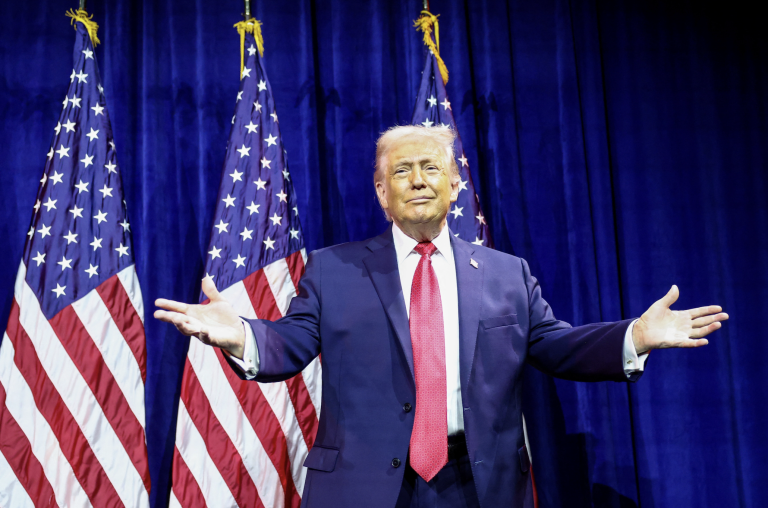
The next World Economic Forum (WEF) begins on Monday, January 19, in Davos, Switzerland. On the second day, US President Donald Trump will give a speech, which, according to preliminary estimates, will be the most watched panel of the entire forum.
In addition to the White House chief, several European and Islamic leaderswillalsospeak, including French President Emmanuel Macron, European Commission President Ursula von der Leyen, Moroccan Prime Minister Aziz Akhannouch, Qatari Prime Minister Muhammad bin Abdarrahman al-Thani, as well as technology pioneers such as Microsoft CEO Satya Nadella, Nvidia CEO Jensen Huang, and Palantir CEO Alex Karp.
The published line-up also includes several recurring names, such as former Norwegian Prime Minister Børge Brende (Klaus Schwab's successor at the helm of the WEF), BlackRock investment giant CEO Larry Fink, Financial Times analyst Gideon Rachman, and former British Foreign Secretary David Miliband. Two women from the financial sector can also be added to this list: Kristallina Georgieva, managing director of the International Monetary Fund, and Christine Lagarde, head of the ECB.
The forum, which Schwab founded in 1971 and left after a series of scandals in April 2025,publishedits Global Risks Report 2026 a few days before Trump's speech. It is therefore likely that the American "aspirant to the imperial throne" will also address the list of threats that the globalist elite considers most significant.
World leaders expect deterioration
The WEF report indicated that respondents' concerns about the future are growing in direct proportion to the length of the period under review. "We found that 50 percent of the leaders and experts surveyed expect turbulent or stormy developments in the next two years, with this proportion rising to 57 percent over the next ten years," the forum explained in its introduction.
As its executive director, Saadia Zahidi, specified, the forum addressed 33 risks, which respondents ranked according to urgency. The most significant risk is said to be "geo-economic conflict," a category that includes trade wars, sanctions, and the cultivationof"strategic rivalry"in the private sector.
This category does not include war (open, asymmetric, or hybrid), as can be seen in the risk that respondents ranked second: armed conflict at the state level.
Zahidi noted that environmental "threats" are moving lower in the rankings year after year, suggesting that "leaders and experts" apparently consider them to be an increasingly minor risk (albeit only in the short term). In a two-year horizon, on the other hand, the second biggest threat is "misinformation, disinformation," while in a ten-year horizon, the top three threats are all environmental in nature.
Among the economic factors that have grown the fastest compared to previous editions are inflation, economic recession, and the bursting of a market bubble. A special category is the possibility of disruption to critical infrastructure, which is apparently linked to the wars in Ukraine and the Gaza Strip.
A Pakistani analyst described the beginning of the new quarter-century as a period in which "alliances are being reshaped and the resilience of markets and institutions created at the Bretton Woods conference in 1944 is being tested."
Protectionism is strengthening worldwide, to the extent that the boundaries between the public and private sectors are beginning to blur. One of the processes Zahadiová identified is "active government influence on critical supply chains."
"As many as 68 percent of respondents describe the global political environment in the next ten years as 'a multipolar or fragmented order in which medium and large powers compete, set and enforce regional rules and norms,' an increase of four percentage points over last year," the report emphasizes.
"Only 6 percent of respondents expect a revival of the previous unipolar, rules-based international order," the forum continues, using common globalist rhetoric.
Causes of the breakdown of the world order
The dozens of risks that representatives of politics, economics, and even journalism expect to materialize in the next ten years have a common basis. Zahadiová and her analytical team defined four "structural forces," i.e., stable conditions that influence the development of these crises.
According to the forum, these forces will "continue to converge and accelerate," meaning that their intersection will become increasingly pronounced. The 2024 Global Risks Report already defined four such forces: technological acceleration, geostrategic shifts, climate change, and demographic bifurcation.
The first three are easy to define—the acceleration of technological development and its downside are even listed as a separate risk, "undesirable AI development." Changes in the balance of power between new superpowers are also predictable, as is the continuation of pollution and deforestation. However, what is meant by "demographic bifurcation" deserves a broader explanation.
In mathematics,bifurcationis a process in which a system divides into two parts, each of which then divides into two parts again, and so on ad infinitum. In demography, however, it isamore tangibleproblem, with countries with aging populations on one side and those with accelerating growth on the other.
This development is threatening social systems (in layman's terms, when "there will be no one to pay for pensions"), migration (in this case for job opportunities), and the subsequent breakdown of social cohesion and growth of social distrust.
The effect of the widening demographic gap will thus contribute to the acceleration of migration, threatening the possibility of replacing the domestic population, especially in Europe and North America. Every country is essentially a system that needs a stable population to function – which is why the countries of the global North will ultimately be open to systematic migration.
All these structural forces manifest themselves in different ways, and the World Forum understands these manifestations as separate "risks" defined in the first chapter of the report.
The Big Six
In addition to describing these structural forces that are expected to be present globally in the coming decade, the forum has taken a rather original approach to researching the above-mentioned risks. It has classified several risks according to their internal connections into a small number of categories, which it attempts to describe in their entirety.
The WEF is therefore preparing for six risks that all global players will face in the coming decade. These are multipolarity without multilateralism, values at war, economic reckoning, infrastructure under threat, quantum leaps, and AI as a whole.
The emergence of new geopolitical blocs will result in the "decline of the rules-based international order," which, according to the forum, will lead to an increase in cross-border conflicts and trade wars.
This will divert the attention of political leaders from "global challenges." A multipolar world without cooperation, for example in the form of the UN, will not be able to respond to crises caused by "climate change" or the "undesirable effects" of artificial intelligence.
Social polarization will transfer the conflict between blocs to the everyday interpersonal level, with people taking sides on issues such as "Americanism," "Russophilia," "green transformation," and the treatment of migrants and their social inclusion.
This growing internal social conflict will also be fueled by the crisis that the forum has termed "economic reckoning." Living on debt, growing deficits in economically advanced countries, and the ever-present threat of bubbles bursting, as in 2008, will be problems that everyone will face in the coming decade.
The crisis will not spare even the "outdated" infrastructure that is taken for granted in developed countries. Although Americans and Slovaks still have electricity in their sockets and water and gas in their pipes, this cannot be taken for granted – leaders will therefore have to focus on such mundane matters as maintenance in network industries.
A special chapter in the infrastructure section is the fact that it is increasingly becoming the target of military action, as can be seen in the war in Ukraine. Ukrainians are experiencing one of the harshest winters since the war began in 2022, with power outages of up to 20 hours a day already recorded in the fall of 2025.
The section Quantum Leaps discusses the threats posed by the ever-accelerating development of artificial intelligence and related technologies, which "potentially transform the risks to cryptography" while "increasing economic and trade imbalances."
According to the forum, AI as a whole is a risk simply because its "use in labor markets" is a threat to employment, even though this technology also carries the risk of so-called misalignment.
This misalignment is a state in which an artificial intelligence model generates outputs other than those required by human workers. This is related to the well-known thought experiment in which "the greatest threat to humanity is humanity itself" – which could result in a scenario similar to the Terminator film series.
The first topic already shows a kind of jab at Donald Trump. "In the worst case, governments could impose tariffs not only on those countries or blocs that imposed tariffs on them, but on all trading partners," the forum writes. This is an indirect reference to Trump's day of liberation, during which he imposed "reciprocal" tariffs on most countries in the world.
"Such blanket tariffs would lead to a significant decline in global trade," it warns.
However, tariffs are only the beginning of a "geo-economic confrontation." Another important factor in the loss of confidence in world trade is the weakening of the World Trade Organization, which, according to the Americans, works in China's interests and whose appeals body has been dysfunctional since 2019.
"At the same time, G20 countries are increasingly implementing investment control policies. Compared to previous years, they are motivated more by considerations of strategic reorientation and national security," the forum notes. The new superpowers, the US and China, could force smaller states into "obedience" through a system of sanctions similar to those applied by the West against Russia.
"The number of industries considered 'strategic' for national security and affected by sanctions, including export controls and investment bans, is growing," warns the forum, noting that these industries now include "artificial intelligence, chips, biotechnology, quantum technology, drones, and rare earths."
Trump will have to respond to this extensive list. From cleverly concealed criticism of tariffs and sanctions to support for social polarization, it is primarily he and his opponents who should distance themselves from allegedly causing these crises—or explain why they are beneficial to his voters.