
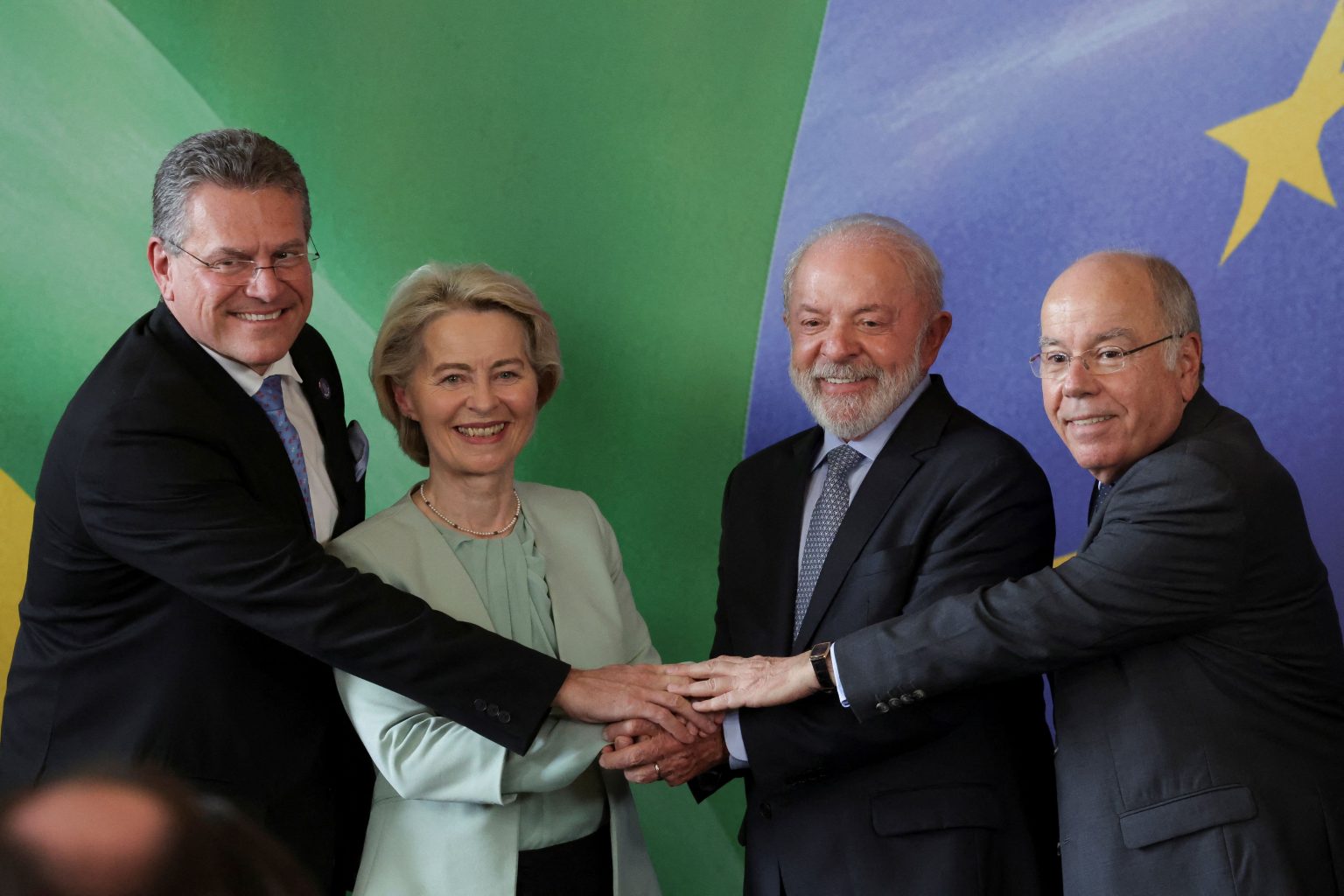
On Saturday, the European Union and the South American trade bloc Mercosur signed a historic free trade agreement in the Paraguayan capital of Asunción, which took more than a quarter of a century to prepare.
If ratified, it will create the world's largest free trade area, linking markets with more than 700 million consumers on two continents.
EU countries gave the green light to the agreement on January 9 by a qualified majority.
The signing comes at a time of growing geopolitical tensions and Europe's efforts to strengthen its competitiveness, reduce its dependence on a limited number of suppliers, and diversify its trade relations.
Europe is looking for new allies
The European Commission describes the agreement as a strategic tool to help the EU compete globally with the US and China. "This historic trade agreement is proof that Europe is going its own way and is a reliable partner," said Ursula von der Leyen.
European Commissioner for Trade Maroš Šefčovič speaks of a "landmark achievement" and an important moment for Europe's economic future. According to him, the agreement goes beyond trade statistics and will shape the EU's position in the global economy for decades to come.
End of high tariffs, new opportunities for businesses
At the heart of the agreement is the gradual elimination of tariffs on most goods traded between the two blocs, the liberalization of services, and the strengthening of investment protection, intellectual property, and public procurement rules.
For European companies, this means significantly improved access to Mercosur markets, which until now have been protected by high tariffs and administrative barriers.
Tariffs on European products in the region currently reach up to 35 percent for cars, clothing, and spirits, 28 percent for dairy products, and 27 percent for wine. In some agri-food sectors, they are as high as 55 percent.
Reducing or eliminating these tariffs is estimated to save European companies around €4 billion a year.
The European Commission expects the agreement to increase annual EU exports to Mercosur countries by up to 39 percent, representing approximately €49 billion, and to support more than 440,000 jobs across the Union.
Mercosur as a key partner
Mercosur, which brings together Argentina, Brazil, Paraguay, and Uruguay, was founded in 1991 with the aim of promoting regional integration. The European Union is the region's second-largest trading partner after China, accounting for almost 17 percent of Mercosur's total trade in 2023.
Nevertheless, Mercosur has so far been the only major partner in Latin America with which the EU did not have a preferential trade agreement.
For South American countries, the agreement with the EU is a tool for modernization, opening up to global markets, and attracting investment. Brazilian President Luiz Inácio Lula da Silva has repeatedly called it a geopolitical priority for the region.
The agreement also opens up new opportunities for Slovakia
The agreement is also important for Slovakia, whose economy is heavily dependent on exports, which provide approximately 450,000 jobs, or one in five jobs in the country. Trade between Slovakia and Mercosur countries currently amounts to €385 million.
The removal of high tariffs could help Slovak companies, especially small and medium-sized enterprises, which account for 92 percent of Slovak exporters. Significant improvements are also expected in the agri-food sector, where European products are often not price-competitive in South America today.
However, Agriculture Minister Richard Takáč pointed out that imports of agricultural commodities from Ukraine are a bigger problem for Slovakia than those from Mercosur countries. At the same time, he supported the idea of creating an EU fund to compensate European farmers for any losses.
Criticism and concerns of farmers
The agreement also has vocal critics. France, in particular, has long described it as unacceptable and warned against an influx of cheap beef, poultry, sugar, and corn, which could harm European farmers. Poland, Hungary, Austria, and Ireland also voted against the agreement, while Belgium abstained.
However, the signing does not end the process – the agreement must be ratified by the European Parliament and, in some cases, by the national parliaments of the member states. Until then, it will apply in a more limited transitional trade version.
Despite political disputes, this is one of the most important moments in EU trade policy in recent decades. After 25 years of negotiations, Europe and Mercosur are moving into a new era of economic cooperation.
(reuters, pir)