
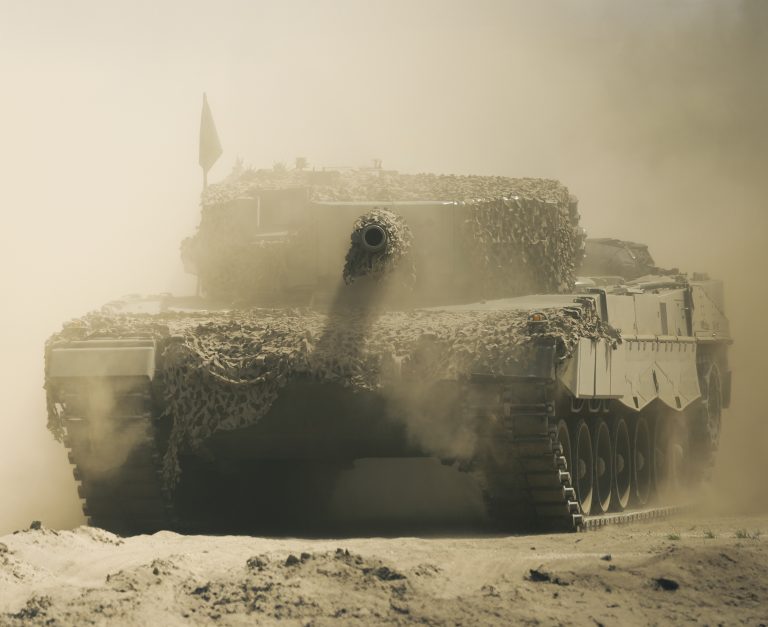
It is no longer just Poland that is investing huge sums in building a modern army. It now faces competition from a country that has dismantled its military capabilities over the past decade and had people like Ursula von der Leyen as defense minister, who was more concerned with converting tanks into inclusive spaces suitable for pregnant women than with the army's operational capabilities.
In a country that not long ago boasted the world's first transgender general, this comes as no surprise.
The €377 billion rearmament of the army should make Germany the most powerful army in Europe by 2035. Soldiers will receive new tanks, fighter jets, and more modern artillery. Germany already increased its defense spending last year and plans to invest €500 billion over the next five years.
Of course, massive investments in tanks and fighter jets will also require more soldiers. Germany plans to increase its current number (more than 180,000) by another 80,000. If this fails, Defense Minister Boris Pistorius has even announced partial conscription.
Where to find the men?
It is precisely in terms of personnel capacity that a certain delicate problem may arise. The sharp increase in spending on military equipment is taking place at a time when Germany, in a rainbow frenzy, has passed a law on gender self-determination, according to which Germans can change their gender once a year. In the event of a real war, they could easily avoid joining the army.
Of course, the "presciently astute" German lawmakers smuggled an amendment into the law stating that this option is not available to men during wartime.
We have not been given any justification as to why this "fundamental and inalienable human right" suddenly does not apply in such circumstances, in short, why all testosterone-producing women with penises must suddenly be men, even though they have decided otherwise. Discrimination and gender segregation apply to only one gender—women can change their gender as they please, even during wartime.
For the gentler sex, however, the opposite is true – if they change their gender during a state of war, they will automatically have to enlist.
Right or wrong, inalienable or alienable, fundamental or ancillary. There are simply times when rights cannot be enforced. That is the message from the German Bundestag.
From the point of view of building an army, this law may not be problematic in times of peace. But what will happen during a real war, when new war capacities will have to be used in real combat and Germany declares war mobilization, which will be a matter of life and death for conscripts?
Gender reassignment as a factor in war
Today, thanks to the above-mentioned law, they have the opportunity to conveniently avoid military service. Germans who do not want to fight will not wait for the government to declare a state of war. This is not a simple procedure in democratic states and is usually known at least weeks, if not months, in advance.
Germany is not the only country where you can change your gender solely on the basis of self-determination, meaning you don't have to go through any process. All you have to do is fill out an official questionnaire and declare that you are suddenly a different gender. The state must respect this, otherwise it would be "fascist."
The fact that an official gender change can be carried out in a flash is also evidenced by the case of convicted German neo-Nazi Sven Liebich (now known as Marla), who changed his gender at the beginning of last year so that he could be transferred to a women's prison. In several Western countries, there are known cases of sex offenders and predators who, after being sentenced to prison, simply did not want to stop raping women just because they were locked up in a men's prison. Therefore, they suddenly declared themselves to be women.
If a sex change is possible in such serious and absurd cases, it is inevitable to assume that it will be no different when martial law is about to be declared. An amendment to the law stating that this option is suspended during wartime will become unnecessary.
Any German who wants to take advantage of it will not wait unnecessarily.
So who will fight in the European war? Countries that do not support inalienable human rights will have to fight for Germany—those that have not yet managed to impose gender arbitrariness based on sentiment or cynical calculation.
The German state will thus have two options: not to fight and let the largest army in the world just sit around with all its ultra-modern tanks and expensive fighter jets. Or to deny human rights and officially become a fascist country (they themselves use this term).
If there is a threat of a declaration of war, Germany will suddenly become the first country in the world where no men live. At least those who are of mobilization age.
Logic will not allow it. The Germans will therefore have the largest army in Europe, but only if they also become a fascist country. Not because someone from outside labeled them as such. They actually labeled themselves as such as a preventive measure.
With those stars on their tanks, they will march on Russia, of course. To fight against fascism.
Mandatory for the entire EU
However, this problem is far from being limited to Germany. There are currently twelve countries in Europe that allow gender records to be changed. This means that half of Europe will have a problem in a potential fight against Putin.
The question is whether, by the time war breaks out with Russia (Western intelligence agencies predict that Europe could be militarily ready by 2030), such progressive options will not apply to all EU member states. According to the new Brussels LGBTI strategy, official "self-determination" should apply everywhere and should even apply to children.
If you have so far doubted that Putin could overrun Europe as far as Dublin – for example, because it took him eight months to conquer a city the size of Hlohovec (Bachmut) – suddenly the logic behind why our Euro-leaders and hawkish journalists are so serious about Russia's conquest of Europe begins to emerge.
Who would have thought that Putin's hybrid influence extends so far that it even defines Brussels' rainbow strategies...