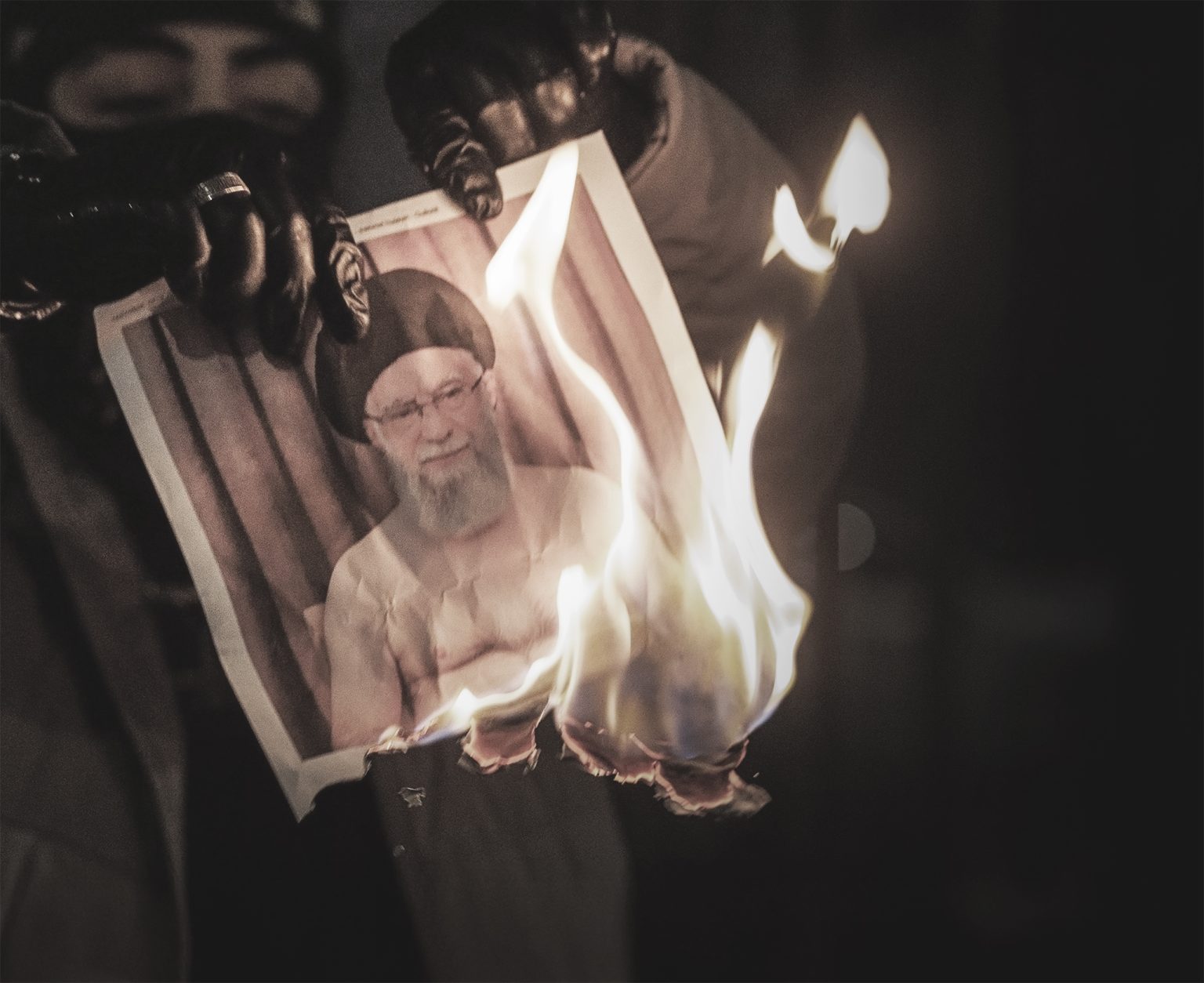
From protests to revolution
According to the book Revolutions published by Oxford University Press, a revolution needs a number of factors to succeed, namely significant economic upheaval, favorable international conditions, divided elites, a coalition of opposition-minded people, and a compelling narrative of resistance. The author of the book, Professor Jack A. Goldstone, believes that the state of affairs in Iran for the first time since the Islamic revolution in the country "meets almost all five requirements."
The economic crisis, coupled with incredible year-on-year inflation, is exacerbated by the middle class's limited access to basic foodstuffs and the country's shortage of drinking water. Although China is supporting the suppression of protests in Iran with modern technology, neither Beijing nor Moscow will help Tehran militarily.
On the other hand, Israel is supporting the protests directly on the ground, and the US could intervene militarily in favor of a coup if necessary. And, like the elites at the time of the collapse of the USSR, the elites in Iran are suffering from a significant decline in genuine ideological fervor, which also plays into the hands of the regime's opponents.
Finally, there is a compelling narrative of resistance in the form of a symbolic system associated with the non-Islamic nature of Iran: the ubiquitous flags of the country from the days of the monarchy and the destruction of the current ones, the portraits of the son of the last shah deposed during the Islamic revolution in 1979 carried by demonstrators, and also the opposition to Islam expressed by the burning of mosques at home and the artistic work of Persians in exile.
From revolution to civil war
According to various sources, ethnic Persians make up 51 to 65 percent of the population of 92-million-strong Iran, Azerbaijanis 16 to 24 percent (and there are several times more of them in Iran than in Azerbaijan itself), Kurds represent approximately seven percent of the population, and a dozen other nationalities are also represented to a lesser extent. In addition, approximately four million refugees from Afghanistan are staying in Iran.
Since the fifth requirement for a successful revolution is a coalition of anti-regime-minded people, it should be noted that in such an ethnically diverse country, this coalition is quite fragile.
In mid-January, armed Kurds attempted to cross the Iraqi-Iranian border, and some of them succeeded. Well prepared for war, the Kurds are waiting for their chance in Iraq and clearly intend to seize it. The only question is whether, by fighting the regime's loyal Islamic Revolutionary Guard Corps, they will help bring about the fall of the regime or wait for it in Iraq and strike only afterwards.
Although the short-term goals of the various Kurdish groups differ, they all consider one thing to be the ultimate victory: an independent Kurdish state. However, Arab and other separatists also pose a threat to Iran's territorial integrity, and they will certainly take advantage of the weakening of central power during or shortly after the fall of the regime.
Persians in the streets and Western leaders would like to see a quick transfer of power from Ali Khamenei to the only opposition leader recognized both domestically and internationally, the Shah in exile, Reza Pahlavi, in the interests of Iran's well-being and stability. However, several experts point out that the country is likely to face only two options: either the Ayatollahs' dictatorship will remain in place, or it will fall, creating a power vacuum that will inevitably lead to civil war.
Even if the transition of power were fast enough to prevent separatists from activating and joining forces with militants in neighboring countries (often just a few kilometers from the border), there are still a large number of people who are not visible on the streets, but who are millions of pro-regime Iranian citizens for whom their nationality is not the most important thing, but rather their faith and, therefore, the supreme spiritual leader – the Ayatollah.
It should be noted that no surveys of political attitudes are conducted in Iran, and no one dares to estimate how many Iranians support the regime. The theocratic system can still rely on the armed forces, but the question remains as to what extent and to what degree these forces remain loyal to the regime.
Fighting to maintain the status quo is definitely something: the Islamic Revolutionary Guard Corps and the regime's only partially loyal army have at their disposal a huge number of ballistic missiles and suicide drones, familiar from Russian attacks on Ukraine.
If the regime falls, these weapons could end up in the hands of decentralized armed groups that could turn Iran into a new Iraq. There, after the American intervention, the central power of the dictatorship was replaced in 2003 by prolonged chaos and years of endless war between supporters of the new regime and the divided camp of its opponents.