
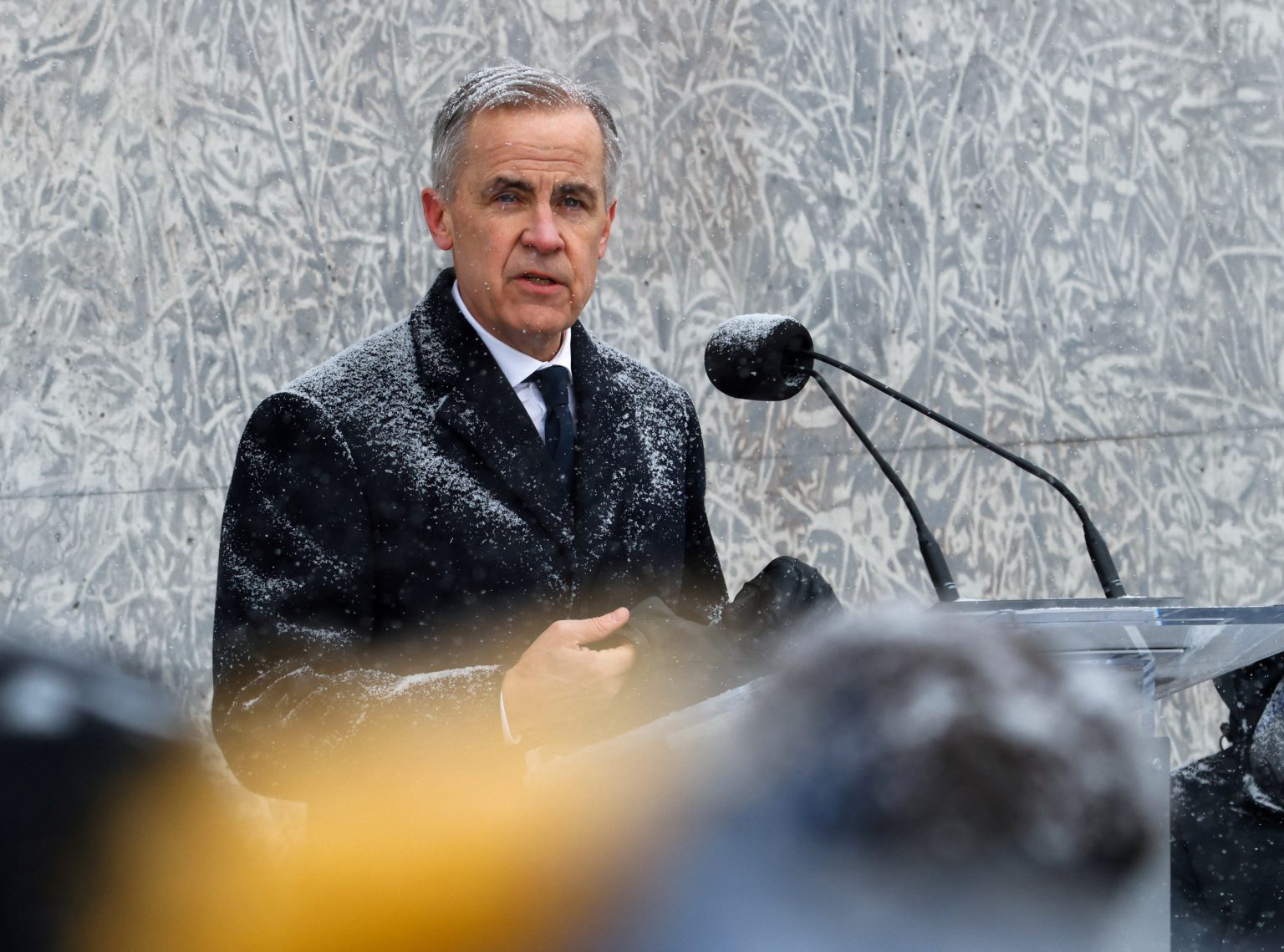
Representatives of US President Donald Trump's administration met at least three times last year with hard-line right-wing separatists from the Canadian province of Alberta. They are trying to exploit the rift between the White House chief and Canadian Prime Minister Mark Carney.
The separatists are united in the Alberta Prosperity Project, which, however, does not advocate annexation to the United States, but independence. The viability of a potentially independent state is guaranteed by the fact that most of Canada's oil reserves are located on its territory.
Since April 2025, Albertans have met at least three times in secret talks with representatives of the US State Department, anonymous APP members told the Financial Times. The separatists are planning another meeting in February, which will be attended by diplomats and representatives of the finance ministry.
They are to ask Scott Bessent's department for a credit line of $500 billion, which they will use to finance the new state if the independence referendum is successful. The British newspaper noted that the APP has not yet announced a referendum.
However, as the daily Le Parisien pointed out, the separatistsannouncedthe collection of signatures for the referendum at the beginning of January and must collect 178,000 signatures by May 2.
Natural partner
APP legal expert Jeff Rath also participated in the talks with American diplomats, boasting that he has a "much stronger relationship" with Trump than Carney. "The US is extremely enthusiastic about the idea of a free and independent Alberta," he told the FT.
"The State Department meets regularly with representatives of civil society. As is customary in such routine meetings, no commitments were made," replied the press office of the US diplomatic service.
"Administration officials meet with a variety of civil society groups. No such support or other commitments were expressed," the White House added. Carney's spokesman and the US Treasury Department declined to comment.
An official close to Bessent told the daily that no one at the ministry had been informed of the proposed credit line for Canadian separatists.
However, the minister recently described the oil-rich province as a "natural partner for the United States." "Albertans are very independent people," he said on Jack Posobiec's podcast. "There are rumors that they could hold a referendum on whether they want to remain in Canada or not," he added.
However, this is a serious deepening of the rift between Washington and Ottawa after Trump and Carney indirectly traded barbs at the World Economic Forum (WEF) in Davos. While the prime minister and former governor of the Bank of England accused Trump of creating a "break" in the old world order, Trump directly told him to "remember that Canada only exists because of us."
The Chinese footprint
According to the FT, Rath uses similar arguments to those of Brexit activists – leaning towards China, persecuting Christians, pushing a globalist agenda, and the federal government in Ottawa bleeding the province dry.
Since 2021, radical activists have officially set fire to more than two dozen churches, prompted by false reports of alleged Native American remains on seminary grounds. This hysteria was also supported by former Pope Francis, who apologized for the "violence" against indigenous people in residential schools – even though no bodies of "tortured" Indians were found on the premises.
According to the Catholic portal EWTN News, up to 96 churches fell victim to anti-Christian vandalism.
Trump also drew attention to the growing favor toward Beijing, warning Carney of 100% tariffs if he ratifies a trade agreement with America's "strategic adversary."
Back in May last year, he suggested to Carney that Canada would be protected by the Golden Dome air defense system "if it became our beloved 51st state." Otherwise, it would have to pay $61 billion, as the North American states have joint air defense and monitoring through the NORAD system.
Similarly, he called Carney's predecessor, Justin Trudeau, the Canadian "governor" and repeatedly shared a map of North America on social media in which he marked Canada as the 51st state of the US.
However, his actions in Alberta suggest that he is not trying to draw attention to the need for continental airspace protection, but actually desires to occupy or control his northern neighbor.
Let us recall that the United States has a population of approximately 342 million, while Canada, with a larger area, has only 41.5 million inhabitants – a third less than France. Nearly 95 percent of the population lives south of the 55th parallel.
The province of Alberta alone has just over five million inhabitants. Despite its vast size, it is inhabited by fewer people than the population of Slovakia. In its latest opinion poll, the Ipsos Institute found that almost 28 percent of Albertans want independence.
Canada on the verge of collapse
Expert APP Rath concluded that he had repeatedly met with Francophone separatists from the province of Quebec, whose efforts to achieve independence date back 150 years. However, French Canadians lost in referendums in 1980 and 1995.
Unlike Quebec's push for independence, in Alberta it was "initially mainly an economic idea, so they wouldn't have to pay for the rest of Canada," Frédéric Boily, a professor at the University of Alberta, told AFP. He added that separatists in the west of the country had been protesting since 2018 against Trudeau's green policies, which they believed threatened fossil fuel extraction.
Le Parisien noted that Carney's arrival put an end to the environmental excesses of the former Liberal Party leadership, but the end of the separatist movement is not in sight.
Paradoxically, however, Canadian conservatives led by Pierre Poilievre suffered more from the "Trump effect" than Trudeau. Although the right-wing leader was on track for victory in 2024, it was the Liberals who were able to distance themselves more easily from talk of a 51st state.
Therefore, when Trudeau resigned on March 9, 2025, and the Liberals chose Carney on March 14, the Conservative Party had no chance in the upcoming elections. Canadians elected all 343 members of the House of Commons, and on April 28, distancing themselves from Trump and his tariffs, they once again supported the Liberal Party. As the British House of Commons Library noted, Poilievre himself lost his seat after two decades.
Similarly, the Liberal prime minister improved his standing in the polls after his speech in Davos, in which he criticized appeasement of hegemonic powers. Postmedia (which publishes the National Post daily) in collaboration with the analytical firm Léger found that up to 47 percent of voters would give their vote to the Liberal Party.
The popularity of Carney's government rose to 58 percent, while the prime minister himself enjoys a 59 percent popularity rating. "It was a powerful speech," explained Léger Vice President Andrew Enns, adding that "it's not often that a speech has such an impact." "It has reawakened the patriotic spirit in Canada," he added. This is one of the reasons why Carney rejected the idea of early elections.
One thing is clear from these developments on the Canadian political scene. The more Trump attacks Canadian sovereignty, the more Canadians unite. And despite Trudeau's praise of the Chinese dictatorship in 2013, they are clearly willing to protect that sovereignty—even against an ally.
However, if Washington supports separatism, it will open a completely different chapter, which may end with the redrawing of borders – exactly what the "collective West" warned Russia about after the annexation of Crimea. But it was the West itself that opened this Pandora's box by supporting Kosovo's unilateral declaration of independence.