
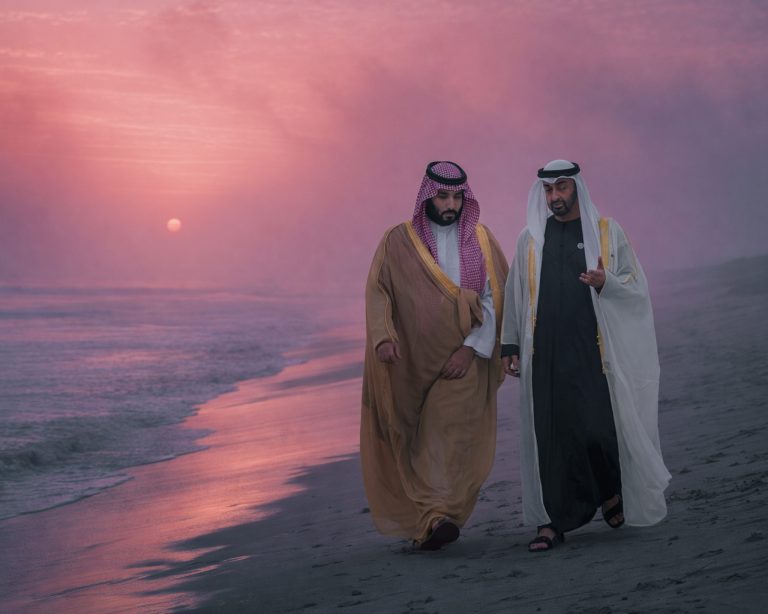
On the neutral ground of Djibouti, where most of the superpowers have military bases, they coexist peacefully. The rest has been very turbulent since last fall. Israel deepened Somalia's long-term disintegration when it recognized one part of it, called Somaliland, as a state. The United Arab Emirates (UAE) had some explaining to do when its allies in the Sudanese civil war committed an extraordinary massacre. And in Yemen, the UAE narrowly avoided war with its former ally Saudi Arabia.
Who are the Emirates oriented towards?
The Emirates are indirectly involved in all of the conflicts mentioned above. One of the richest countries in the world—originally from oil, now also from tourism and trade—is comparable in size and population to the Czech Republic, but has a much stronger army. This federation of seven monarchies in the Persian Gulf is ruled by the two most powerful families of local sheikhs, with the Nahyans in Abu Dhabi playing first fiddle and the Maktoums in Dubai playing second.
The ruling Nahyan family has a distinctly Anglo-Saxon orientation. Until the 1970s, this territory was a British protectorate, then the Americans arrived and established several bases in the Emirates. Local officers are trained either at Sandhurst in the UK or West Point in the US.
This is in contrast to Qatar, which hosts the most important American base in the region but supports the most radical Islamist forces abroad. The Nahyan family, represented by current President Muhammad bin Zayed,on the other hand, takes a hard line against Islamism, whether it be Iranian Shiites or the Sunni Muslim Brotherhood.
The Emirates were also the first Gulf country to recognize Israel six years ago and are the only ones to maintain normal diplomatic relations with it. When Washington considers further strikes against Iran, the Emirates, unlike Saudi Arabia, do not say no. Recently, the UAE has been clashing with Saudi Arabia more and more often.
While years ago, Muhammad bin Zayed Al Nahyan and Saudi Crown Prince Muhammad bin Salman Al Saud were a pair of young modernizers with similar interests in domestic and foreign policy, today they do not see eye to eye. In recent months, this has been particularly evident in Sudan and Yemen.
Unclear situation in Sudan
In the fall, reports of massacres in the Sudanese civil war shook the world. The Rapid Support Forces (RSF) led by Muhammad Dagalo captured the western Sudanese city of al-Fashir. Although the country has become accustomed to widespread massacres during three years of war, the tens of thousands of deaths exceeded the usual scale and Sudan made the front pages of Western media.
Dagalo's main supporters are the Emirates, which supply weapons and mercenaries via Chad in exchange for Sudanese gold. But it may not be just about money. Dagalo's fight against the Islamist government of President Abdel Fattah Burhan is defined by Arab nationalism, which in Sudanese terms often entails genocidal racism against non-Arab ethnic groups in the south and west of the country, including their Muslim members.
After the massacre, the Emirates also faced increased pressure from the US, as influential opposition congressmen tried to block their arms purchases. On the other hand, both the United States and the United Kingdom appear to be playing a dual role in Sudan. Outwardly, they support the recognized government of President Burhan, but quietly they may prefer an Arab nationalist to an Islamist. Or could it be that they have been unable to rein in their super-loyal allies in Abu Dhabi?
After all, until recently, the Sudanese government had nothing good to say about the Americans or the British. On the contrary, Moscow, which previously supported the rebels, is offering a base in Port Sudan on the Red Sea in exchange for weapons.
Saudi Prince Muhammad bin Salman took advantage of these facts at the end of last year when he flattered President Donald Trump as a peacemaker and asked him to bring peace to Sudan as well. In the Saudi view, this would mean stabilizing the Islamist government on the opposite shore of the Red Sea, pushing out the Emirates as a rival, and disrupting the privileged relationship between Washington and Abu Dhabi.
How Yemen is divided
Bin Salman is also poised to oust his rival in Yemen. Ten years ago, he went to war in Yemen alongside bin Zayed to defend against Iranian influence, which they attributed to the Houthis. The Houthis adhere to the local Islamic doctrine of Zaidism. Not only did they fail to defeat the Houthis, but they also quarreled among themselves to the point of bringing Yemen to the brink of war.
Yemen is now effectively divided, much as it was during the Cold War. The Houthis control the former North Yemen, including almost the entire Red Sea coast. They have created a de facto independent state, which even President Trump failed to change when he attempted to bomb these enemies of Israel in the spring.
Until recently, the former socialist southern Yemen was divided between the Southern Council and the Presidential Council, which represented the official government of the entire country. The Southern Council, supported by Abu Dhabi, brings together mainly secular forces and moderate Muslims, while Riyadh supports the Presidential Council, which is backed by Sunni Islamists from the Muslim Brotherhood.
Last December, the Southern Council launched a surprising and successful offensive against the Saudi-backed forces. Within a few weeks, it had taken control of the entire south of Yemen and declared an independent South Yemeni state, while the government fled to Riyadh.
Abu Dhabi celebrated, but not for long. The Saudis did not let it go. They struck Emirati arms shipments with fighter jets, gave the Emirates 24 hours to withdraw all troops, and invaded in early January. Under Saudi pressure, the Emirates withdrew, and the regime they supported collapsed in early January after its December triumph.
The head of the Southern Council fled to Abu Dhabi, and some of its top officials went to Riyadh for talks, where they were captured and forced to announce its dissolution. However, this was not accepted by those officials who remained in Yemen. Despite the unclear situation, it can be said that bin Salman has cornered bin Zayed in Yemen.
Room for the displacement of Palestinians?
The situation across the sea in Somalia is also unclear. It has not existed as a unified state for decades, having broken up into several completely autonomous entities, which until recently were not recognized by anyone as independent states. That changed at the end of December when Israel announced that it recognized Somaliland and was establishing diplomatic relations with it. This northern part of Somalia, formerly British Somaliland, has been functioning as an independent state for more than thirty years, but until now it has not been recognized by anyone. Somaliland has had three significant supporters abroad.
The former British protector, whose consulting firms and politicians helped create state structures. Landlocked Ethiopia, which could gain access to the seaport of Berbera via Somaliland. And then the Emirates. Not only do they control the operation of the aforementioned port, but they have also established a military base there.
Israel has not been very visible there so far, but it had its motives. In addition to access to strategic territory from which it can monitor the Houthis as enemies, it gains a grateful ally in the Muslim world and perhaps even space to relocate inconvenient Palestinians. By recognizing Somalia, Israel can also help allies who are considering doing the same but are hesitant because respect for the territorial integrity of other states is one of the strongest norms of international law.
After Israel's recognition, it may be a little easier, but not much. The angry Somali government in Mogadishu assessed Israel's move as part of the Emirates' intrigues. It severed all cooperation with them and turned to bin Salman in Riyadh with a request to help them expel bin Zayed, as in Yemen.
Not only Saudi Arabia, but also Turkey and other Muslim states have diplomatically supported the Somali government. Time will tell whether bin Zayed has gained more than he has lost there. But it is already clear that, following the weakening of Iran, a serious conflict is unfolding between American allies in this strategic region. On one side are their closest allies, Israel and the Emirates. Although they have their own interests, most of their actions can be assumed to be agreed with Washington—with the slight difference that Abu Dhabi is coordinated from Washington, while Tel Aviv often coordinates with Washington.
On the other side are regional powers such as Saudi Arabia, Egypt, Turkey, and Pakistan, which is geographically distant but strategically present. They cooperate with the US, but often act independently. Trump needs them and negotiates with them with greater respect than, for example, with the Europeans. In the fall, he managed to get everyone on board with his plan for Gaza, but he will probably not be able to convince them about Iran.
However, if the Americans begin to withdraw from the region, as they say, the tension between allies may suit them. Divide and rule still applies.